| Appearance | - Corylus cornuta is a deciduous shrub that typically grows with several trunks. English Wikipedia
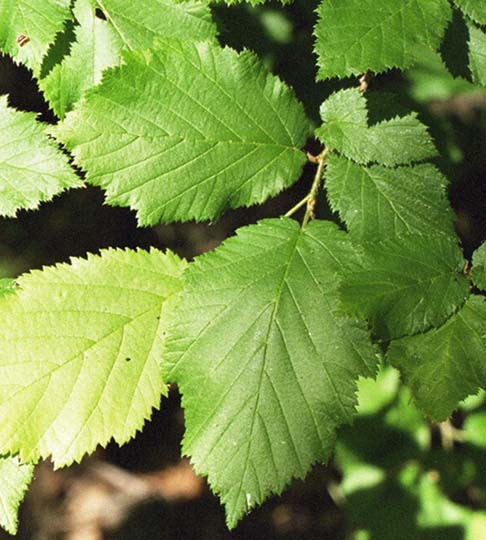
- Its leaves are alternately arranged, rounded oval with pointed tips, and have irregularly double-toothed margins. English Wikipedia
- The undersides of its leaves are soft and hairy. English Wikipedia
- Its male flowers grow in firm catkins arranged in clusters of one to three on twigs from the previous year. English Wikipedia
- The male catkins become elongated and pendulous in spring. English Wikipedia
- The husk bears tiny filaments that can penetrate and irritate contacting skin. English Wikipedia
- Its nuts are spherical, small, and enclosed in hard shells. English Wikipedia
| - Corylus colurna has a pale grey-buff bark with a thick, corky texture. English Wikipedia
- Young trees have a slender, conical crown that becomes broader and irregular as they age. English Wikipedia
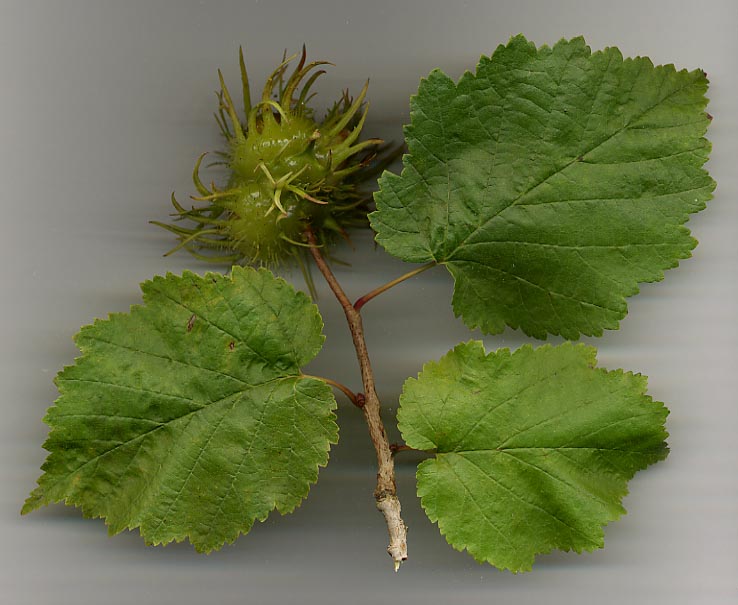
- Its leaves are deciduous, rounded and softly hairy on both surfaces. English Wikipedia
- The leaf margins are coarsely double-serrate to shallowly lobed. English Wikipedia
- The male flowers occur in conspicuous, pale-yellow catkins. English Wikipedia
- The female flowers are inconspicuous and have bright-red styles measuring 1–3 mm. English Wikipedia
- Its fruits are nuts enclosed in thick, softly spiny and bristly husks. English Wikipedia
- The nuts occur in clusters of three to eight, with their husks fused at the base. English Wikipedia
|
|---|
| Size | | |
|---|
| Habitat | - The species is more common in forests with relatively open canopies than in forests with dense canopies. English Wikipedia
- The species does not tolerate completely open habitats that become hot and dry. English Wikipedia
- The eastern variety occurs at elevations of 100–500 metres across most of its range, reaching 1,000 metres in Alberta. English Wikipedia
- The western variety occurs below 2,100 metres in California and below 800 metres in British Columbia. English Wikipedia
| - The species occurs mainly on shallow, nutrient-poor limestone soils. English Wikipedia
- At lower elevations, it occurs in thermophilous oak forests alongside Hungarian oak, Oriental hornbeam and flowering ash. English Wikipedia
- At higher elevations, it occurs alongside beech and sycamore maple. English Wikipedia
- The species occupies elevations ranging from 100 metres in the Balkans to 1,700 metres in the Caucasus. English Wikipedia
- It becomes dominant mainly in very dry sites because it is relatively uncompetitive. English Wikipedia
- In cultivation, it prefers moist, well-drained soil and full sun. English Wikipedia
|
|---|
| Diet | - Deer, moose, and livestock browse the foliage of the eastern variety. English Wikipedia
- Ruffed grouse feed on the species' catkins and young buds. English Wikipedia
- Red squirrels and least chipmunks are important rodents that cache the species' seeds. fs.usda.gov
| No checked fact yet |
|---|
| Behaviour | - The species can tolerate some shade but does not thrive in completely open, hot, dry areas. English Wikipedia
- Above-ground growth is killed by fire, but the shrub can resprout from its root crown or rhizomes. English Wikipedia
- Rodents generally disperse the species' nuts no farther than approximately 90 metres. fs.usda.gov
- Squirrels generally distribute the nuts no farther than approximately 90 metres. English Wikipedia
| |
|---|
| Reproduction | - Single female flowers develop in early spring. English Wikipedia
- The male flowers develop on twigs produced during the previous year. English Wikipedia
- Some nuts buried by squirrels in soil or leaves have an increased chance of germination. English Wikipedia
| - Corylus colurna is monoecious, producing male and female flowers on the same tree. English Wikipedia
- The flowers appear in late winter or early spring before the leaves emerge. English Wikipedia
- The fruits mature between September and October. English Wikipedia
- Nut production is irregular and generally occurs every two to three years. English Wikipedia
|
|---|
| Distribution | - The eastern variety occurs from southern Canada south to Georgia. English Wikipedia
- The western variety occurs along the west coast from Alaska to California. English Wikipedia
- The species has two geographically distinct varieties, an eastern variety and a western variety. English Wikipedia
| - The species is native to southeastern Europe and southwestern Asia. English Wikipedia
- Its native range extends from the southern Balkans through northern Anatolia to the Caucasus. English Wikipedia
|
|---|
| Conservation | - The species is threatened in boreal regions by the invasive Siberian peashrub. English Wikipedia
| - The species is generally uncommon across its natural range but can be locally abundant in suitable habitats. English Wikipedia
|
|---|
| Uses | - The Gitxsan, Tsimshian, and Nisga'a peoples have cultivated the species for at least 7,000 years. English Wikipedia
- Native American peoples used the sprouts to make baskets, fish traps, and baby carriers. English Wikipedia
- The nuts were eaten and traded among Indigenous groups. English Wikipedia
- The species was used medicinally as an emetic, deworming agent, astringent, and teething aid. English Wikipedia
- The species is used in restoration plantings to increase biodiversity and improve wildlife food sources. English Wikipedia
- The species is used in restoration plantings to reduce laminated root rot in nearby Douglas-fir and Sitka spruce. English Wikipedia
| - Corylus colurna is used as a single-stemmed rootstock for grafting common hazel cultivars. English Wikipedia
- The species is cultivated as an ornamental tree in Europe and North America. English Wikipedia
- Its dense shade makes it suitable for use as a shade tree. English Wikipedia
- Its narrow crown and tolerance of air pollution make it suitable for planting along urban streets. English Wikipedia
|
|---|
| Similar species | - The western variety is considered to have low palatability for ungulates, unlike the eastern variety. English Wikipedia
| - Corylus jacquemontii is a closely related species that was formerly treated as a variety of Corylus colurna. English Wikipedia
|
|---|
| Name origin | - The common name beaked hazelnut refers to the beak-like tubular extension of the fruit husk. English Wikipedia
| No checked fact yet |
|---|