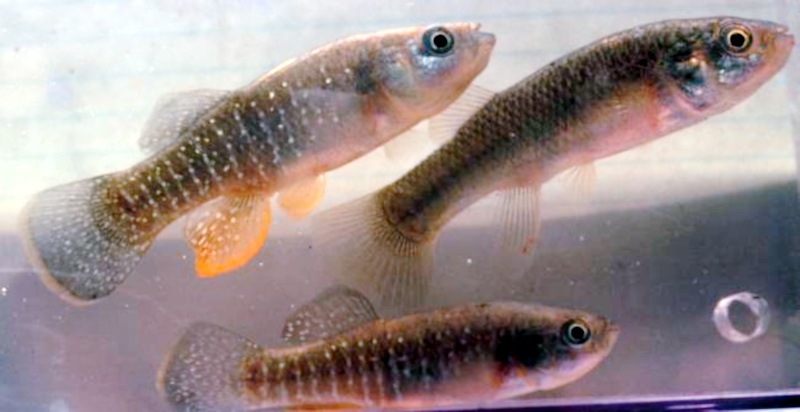
| Appearance | - Spawning males are dark green with a yellow underside and a dark ocellus on the dorsal fin. English Wikipedia
- Females are brown or olive-coloured and paler on their undersides. English Wikipedia
| - The species has an elongated, thick body and a deep caudal peduncle. English Wikipedia
- Its mouth is upturned, and its lower jaw protrudes when the mouth is closed. English Wikipedia
- Its pectoral and tail fins are rounded. English Wikipedia
- Males have larger dorsal and anal fins than females. English Wikipedia
- Its coloration is generally olive-brown or olive-green and may vary with the surrounding background. English Wikipedia
- Males develop dark olive-green backs, steel-blue sides with approximately 15 silvery bars, and yellow or orange-yellow undersides during reproduction. English Wikipedia
- Females are generally paler than males and lack their characteristic body bars and intense yellow belly coloration. English Wikipedia
|
|---|
| Size | | |
|---|
| Habitat | - Early settlers described the species as common in freshwater and brackish ponds and marshes and in muddy bays throughout Bermuda. English Wikipedia
| - The species inhabits brackish and coastal waters, including estuaries and salt marshes. English Wikipedia
- Its coastal habitats include muddy creeks, tidal channels, eelgrass or cordgrass beds, and sheltered shorelines. English Wikipedia
- The species occurs in coastal rivers but seldom beyond the tidal limit. English Wikipedia
- Tidal creeks are a preferred habitat, alongside saltwater marshes, estuaries, and sheltered shores with submerged eelgrass. animaldiversity.org
- Submerged vegetation is a common feature of the habitats used by this species for spawning and feeding. animaldiversity.org
|
|---|
| Diet | | - The species is an omnivore without a stomach. English Wikipedia
- Its recorded food includes diatoms, amphipods, other crustaceans, molluscs, fish eggs, small fish, insect larvae, and eelgrass. English Wikipedia
- Its diet includes phytoplankton, molluscs, crustaceans, insect larvae, eelgrass, and smaller fish. animaldiversity.org
|
|---|
| Behaviour | No checked fact yet | - Individuals form dense shoals that can contain several hundred fish. English Wikipedia
- During northern winters, individuals move into upstream tidal pools and burrow into mud to depths of up to 20 cm. English Wikipedia
- Some individuals move into deeper waters during freezing winter conditions rather than burrowing into sediment. animaldiversity.org
- The species can survive several hours in moist air outside water by breathing air directly. English Wikipedia
- Adults can use aquatic surface respiration when dissolved oxygen falls to approximately 1 mg/L. English Wikipedia
|
|---|
| Reproduction | | - The spawning season extends from spring through fall. English Wikipedia
- Southern populations can spawn up to eight times in a single season. English Wikipedia
- Spawning occurs most frequently during high tides associated with new or full moons. English Wikipedia
- Female fish attract males by turning onto their sides near the bottom and flicking their tails. English Wikipedia
- Mummichog eggs are pale yellow, strongly adhesive, and approximately 2 mm in diameter. English Wikipedia
- A female can deposit up to 740 eggs during a spawning event. English Wikipedia
- Eggs may be attached to vegetation, algal mats, empty mussel shells, sand, or mud. English Wikipedia
- Eggs develop while exposed to moist air and hatch when subsequent high spring tides submerge them. English Wikipedia
- Northern subspecies eggs possess adhesive chorionic fibrils that are absent from southern subspecies eggs. English Wikipedia
- Most individuals reach sexual maturity at approximately two years of age and 3.8 cm in length. English Wikipedia
- Newly hatched larvae are approximately 7 mm long. animaldiversity.org
- Larvae remain in the intertidal zone for six to eight weeks after hatching. animaldiversity.org
|
|---|
| Distribution | - The Bermuda killifish is endemic to the islands of Bermuda in the western Atlantic Ocean. English Wikipedia
- Ex-situ populations of the species have been established at Vienna Zoo, London Zoo and Chester Zoo. English Wikipedia
| No checked fact yet |
|---|
| Conservation | - The species' population has declined because human activities have destroyed and modified its habitat. English Wikipedia
- The Bermuda killifish is listed as a protected species under Bermuda's Protected Species Act of 2003. English Wikipedia
- Translocations to additional ponds have been undertaken to increase the species' range and population. English Wikipedia
| - Introduced populations of the species are considered a significant ecological concern in the European Union. English Wikipedia
|
|---|
| Uses | No checked fact yet | - The species has been used in attempts to control mosquito populations by consuming mosquito larvae. English Wikipedia
- The species is commonly used in research on stress biology, thermal physiology, and toxicology. English Wikipedia
|
|---|
| Similar species | - Fundulus bermudae and Fundulus relictus are reported not to coexist in mixed populations within Bermuda's killifish ponds. fishbase.org
- Fundulus relictus was formerly classified as Fundulus bermudae in Lover's Lake and Bartram's Pond. English Wikipedia
- Fundulus bermudae and Fundulus relictus are indistinguishable in the field. English Wikipedia
- Fundulus bermudae and Fundulus relictus are differentiated using body measurements and egg morphologies. English Wikipedia
- No pond is reported to contain both Fundulus bermudae and Fundulus relictus. English Wikipedia
| - The mummichog closely resembles the banded killifish (Fundulus diaphanus), and the two species have been reported to interbreed. English Wikipedia
|
|---|
| Other | - Documented predators include diamondback terrapins, grey snappers and American eels. English Wikipedia
- Introduced red-eared terrapins and yellow crowned night herons are listed among the species' predators. English Wikipedia
- The eastern mosquitofish preys on the eggs and fry of the Bermuda killifish. English Wikipedia
| - Mummichogs are nonmigratory and typically occupy home ranges smaller than 1,000 m. pmc.ncbi.nlm.nih.gov
|
|---|