Comparison

Bibron's Toadlet vs Southern Corroboree Frog

Bibron's Toadlet (Pseudophryne bibronii) and Southern Corroboree Frog (Pseudophryne corroboree) both belong to the genus Pseudophryne (crowned toadlets) and part ways below it. Both are recorded in 1 country.

Bibron's Toadlet

Bibron's Toadlet

Pseudophryne bibronii

Original uploader was Tnarg 12345 at en.wikipedia, CC BY-SA 3.0, via Wikimedia Commons

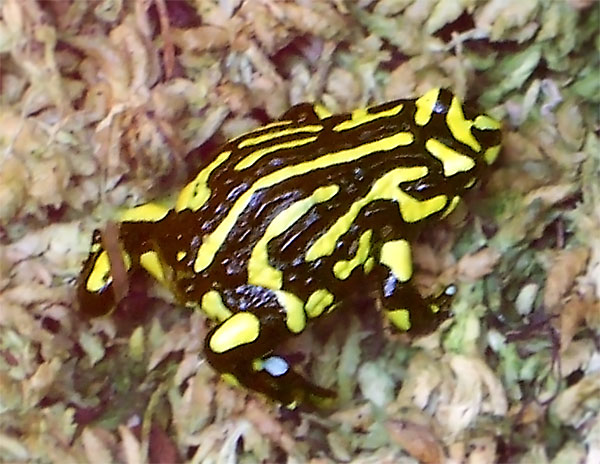
Southern Corroboree Frog

Southern Corroboree Frog

Pseudophryne corroboree

No machine-readable author provided. Andrew c assumed (based on copyright claims)., CC BY-SA 3.0, via Wikimedia Commons

Side by side

Bibron's ToadletSouthern Corroboree Frog
Scientific namePseudophryne bibronii Günther, 1859Pseudophryne corroboree Moore, 1953
English nameBibron's ToadletSouthern Corroboree Frog
GroupAmphibiansAmphibians
ClassAmphibia AmphibiansAmphibia Amphibians
OrderAnura FrogsAnura Frogs
FamilyMyobatrachidae Australian FrogsMyobatrachidae Australian Frogs
GenusPseudophryne Crowned ToadletsPseudophryne Crowned Toadlets
Named in18591953
Red List categoryLeast ConcernCritically Endangered
Countries on record1 country1 country
GBIF occurrence records11,136 records354 records

Rows where the two agree are shown in grey.

Where each is found

Both recorded in 1 country

From Catalogue of Life checklists and GBIF occurrence records. A country missing from a list means no record is held, which is not proof of absence.

Checked facts

Bibron's ToadletSouthern Corroboree Frog
Appearance
  • The species has a variable coloration, with brown, grey, or black upper surfaces that often bear scattered red spots. English Wikipedia
  • The underside is generally strongly marbled with black and white, although the pattern can be faint in some locations. English Wikipedia
  • The species has an orange, red, or yellow patch in each armpit. English Wikipedia
  • A yellow or orange patch or raised bump occurs on the back of the thigh. English Wikipedia
  • Its fingers and toes lack webbing and discs. English Wikipedia
  • The species has horizontal pupils and golden-colored irises. English Wikipedia
  • Adults have vivid yellow and black stripes across their head, back, and limbs. English Wikipedia
  • The species has a short, wide body and head, a slightly pointed snout, and unwebbed fingers and toes. English Wikipedia
Size
Habitat
  • The species occupies dry forests, woodlands, shrublands, grasslands, coastal swamps, heathlands, and sub-alpine environments. English Wikipedia
  • The species inhabits locations likely to flood following rainfall. English Wikipedia
  • Its habitats include creeks, temporary ponds, and roadside ditches in forests. English Wikipedia
  • The species' natural habitat consists of sphagnum bogs at elevations above 1,200 m. English Wikipedia
  • Breeding takes place near shallow pools, fens, seepages, wet grasslands, and wet heaths. English Wikipedia
  • The species occurs at elevations of 1,300–1,760 m above sea level. English Wikipedia
Diet
  • The species feeds primarily on small invertebrates found in leaf litter, including ants and greenfly. English Wikipedia
  • The species consumes available arthropods in its leaf-litter habitat without apparent prey-type selection. English Wikipedia
  • Small black ants are the most common food source reported for this species. English Wikipedia
  • Adult southern corroboree frogs eat beetles, mites, ants, and insect larvae. English Wikipedia
  • Tadpoles consume algae and small pieces of organic material found in their pools. English Wikipedia
Behaviour
  • When threatened, the species may lie motionless on its back and appear dead. English Wikipedia
  • The apparent-death response has been reported to last as long as one hour. English Wikipedia
  • Males attract females by producing a grating call from concealed locations. English Wikipedia
  • The species uses chemical signals to attract females and repel competing males. English Wikipedia
  • Male odors attract females, while males avoid the odors of other males. English Wikipedia
  • Females are also attracted to the odors of other females. English Wikipedia
  • The male calling rate doubles when additional males are present. English Wikipedia
  • The male calling rate triples when additional females are present. English Wikipedia
Reproduction
  • Breeding begins following heavy rainfall during the Australian autumn months of March, April, and May. English Wikipedia
  • The breeding season continues for approximately four to five months after its onset. English Wikipedia
  • Most mating and breeding activity occurs at night and can take place at cold temperatures. English Wikipedia
  • The species exhibits polyandry, with individual females mating with multiple males. English Wikipedia
  • A female may visit and mate with as many as eight males. English Wikipedia
  • Females deposit their eggs in shallow nests excavated by the males. English Wikipedia
  • Males fertilize eggs externally as females release them during inguinal amplexus. English Wikipedia
  • After mating, males remain to tend the nests. English Wikipedia
  • Nests may contain moist leaf litter or sphagnum moss. English Wikipedia
  • Eggs hatch and tadpoles develop in water after nests become flooded. English Wikipedia
  • Without sufficient rainfall, eggs may remain unhatched for several weeks while tadpoles continue developing inside them. English Wikipedia
Distribution
  • The species occurs across most of New South Wales, Victoria, southeastern Queensland, and eastern South Australia, including Kangaroo Island. English Wikipedia
  • The species is native to southeastern Australia. English Wikipedia
  • Its historical distribution included the Snowy Mountains region of New South Wales, from Smiggin Holes northwards to the Maragle Range. English Wikipedia
  • The species was described from a specimen collected at Towong Hill Station near Corryong, Victoria. English Wikipedia
Conservation
  • The species is classified as Least Concern on the IUCN Red List. iucnredlist.org
  • The species has experienced declines across much of its geographic range. English Wikipedia
  • Increasing drought in Australian grasslands has contributed to declining frog populations. English Wikipedia
  • Habitat loss has contributed to a significant decline in the species' population. English Wikipedia
  • The species is classified as critically endangered. English Wikipedia
  • Chytridiomycosis caused a drastic population decline during the 1980s. English Wikipedia
  • Chytrid fungal infection and bushfires are considered major threats to the species. English Wikipedia
  • Climate change, drought, fires, pollution, and residential and commercial development also threaten the species. English Wikipedia
  • Captive breeding programs have been established at four institutions. English Wikipedia
  • Captive breeding programs were established at the Amphibian Research Centre in 1997, Melbourne Zoo in 2001, Taronga Zoo in 2006, and Healesville Sanctuary in 2007. English Wikipedia
  • Five breeding enclosures have been established in Kosciuszko National Park. English Wikipedia
  • Two-thirds of the frogs in the breeding enclosures died during the 2019–20 Australian bushfires. English Wikipedia
OtherNo checked fact yet

In brief

Bibron's Toadlet

Pseudophryne bibronii occurs across most of New South Wales, Victoria, southeastern Queensland, and eastern South Australia, including Kangaroo Island. It has variable brown, grey, or black upper surfaces, often with scattered red spots, and a strongly marbled black-and-white underside. Full profile

Southern Corroboree Frog

Pseudophryne corroboree lives in sphagnum bogs at elevations above 1,200 m. Adults have vivid yellow and black stripes across their head, back, and limbs. Full profile

Compare something else

Page built on 28 November 2026 from the data on the two species pages, where every source is listed.

Cite this page

ScientificNames.org. (2026). Bibron's Toadlet vs Southern Corroboree Frog. Retrieved November 28, 2026, from https://scientificnames.org/compare/bibrons-toadlet-vs-southern-corroboree-frog