Species · Amphibians
Bibron's Toadlet Pseudophryne bibronii
The scientific name of the Bibron's Toadlet is Pseudophryne bibronii. It is a species of amphibian in the family Myobatrachidae (australian frogs), order Anura. The name dates from 1859.
- Scientific name
- Pseudophryne bibronii Günther, 1859
- Common name
- Bibron's Toadlet
- Genus
- Pseudophryne
- Family
- Myobatrachidae (Australian Frogs)
- Order
- Anura
- Class
- Amphibia
- Red List category
- LC Least Concern
- Recorded in
- 1 country
- Name status
- accepted in the Catalogue of Life

Overview
Pseudophryne bibronii occurs across most of New South Wales, Victoria, southeastern Queensland, and eastern South Australia, including Kangaroo Island. It has variable brown, grey, or black upper surfaces, often with scattered red spots, and a strongly marbled black-and-white underside.
Written 26 November 2026 from the sources listed below. Each statement was checked against the passage it cites; statements that could not be supported were removed.
Appearance
The species has variable brown, grey, or black upper surfaces, often bearing scattered red spots. Its underside is generally strongly marbled with black and white, although the pattern can be faint in some locations.[1][2]
An orange, red, or yellow patch occurs in each armpit. A yellow or orange patch or raised bump occurs on the back of the thigh.[3][4]
Its fingers and toes lack webbing and discs. It has horizontal pupils and golden-colored irises.[5][6]
Adults grow to approximately 30 mm in length. Females are approximately 14% longer and 15% heavier than males.[7][8][9]
Habitat
The species occupies dry forests, woodlands, shrublands, grasslands, coastal swamps, heathlands, and sub-alpine environments. It inhabits locations likely to flood following rainfall.[10][11]
Its habitats include creeks, temporary ponds, and roadside ditches in forests.[12]
Diet
The species feeds primarily on small invertebrates found in leaf litter, including ants and greenfly. Small black ants are the most common reported food source.[13][14]
It consumes available arthropods in its leaf-litter habitat without apparent prey-type selection.[15]
Behaviour
When threatened, the species may lie motionless on its back and appear dead. This apparent-death response has been reported to last as long as one hour.[16][17]
Males attract females by producing a grating call from concealed locations. The male calling rate doubles when additional males are present and triples when additional females are present.[18][19][20]
The species uses chemical signals to attract females and repel competing males. Male odors attract females, while males avoid the odors of other males, and females are also attracted to the odors of other females.[21][22][23]
The species produces pumiliotoxins that deter predators.[24]
Reproduction and life cycle
Breeding begins following heavy rainfall during the Australian autumn months of March, April, and May. The breeding season continues for approximately four to five months after its onset.[25][26]
Most mating and breeding activity occurs at night and can take place at cold temperatures. The species exhibits polyandry, with individual females mating with multiple males, and a female may visit and mate with as many as eight males.[27][28][29]
Females deposit their eggs in shallow nests excavated by the males. Males fertilize the eggs externally as females release them during inguinal amplexus.[30][31]
After mating, males remain to tend the nests. Nests may contain moist leaf litter or sphagnum moss.[32][33]
Eggs hatch and tadpoles develop in water after the nests become flooded. Without sufficient rainfall, eggs may remain unhatched for several weeks while tadpoles continue developing inside them.[34][35]
Conservation
The species is classified as Least Concern on the IUCN Red List. It has experienced declines across much of its geographic range.[36][37]
Increasing drought in Australian grasslands has contributed to declining frog populations. Habitat loss has also contributed to a significant decline in the species' population.[38][39]
Classification of the Bibron's Toadlet
| Kingdom | Animalia |
|---|---|
| Phylum | Chordata |
| Subphylum | Vertebrata |
| Infraphylum | Gnathostomata |
| Parvphylum | Osteichthyes |
| Megaclass | Tetrapoda |
| Class | Amphibia (Amphibians) |
| Order | Anura (Frogs) |
| Superfamily | Myobatrachoidea |
| Family | Myobatrachidae (Australian Frogs) |
| Genus | Pseudophryne (Crowned Toadlets) |
| Species | Pseudophryne bibronii Günther, 1859 |
Where the Bibron's Toadlet is found
Checklists and occurrence records place Pseudophryne bibronii in 1 country. GBIF holds 11,136 georeferenced records of it.
Countries
Regions and cities with the most records
- New South Wales, Australia 5,964
- Victoria, Australia 2,961
- South Australia, Australia 1,023
- Adelaide Hills, Australia 410
- Adelaide, Australia 409
- Batemans Bay, Australia 323
- Mount Barker, Australia 264
- Wallan, Australia 250
- Bendigo, Australia 219
- Liverpool, Australia 183
- Parramatta, Australia 162
- Australian Capital Territory, Australia 145
- Queensland, Australia 130
- Hornsby, Australia 120
- Sydney, Australia 114
- Canberra, Australia 73
- Newcastle, Australia 66
- Gawler, Australia 62
- Tuggeranong, Australia 61
- Maitland, Australia 51
- Cessnock, Australia 48
- Wodonga, Australia 46
- St Albans, Australia 44
- Balwyn North, Australia 41
- Central Coast, Australia 31
- Burwood, Australia 30
- Taree, Australia 27
- Melbourne, Australia 24
- Armidale, Australia 23
- Torquay, Australia 23
- Dubbo, Australia 20
- Tamworth, Australia 18
- Brisbane, Australia 15
- Wangaratta, Australia 14
- Bacchus Marsh, Australia 12
- Ballarat, Australia 10
A number beside a place is its count of GBIF occurrence records. A place without a number comes from a checklist alone. Records show where a species has been observed or collected, which can include escapes and vagrants.
Common names
English
- Bibron's Toadlet
- Bibron's Brood Frog
- Bibron’s Toadlet
- Brown Brood Frog
- Brown Toadlet
Names in 4 other languages
- Czech
- paropucha Bibronova
- Hungarian
- Bibron álvarangya
- Norwegian Bokmål
- Bibronfrosk
- Russian
- Ложная жаба
Synonyms
2 other scientific names have been used for this species and are now treated as synonyms of Pseudophryne bibronii.
- Bufo proteus Péron, 1807
- Pseudophryne barkeri Wells & Wellington, 1989
Related species
-
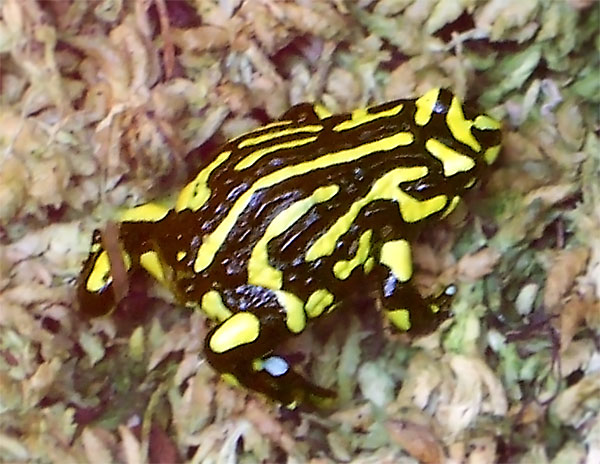 Southern Corroboree FrogPseudophryne corroboree
-
 Northern Corroboree FrogPseudophryne pengilleyi
-
 Red-crowned ToadletPseudophryne australis
-
 Red-backed ToadletPseudophryne coriacea
-
 Southern ToadletPseudophryne semimarmorata
-
 Magnificent Brood FrogPseudophryne covacevichae
-
 Günther's ToadletPseudophryne guentheri
-
 Dendy's ToadletPseudophryne dendyi
Compare
Questions and answers
What is the scientific name of the Bibron's Toadlet?
The scientific name of the Bibron's Toadlet is Pseudophryne bibronii. Written with its author, the full name is Pseudophryne bibronii Günther, 1859.
Which family does the Bibron's Toadlet belong to?
Pseudophryne bibronii belongs to the family Myobatrachidae, in the order Anura and the class Amphibia.
Where is the Bibron's Toadlet found?
Checklists and occurrence records place Pseudophryne bibronii in 1 country: Australia.
What is the conservation status of the Bibron's Toadlet?
The IUCN Red List category recorded for Pseudophryne bibronii is Least Concern (LC).
What other names does the Bibron's Toadlet have?
Pseudophryne bibronii is also known in English as Bibron's Brood Frog, Bibron’s Toadlet, Brown Brood Frog and Brown Toadlet.
Sources
Passages the profile rests on
- The species has a variable coloration, with brown, grey, or black upper surfaces that often bear scattered red spots. Source passage: “It grows to about 30mm in length and is brown, grey, or black above, often with scattered red spots.” — English Wikipedia
- The underside is generally strongly marbled with black and white, although the pattern can be faint in some locations. Source passage: “It is normally strongly marbled black and white on the ventral surface, however in some areas this marbling can be faint.” — English Wikipedia
- The species has an orange, red, or yellow patch in each armpit. Source passage: “There is always an orange, red or yellow patch in the armpits.” — English Wikipedia
- A yellow or orange patch or raised bump occurs on the back of the thigh. Source passage: “There is also a yellow/orange patch or raised bump on the back of the thigh.” — English Wikipedia
- Its fingers and toes lack webbing and discs. Source passage: “Its fingers and toes do not show any webbing nor do they contain any discs.” — English Wikipedia
- The species has horizontal pupils and golden-colored irises. Source passage: “The species has horizontal pupils and the iris displays a gold coloring.” — English Wikipedia
- Adults grow to approximately 30 mm in length. Source passage: “It grows to about 30mm in length” — English Wikipedia
- Females are approximately 14% longer than males. Source passage: “Females are 14% longer than male toadlets” — English Wikipedia
- Females are approximately 15% heavier than males. Source passage: “15% heavier than male toadlets.” — English Wikipedia
- The species occupies dry forests, woodlands, shrublands, grasslands, coastal swamps, heathlands, and sub-alpine environments. Source passage: “they mainly reside in dry forests, woodland, shrubland, grassland, coastal swamps, heathland, and sub-alpine areas.” — English Wikipedia
- The species inhabits locations likely to flood following rainfall. Source passage: “This species inhabits areas that are likely to be flooded after rain.” — English Wikipedia
- Its habitats include creeks, temporary ponds, and roadside ditches in forests. Source passage: “This can be anything from coastal swamps, creeks, temporary ponds/roadside ditches in forest” — English Wikipedia
- The species feeds primarily on small invertebrates found in leaf litter, including ants and greenfly. Source passage: “They primarily feed on small invertebrates present in leaf litter, such as small ants and greenflys.” — English Wikipedia
- Small black ants are the most common food source reported for this species. Source passage: “Small black ants are the most common source of food for this species.” — English Wikipedia
- The species consumes available arthropods in its leaf-litter habitat without apparent prey-type selection. Source passage: “They will consume any arthropod that becomes available to them in the leaf litter present in their habitat.” — English Wikipedia
- When threatened, the species may lie motionless on its back and appear dead. Source passage: “When threatened, the Bibron's toadlet will often lie on its back, unresponsive, pretending to be dead.” — English Wikipedia
- The apparent-death response has been reported to last as long as one hour. Source passage: “This performance had been reported to last for up to an hour.” — English Wikipedia
- Males attract females by producing a grating call from concealed locations. Source passage: “The males attract the females by making a grating "cre-eek" noise from a concealed area, in mud, under rocks, or within damp leaf litter.” — English Wikipedia
- The male calling rate doubles when additional males are present. Source passage: “In response to increased presence of males the call rate increased by twofold” — English Wikipedia
- The male calling rate triples when additional females are present. Source passage: “in response to the increased presence of females the call rate increased by threefold.” — English Wikipedia
- The species uses chemical signals to attract females and repel competing males. Source passage: “this species utilizes chemosignals to attract females and repel males from their territory.” — English Wikipedia
- Male odors attract females, while males avoid the odors of other males. Source passage: “Female P. bibronii have been proven to be attracted to male odors and males have been proven to avoid other male odors.” — English Wikipedia
- Females are also attracted to the odors of other females. Source passage: “Interestingly, females are also attracted to other female odors” — English Wikipedia
- The species produces pumiliotoxins that deter predators. Source passage: “This species also produces pumiliotoxins (PTXs) that deter predators through their diet.” — English Wikipedia
- Breeding begins following heavy rainfall during the Australian autumn months of March, April, and May. Source passage: “Breeding season begins after the heavy rains during the Australian autumn months of March, April, and May” — English Wikipedia
- The breeding season continues for approximately four to five months after its onset. Source passage: “and proceeds for four to five months after.” — English Wikipedia
- Most mating and breeding activity occurs at night and can take place at cold temperatures. Source passage: “Most breeding and mating occurs at night and can occur at cold temperatures.” — English Wikipedia
- The species exhibits polyandry, with individual females mating with multiple males. Source passage: “The species is polyandrous, with each female mating with several males.” — English Wikipedia
- A female may visit and mate with as many as eight males. Source passage: “The female visits up to eight males, mates with each” — English Wikipedia
- Females deposit their eggs in shallow nests excavated by the males. Source passage: “and deposits eggs in the shallow nest he has dug.” — English Wikipedia
- Males fertilize eggs externally as females release them during inguinal amplexus. Source passage: “the male grabs the female by the inguinal amplexus and fertilizes the eggs as they are being released by the female.” — English Wikipedia
- After mating, males remain to tend the nests. Source passage: “The female moves on and the male tends to the nest.” — English Wikipedia
- Nests may contain moist leaf litter or sphagnum moss. Source passage: “The nest, which may contain moist leaf litter or sphagnum moss, floods during rain.” — English Wikipedia
- Eggs hatch and tadpoles develop in water after nests become flooded. Source passage: “The eggs hatch and the tadpoles develop in the water.” — English Wikipedia
- Without sufficient rainfall, eggs may remain unhatched for several weeks while tadpoles continue developing inside them. Source passage: “If no sufficient rain happens soon after laying the eggs can remain unhatched for many weeks, with the tadpoles developing inside.” — English Wikipedia
- The species is classified as Least Concern on the IUCN Red List. Source passage: “Pseudophryne bibronii is listed as Least Concern.” — iucnredlist.org
- The species has experienced declines across much of its geographic range. Source passage: “although having declined over much of its range” — English Wikipedia
- Increasing drought in Australian grasslands has contributed to declining frog populations. Source passage: “Increasing drought in the Australian grasslands has caused a decrease in frog populations overall.” — English Wikipedia
- Habitat loss has contributed to a significant decline in the species' population. Source passage: “There has been increasing habitat loss for these frogs causing a significant decline in the population.” — English Wikipedia
Data
- Catalogue of Life, 2026-10-16 XR cc by
- Global Biodiversity Information Facility CC BY 4.0
- Wikidata CC0
- GeoNames CC BY 4.0
- Wikimedia Commons per image; credit shown with each image
- Within the Catalogue of Life, this name comes from The Integrated Taxonomic Information System cc0
This species in other databases
Page built on 28 November 2026. See how the catalog is made and all sources and licences.
Cite this page
ScientificNames.org. (2026). Pseudophryne bibronii (Bibron's Toadlet). Retrieved November 28, 2026, from https://scientificnames.org/species/pseudophryne-bibronii
“Pseudophryne bibronii (Bibron's Toadlet).” ScientificNames.org, 2026, scientificnames.org/species/pseudophryne-bibronii. Accessed 28 Nov. 2026.
ScientificNames.org. “Pseudophryne bibronii (Bibron's Toadlet).” Accessed November 28, 2026. https://scientificnames.org/species/pseudophryne-bibronii.
@misc{scientificnames_pseudophryne_bibronii_bibrons_toadlet,
  author = {{ScientificNames.org}},
  title = {Pseudophryne bibronii (Bibron's Toadlet)},
  year = {2026},
  url = {https://scientificnames.org/species/pseudophryne-bibronii},
  note = {Accessed 2026-11-28}
}