Comparison

Apple Berry vs Common Apple-berry

Apple Berry (Billardiera scandens) and Common Apple-berry (Billardiera mutabilis) both belong to the genus Billardiera (apple-berries) and part ways below it. Both are recorded in 1 country.
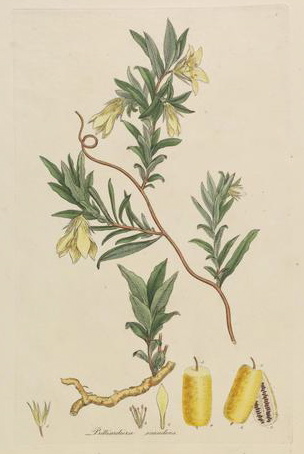
Apple Berry

Apple Berry

Billardiera scandens

Sowerby, James, Public domain, via Wikimedia Commons

Common Apple-berry

Billardiera mutabilis

Side by side

Apple BerryCommon Apple-berry
Scientific nameBillardiera scandens Sm.Billardiera mutabilis Salisb.
English nameApple BerryCommon Apple-berry
GroupFlowering plantsFlowering plants
ClassMagnoliopsidaMagnoliopsida
OrderApialesApiales
FamilyPittosporaceae Cheesewood FamilyPittosporaceae Cheesewood Family
GenusBillardiera Apple-berriesBillardiera Apple-berries
Countries on record1 country1 country
GBIF occurrence records27,382 records6,424 records

Rows where the two agree are shown in grey.

Where each is found

Both recorded in 1 country

From Catalogue of Life checklists and GBIF occurrence records. A country missing from a list means no record is held, which is not proof of absence.

Checked facts

Apple BerryCommon Apple-berry
Appearance
  • Billardiera scandens is an evergreen sprawling groundcover or climbing plant. anbg.gov.au
  • The plant has wiry stems ranging from red to brown-grey. anbg.gov.au
  • The shoot tips are covered in fine white hairs. anbg.gov.au
  • The flowers are pendulous and bell-shaped. anbg.gov.au
  • Each flower has five bright yellow-cream petals that become tinged with purple as they age. anbg.gov.au
  • The flower petals reflex as the flowers open. anbg.gov.au
  • The leaves are narrowly oval, mid-green and hairy, with wavy or sometimes recurved margins. anbg.gov.au
  • The underside of the leaves is pale green and silky. anbg.gov.au
  • The fruit is an oblong berry with a hairy skin. anbg.gov.au
  • The fruit changes from green and purple to yellow as it ripens. anbg.gov.au
  • The fruit has a hairy skin resembling that of a peach. anbg.gov.au
  • The plant has a silky appearance and becomes more brittle as its dense growth matures. English Wikipedia
  • The inflorescence consists of single or paired yellow flowers with pink-tinged yellow sepals and bright yellow petals. English Wikipedia
  • The flowers are attached to hairy, drooping peduncles. English Wikipedia
Size
  • The stems can grow up to 3 metres long. anbg.gov.au
  • In open positions, the plant can grow as a shrub up to 1.5 metres high. anbg.gov.au
  • The flowers measure 1–2 centimetres long. anbg.gov.au
  • The berries measure approximately 2 centimetres long and 1 centimetre wide. anbg.gov.au
  • The leaves measure approximately 5 centimetres long and 0.5 centimetres wide. anbg.gov.au
  • The berries can reach up to 30 millimetres in length. English Wikipedia
Habitat
  • The species occurs in coastal heath, sclerophyll forest and inland mallee habitats. anbg.gov.au
  • The species occurs in forests in coastal and tableland areas. English Wikipedia
  • Naturally occurring plants in dry, shaded or cool positions often develop sparse foliage. anbg.gov.au
Diet
  • The ripe fruit can be eaten raw after falling to the ground. anbg.gov.au
  • Unripe green fruit can be eaten after roasting. anbg.gov.au
  • The fruit has a sweet, astringent flavour similar to kiwifruit. anbg.gov.au
  • Aboriginal Australians consume the fruit either ripe or roasted while unripe. English Wikipedia
No checked fact yet
Behaviour
  • The plant has a climbing habit that is not invasive. anbg.gov.au
No checked fact yet
Reproduction
  • The flowers develop during spring and summer. anbg.gov.au
  • Flowers occur singly or in groups of two to three on slender stalks. anbg.gov.au
  • The fruit develops during summer. anbg.gov.au
  • The berries ripen only after dropping to the ground. English Wikipedia
  • Summer-sown seeds may take up to 12 weeks to germinate in autumn. anbg.gov.au
  • The species can be propagated using firm tip cuttings taken in summer. anbg.gov.au
Distribution
  • The species occurs across eastern Australia from southern Queensland to Tasmania and South Australia. anbg.gov.au
  • Billardiera mutabilis is endemic to south-eastern Australia. English Wikipedia
  • The species occurs in New South Wales and the Australian Capital Territory south from approximately Kiama. English Wikipedia
  • The species extends through southern Victoria to the coasts of Tasmania. English Wikipedia
Uses
  • The berries are valued as Australian bush food. English Wikipedia
  • The species is cultivated as a rambling shrub in Australian gardens, particularly beneath eucalyptus trees and among other native plants. English Wikipedia
  • The plant is suitable for growing over other plants, in hanging baskets, pots and rockeries. anbg.gov.au
  • Honeyeaters are attracted to the nectar of the flowers. anbg.gov.au
No checked fact yet
Similar speciesNo checked fact yet
  • Billardiera mutabilis is similar in appearance to Billardiera scandens. English Wikipedia
  • Billardiera mutabilis differs from Billardiera scandens in having hairless fruit, whereas the latter has hairy fruit. English Wikipedia

In brief

Apple Berry

The species occurs across eastern Australia from southern Queensland to Tasmania and South Australia, in coastal heath, sclerophyll forest and inland mallee habitats. Full profile

Common Apple-berry

Common Apple-berry (Billardiera mutabilis) is a flowering plant endemic to south-eastern Australia. It grows in heathland, woodland and forest in coastal and tableland environments. It is distinguished from Billardiera scandens by its smooth, hairless green fruit. Full profile

Compare something else

Page built on 28 November 2026 from the data on the two species pages, where every source is listed.

Cite this page

ScientificNames.org. (2026). Apple Berry vs Common Apple-berry. Retrieved November 28, 2026, from https://scientificnames.org/compare/apple-berry-vs-common-apple-berry