Species · Flowering plants
Apple Berry Billardiera scandens
The scientific name of the Apple Berry is Billardiera scandens. It is a species of flowering plant in the family Pittosporaceae (cheesewood family), order Apiales.
- Scientific name
- Billardiera scandens Sm.
- Common name
- Apple Berry
- Genus
- Billardiera
- Family
- Pittosporaceae (Cheesewood Family)
- Order
- Apiales
- Class
- Magnoliopsida
- Recorded in
- 1 country
- Name status
- accepted in the Catalogue of Life
Overview
The species occurs across eastern Australia from southern Queensland to Tasmania and South Australia, in coastal heath, sclerophyll forest and inland mallee habitats.
Written 26 November 2026 from the sources listed below. Each statement was checked against the passage it cites; statements that could not be supported were removed.
Appearance
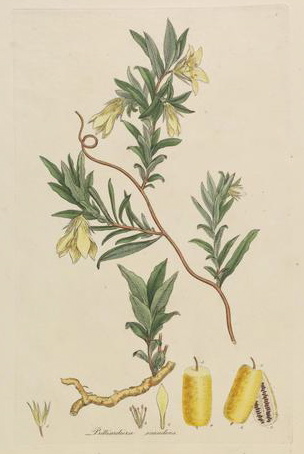
Apple Berry is an evergreen sprawling groundcover or climbing plant with wiry stems ranging from red to brown-grey. The shoot tips are covered in fine white hairs, and the plant has a silky appearance that becomes more brittle as its dense growth matures.[1][2][3][4]
The leaves are narrowly oval, mid-green and hairy, with wavy or sometimes recurved margins. Their undersides are pale green and silky, and the leaves measure approximately 5 centimetres long and 0.5 centimetres wide.[5][6][7]
The flowers are pendulous and bell-shaped, with five bright yellow-cream petals that reflex as the flowers open and become tinged with purple as they age. They measure 1–2 centimetres long and are attached to hairy, drooping peduncles.[8][9][10][11][12]
The inflorescence consists of single or paired yellow flowers with pink-tinged yellow sepals and bright yellow petals. Flowers also occur in groups of two to three on slender stalks.[13][14]
The fruit is an oblong berry with a hairy skin resembling that of a peach. It changes from green and purple to yellow as it ripens, measures approximately 2 centimetres long and 1 centimetre wide, and can reach up to 30 millimetres in length.[15][16][17][18][19]
The stems can grow up to 3 metres long. In open positions, the plant can grow as a shrub up to 1.5 metres high.[20][21]
Habitat
Apple Berry occurs in coastal heath, sclerophyll forest and inland mallee habitats. It also occurs in forests in coastal and tableland areas.[22][23]
Naturally occurring plants in dry, shaded or cool positions often develop sparse foliage.[24]
Behaviour
Apple Berry has a climbing habit that is not invasive.[25]
Reproduction and life cycle
The flowers develop during spring and summer and occur singly or in groups of two to three on slender stalks. The fruit develops during summer.[26][14][27]
The berries ripen only after dropping to the ground.[28]
Summer-sown seeds may take up to 12 weeks to germinate in autumn. The species can also be propagated using firm tip cuttings taken in summer.[29][30]
Diet
The fruit has a sweet, astringent flavour similar to kiwifruit. Ripe fruit can be eaten raw after falling to the ground, while unripe green fruit can be eaten after roasting.[31][32][33]
Aboriginal Australians consume the fruit either ripe or roasted while unripe.[34]
Uses
The berries are valued as Australian bush food. The species is cultivated as a rambling shrub in Australian gardens, particularly beneath eucalyptus trees and among other native plants.[35][36]
The plant is suitable for growing over other plants, in hanging baskets, pots and rockeries. Honeyeaters are attracted to the nectar of its flowers.[37][38]
Classification of the Apple Berry
| Kingdom | Plantae |
|---|---|
| Subkingdom | Pteridobiotina |
| Phylum | Tracheophyta |
| Class | Magnoliopsida |
| Order | Apiales |
| Family | Pittosporaceae (Cheesewood Family) |
| Tribe | Billardiereae |
| Genus | Billardiera (Apple-berries) |
| Species | Billardiera scandens Sm. |
Where the Apple Berry is found
Checklists and occurrence records place Billardiera scandens in 1 country across Oceania. GBIF holds 27,382 georeferenced records of it.
Countries
Regions and cities with the most records
- New South Wales, Australia 18,449
- Victoria, Australia 7,677
- Hornsby, Australia 1,894
- Parramatta, Australia 1,283
- Sydney, Australia 1,074
- Liverpool, Australia 680
- Burwood, Australia 570
- Queensland, Australia 563
- Newcastle, Australia 545
- Central Coast, Australia 541
- Balwyn North, Australia 533
- Maitland, Australia 466
- Cessnock, Australia 421
- Frankston East, Australia 404
- Wollongong, Australia 291
- Port Macquarie, Australia 184
- Australian Capital Territory, Australia 168
- Batemans Bay, Australia 166
- Traralgon, Australia 165
- Canberra, Australia 163
- Taree, Australia 161
- Tuggeranong, Australia 158
- South Australia, Australia 103
- Melbourne, Australia 102
- Torquay, Australia 94
- Caloundra, Australia 93
- Sunshine Coast, Australia 87
- Coffs Harbour, Australia 76
- Goulburn, Australia 63
- Bairnsdale, Australia 43
- Ballarat, Australia 37
- Warragul, Australia 34
- Orange, Australia 29
- Mount Gambier, Australia 24
- Wallan, Australia 22
- Grafton, Australia 15
Range as the checklists state it
Australia (Western Australia, South Australia, Queensland, New South Wales, Victoria, Tasmania)
A number beside a place is its count of GBIF occurrence records. A place without a number comes from a checklist alone. Records show where a species has been observed or collected, which can include escapes and vagrants.
Common names
English
- Apple Berry
- Dumplings
- Apple-berry
- Apple-dumpling
- Common Appleberry
Names in 2 other languages
- Chinese
- 吊藤莓
- Slovak
- bilardiéra popínavá
Synonyms
15 other scientific names have been used for this species and are now treated as synonyms of Billardiera scandens.
- Billardiera brachyantha F.Muell. ex Klatt
- Billardiera brachyantha var. brachyantha
- Billardiera brachyantha var. phyllocalyx Klatt
- Billardiera canariensis J.C.Wendl.
- Billardiera daphnoides Knowles & Westc.
- Billardiera grandiflora Putt.
- Billardiera scandens var. brachyantha (F.Muell. ex Klatt) Benth.
- Billardiera scandens var. scandens
- Billardiera scandens var. sericata E.M.Benn.
- Labillardiera canariensis (J.C.Wendl.) Roem. & Schult.
- Labillardiera mutabilis (Salisb.) Roem. & Schult.
- Labillardiera scandens Roem. & Schult.
- Sollya angustifolia Lindl.
- Billardiera angustifolia DC. ambiguous synonym
- Billardiera latifolia Putt. ambiguous synonym
Related species
-
 Western Australian Bluebell CreeperBillardiera heterophylla
- Purple Apple-berryBillardiera longiflora
-
 Australian BluebellBillardiera fusiformis
- Common Apple-berryBillardiera mutabilis
-
 White-Flowered BillardieraBillardiera floribunda
- Mountain Apple-berryBillardiera macrantha
- Single-flower Apple-berryBillardiera uniflora
-
 Silky Apple-berryBillardiera sericophora
Compare
Questions and answers
What is the scientific name of the Apple Berry?
The scientific name of the Apple Berry is Billardiera scandens. Written with its author, the full name is Billardiera scandens Sm..
Which family does the Apple Berry belong to?
Billardiera scandens belongs to the family Pittosporaceae, in the order Apiales and the class Magnoliopsida.
Where is the Apple Berry found?
Checklists and occurrence records place Billardiera scandens in 1 country: Australia.
What other names does the Apple Berry have?
Billardiera scandens is also known in English as Dumplings, Apple-berry, Apple-dumpling and Common Appleberry.
What is an apple berry?
Apple Berry is the common name used for Billardiera scandens, an evergreen sprawling groundcover or climbing flowering plant.[1]
Sources
Passages the profile rests on
- Billardiera scandens is an evergreen sprawling groundcover or climbing plant. Source passage: “The species is an evergreen sprawling groundcover or climber” — anbg.gov.au
- The plant has wiry stems ranging from red to brown-grey. Source passage: “with wiry, red to brown-grey stems” — anbg.gov.au
- The shoot tips are covered in fine white hairs. Source passage: “The shoot tips are very hairy, with a fine white fringe.” — anbg.gov.au
- The plant has a silky appearance and becomes more brittle as its dense growth matures. Source passage: “It has a silky touch and appearance that becomes more brittle as the dense growth matures.” — English Wikipedia
- The leaves are narrowly oval, mid-green and hairy, with wavy or sometimes recurved margins. Source passage: “The hairy leaves are narrowly oval, mid green, 0.5 cm wide and 5 cm long. The leaves have a wavy, sometimes recurved margin.” — anbg.gov.au
- The underside of the leaves is pale green and silky. Source passage: “The underside of the leaf is pale-green and silky.” — anbg.gov.au
- The leaves measure approximately 5 centimetres long and 0.5 centimetres wide. Source passage: “The hairy leaves are narrowly oval, mid green, 0.5 cm wide and 5 cm long.” — anbg.gov.au
- The flowers are pendulous and bell-shaped. Source passage: “Pendulous bell-shaped flowers develop on the end of stems” — anbg.gov.au
- Each flower has five bright yellow-cream petals that become tinged with purple as they age. Source passage: “Each flower has five bright yellow-cream petals that tinge with purple as the flower ages.” — anbg.gov.au
- The flower petals reflex as the flowers open. Source passage: “The petal tips reflex as the flower opens.” — anbg.gov.au
- The flowers are attached to hairy, drooping peduncles. Source passage: “and is attached to a hairy drooping peduncle.” — English Wikipedia
- The flowers measure 1–2 centimetres long. Source passage: “These 1-2 cm long flowers are borne on slender stalks” — anbg.gov.au
- The inflorescence consists of single or paired yellow flowers with pink-tinged yellow sepals and bright yellow petals. Source passage: “The inflorescence consists of single or paired yellow flowers, pink-tinged yellow sepals and bright yellow petals” — English Wikipedia
- Flowers occur singly or in groups of two to three on slender stalks. Source passage: “These 1-2 cm long flowers are borne on slender stalks, singly or in groups of 2-3.” — anbg.gov.au
- The fruit is an oblong berry with a hairy skin. Source passage: “An oblong berry, 2 cm long and 1 cm wide forms in summer.” — anbg.gov.au
- The fruit changes from green and purple to yellow as it ripens. Source passage: “The fleshy green and purple fruit turns yellow when ripe.” — anbg.gov.au
- The fruit has a hairy skin resembling that of a peach. Source passage: “The skin is hairy and similar to peach” — anbg.gov.au
- The berries measure approximately 2 centimetres long and 1 centimetre wide. Source passage: “An oblong berry, 2 cm long and 1 cm wide forms in summer.” — anbg.gov.au
- The berries can reach up to 30 millimetres in length. Source passage: “fruit of oblong berries up to 30 mm long” — English Wikipedia
- The stems can grow up to 3 metres long. Source passage: “with wiry, red to brown-grey stems up to 3 metres long.” — anbg.gov.au
- In open positions, the plant can grow as a shrub up to 1.5 metres high. Source passage: “In an open position the form may take that of a small shrub to 1.5 m high.” — anbg.gov.au
- The species occurs in coastal heath, sclerophyll forest and inland mallee habitats. Source passage: “B. scandens can be found in habitats ranging from coastal heath to sclerophyll forest and inland mallee.” — anbg.gov.au
- The species occurs in forests in coastal and tableland areas. Source passage: “occurs in forests in the coastal and tableland areas” — English Wikipedia
- Naturally occurring plants in dry, shaded or cool positions often develop sparse foliage. Source passage: “Naturally occurring plants in dry, shaded or cool positions often develop sparse foliage.” — anbg.gov.au
- The plant has a climbing habit that is not invasive. Source passage: “a climbing but not invasive habit” — anbg.gov.au
- The flowers develop during spring and summer. Source passage: “Pendulous bell-shaped flowers develop on the end of stems or on short branchlets in spring and summer.” — anbg.gov.au
- The fruit develops during summer. Source passage: “An oblong berry, 2 cm long and 1 cm wide forms in summer.” — anbg.gov.au
- The berries ripen only after dropping to the ground. Source passage: “The fruits, which only ripen after dropping to the ground” — English Wikipedia
- Summer-sown seeds may take up to 12 weeks to germinate in autumn. Source passage: “Summer sown seed may take up to 12 weeks to germinate in autumn.” — anbg.gov.au
- The species can be propagated using firm tip cuttings taken in summer. Source passage: “Firm tip cuttings may be taken in summer.” — anbg.gov.au
- The ripe fruit can be eaten raw after falling to the ground. Source passage: “Fruit may be eaten raw when it has fallen to the ground” — anbg.gov.au
- Unripe green fruit can be eaten after roasting. Source passage: “or roasted if still green.” — anbg.gov.au
- The fruit has a sweet, astringent flavour similar to kiwifruit. Source passage: “the sweet astringent flavour similar to kiwifruit.” — anbg.gov.au
- Aboriginal Australians consume the fruit either ripe or roasted while unripe. Source passage: “Aboriginal Australians eat these as bush food either in their ripened state or by roasting the unripened fruit.” — English Wikipedia
- The berries are valued as Australian bush food. Source passage: “are valued as an Australian bush food” — English Wikipedia
- The species is cultivated as a rambling shrub in Australian gardens, particularly beneath eucalyptus trees and among other native plants. Source passage: “especially those favouring indigenous plants as a rambling yet non-dominant shrub, especially beneath eucalypts and between other native species.” — English Wikipedia
- The plant is suitable for growing over other plants, in hanging baskets, pots and rockeries. Source passage: “suitable as a climber over other plants or as an attractive potted, hanging basket or rockery specimen.” — anbg.gov.au
- Honeyeaters are attracted to the nectar of the flowers. Source passage: “Honeyeaters are attracted to the nectar.” — anbg.gov.au
Data
- Catalogue of Life, 2026-10-16 XR cc by
- Global Biodiversity Information Facility CC BY 4.0
- Wikidata CC0
- GeoNames CC BY 4.0
- Wikimedia Commons per image; credit shown with each image
- Within the Catalogue of Life, this name comes from Synonymic Checklists of the Vascular Plants of the World cc by
References
- Sm. (1793). Spec. Bot. New Holland 1: t. 1 (1793). where the name was published
This species in other databases
- Catalogue of Life 5WL7D
- Wikidata Q4911547
- iNaturalist 321079
- World Flora Online wfo-0000565362
- GRIN 7228
Page built on 28 November 2026. See how the catalog is made and all sources and licences.
Cite this page
ScientificNames.org. (2026). Billardiera scandens (Apple Berry). Retrieved November 28, 2026, from https://scientificnames.org/species/billardiera-scandens
“Billardiera scandens (Apple Berry).” ScientificNames.org, 2026, scientificnames.org/species/billardiera-scandens. Accessed 28 Nov. 2026.
ScientificNames.org. “Billardiera scandens (Apple Berry).” Accessed November 28, 2026. https://scientificnames.org/species/billardiera-scandens.
@misc{scientificnames_billardiera_scandens_apple_berry,
  author = {{ScientificNames.org}},
  title = {Billardiera scandens (Apple Berry)},
  year = {2026},
  url = {https://scientificnames.org/species/billardiera-scandens},
  note = {Accessed 2026-11-28}
}