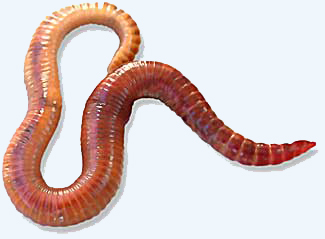
| Appearance | - The worm's body can range in colour from red-violet to chestnut brown or bright purple. English Wikipedia
- The upper surface of the worm is generally darker than its underside. English Wikipedia
- The first body segment has overlapping lobes, a feature described as epilobous. English Wikipedia
- The body segments have paired hair-like setae, with wider spacing between pairs on the sides than underneath. English Wikipedia
- The male reproductive opening is located on segment 15, while the female reproductive opening is located on segment 14. English Wikipedia
- Most body segments have small dorsal pores on their upper surfaces. English Wikipedia
| - The worm has a reddish-brown body with small rings and a yellowish tail. English Wikipedia
- The worm has groups of bristles called setae on each body segment. English Wikipedia
|
|---|
| Size | | No checked fact yet |
|---|
| Habitat | - The species occurs in leaf litter and in the upper 10 centimetres of soil. English Wikipedia
- The species prefers substrates rich in organic material, including rotting wood, plant matter, compost, peat and manure. English Wikipedia
- Cool and moist environmental conditions are favourable for this species. English Wikipedia
- The species commonly inhabits acidic litter in coniferous forests in North America and Europe. English Wikipedia
- The species is also found in caves. English Wikipedia
- In Finnish forests, the species inhabits organic soils in the nest mounds of red wood ants. English Wikipedia
- The species can inhabit soils contaminated with arsenic, nickel and copper. English Wikipedia
- The species tolerates soils containing high concentrations of heavy metals and toxic semimetals. English Wikipedia
| - The species inhabits decaying organic material, including rotting vegetation, compost, and manure. English Wikipedia
- The species is epigean and is rarely found in soil. English Wikipedia
- The species generally lives just below the surface to avoid light. English Wikipedia
- The species is naturally found in moist, organic-rich environments such as livestock manure and beneath woodland logs. composting.ces.ncsu.edu
- Individuals outside composting bins may live beneath rocks, pots, leaves, and mulch. ucanr.edu
- The species thrives in aerobic environments. extension.oregonstate.edu
- The species can be maintained in worm bins at temperatures between 55°F and 77°F. extension.oregonstate.edu
- The species requires a bin environment between 59°F and 77°F for active feeding and reproduction. composting.ces.ncsu.edu
|
|---|
| Diet | No checked fact yet | - The species consumes decaying organic matter. ucanr.edu
- The species can consume most organic materials that are not high in salts or ammonia. composting.ces.ncsu.edu
- The species may consume between 25% and 35% of its body weight daily. composting.ces.ncsu.edu
- The species consumes cardboard and the glue holding its layers together. ucanr.edu
- The species generally avoids dairy products and meat. ucanr.edu
|
|---|
| Behaviour | - The species is epigeic, living primarily on the soil surface and within upper soil layers. English Wikipedia
- The species can spread unintentionally through the movement of soil, timber and plants. English Wikipedia
- Discarded fishing bait is another means by which the species spreads into new habitats. English Wikipedia
- The species consumes leaf litter and changes its composition and stratification on forest floors. English Wikipedia
- Its tunnelling can disturb plant roots and mycorrhizal networks. English Wikipedia
| |
|---|
| Reproduction | - Individuals of this species are hermaphroditic and possess both male and female reproductive organs. English Wikipedia
- Some forms reproduce sexually, while others reproduce through parthenogenesis without fertilisation. English Wikipedia
- The species produces eggs enclosed in cocoons, with multiple eggs contained in each cocoon. English Wikipedia
- Cocoons have an average incubation period of 22 days. English Wikipedia
- Each cocoon typically produces between one and three hatchlings. English Wikipedia
- Approximately 85 percent of cocoons hatch successfully. English Wikipedia
- Young worms reach sexual maturity approximately 54 days after hatching. English Wikipedia
- The species can complete its life cycle in approximately 75 days. English Wikipedia
- Cocoons of the tenuis form can remain viable through winter at temperatures below minus 40 degrees Celsius. English Wikipedia
- In an experiment, half of the cocoons retained viable embryos after 24 hours in liquid nitrogen at minus 196 degrees Celsius. English Wikipedia
- In cold climates, adults die during winter while cocoons survive until temperatures increase. English Wikipedia
| - Each individual can produce approximately three cocoons per week under ideal conditions. English Wikipedia
- Each cocoon may contain between one and nine fertilized eggs. English Wikipedia
- At 25°C, individuals hatch from their cocoons in approximately three weeks. English Wikipedia
- Each egg capsule typically produces an average of three offspring, with a reported range of two to seven. composting.ces.ncsu.edu
- Egg capsules hatch in approximately two weeks according to the Napa Master Gardener account. ucanr.edu
- A juvenile can become reproductively mature and produce offspring within three months. ucanr.edu
- Eight individuals can produce approximately 1,500 adults within six months. ucanr.edu
|
|---|
| Distribution | - The species occurs on every continent except Antarctica and is also present on numerous islands. English Wikipedia
- The species may have originated in North America rather than Europe. English Wikipedia
- A fossilised cocoon indicates that the species was present in Ontario, Canada, more than 10,000 years ago. English Wikipedia
| No checked fact yet |
|---|
| Conservation | - The species is considered invasive in parts of its range where it is non-native. English Wikipedia
- Its ecological effects can contribute to the local extinction of rare species. English Wikipedia
- Preventing introductions is considered more important than attempting to control established populations because available control methods can affect other organisms. English Wikipedia
| No checked fact yet |
|---|
| Uses | - The species is used as fishing bait and is commonly sold under the name red wiggler. English Wikipedia
- A 2007 study found that 61 percent of sampled American bait shops offered this species for sale. English Wikipedia
- The species has been raised to decompose food waste and produce vermicompost. English Wikipedia
| - The species is used to convert domestic and industrial organic waste into compost through vermicomposting. English Wikipedia
- The species is used in vermicomposting systems that process blackwater on site. English Wikipedia
- The species is widely used as fishing bait for tench, bream, and roach. English Wikipedia
- The species is used to produce nutrient-rich compost from food waste and other organic materials. extension.oregonstate.edu
|
|---|
| Similar species | No checked fact yet | - Eisenia andrei is closely related to Eisenia fetida. English Wikipedia
- Eisenia fetida can be lighter in colour than Eisenia andrei, although morphology is not a reliable identification method. English Wikipedia
|
|---|