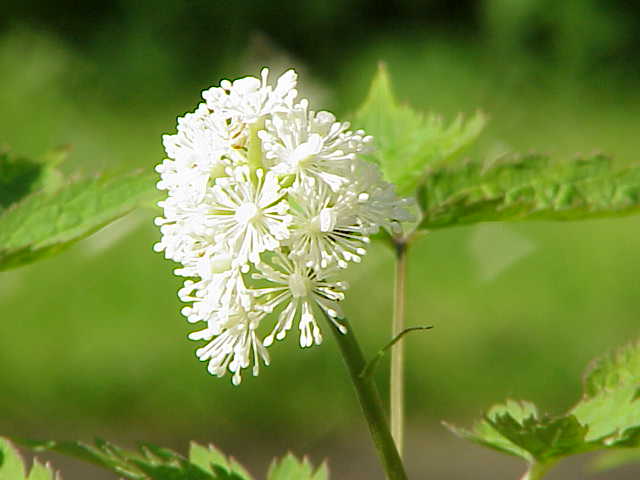
| Appearance | - Actaea racemosa is a smooth, herbaceous perennial with large compound leaves arising from an underground rhizome. English Wikipedia
- Its compound leaves have three leaflets arranged in repeated divisions and coarsely toothed margins. English Wikipedia
- Its flowers lack petals and sepals and consist of clusters of white stamens surrounding a white stigma. English Wikipedia
- The underground rhizome is dark brown to black, thick, and knobby, with large buds on its upper surface. content.ces.ncsu.edu
- Fibrous roots cover the rhizome and are generally concentrated on its lower portion. content.ces.ncsu.edu
- The leaves are large and have three pinnately compound divisions with irregularly toothed leaflets. content.ces.ncsu.edu
| - Actaea rubra is an erect, herbaceous perennial flowering plant. ohiodnr.gov
- The leaves have coarsely toothed edges and deeply lobed margins. English Wikipedia
- The undersides of the leaves commonly have hairy veins. English Wikipedia
- Each stem bears either three leaves branching near its top or three compound leaves and an upright flowering stalk. English Wikipedia
- The flowers are white and have numerous stamens. English Wikipedia
- The flowers have three to five petal-like, obovate sepals that remain after flowering. English Wikipedia
- The petals are spatulate to obovate, clawed at the base, and fall away after flowering. English Wikipedia
- The fruits are ellipsoid berries containing several seeds. English Wikipedia
- The berries become bright red or, in forma neglecta, white during mid to late summer. English Wikipedia
- The berries have a black dot on their surface. English Wikipedia
|
|---|
| Size | No checked fact yet | |
|---|
| Habitat | | - The species grows in shady areas with moist to wet soils. English Wikipedia
- It occurs in open forests and on dry slopes. English Wikipedia
- Red baneberry grows best in cool, moist, nutrient-rich locations. research.fs.usda.gov
- In southeastern Alaska, the species grows along open streambanks and in meadows within dense forest regions. research.fs.usda.gov
- In British Columbia, it grows beneath spruce forests and mixed forests containing spruce, subalpine fir, and aspen. research.fs.usda.gov
- In the northern Rocky Mountains, red baneberry occurs as an understory species in moist and very moist subalpine forests and riparian areas. research.fs.usda.gov
- In Alberta, the species grows beneath white spruce in valleys and on lower slopes. research.fs.usda.gov
- In northeastern Saskatchewan, red baneberry occurs near lake and stream margins with willows, sedges, and reedgrass. research.fs.usda.gov
- In Oregon, the species occurs in seepage areas, marshes, and other moist habitats. research.fs.usda.gov
- The species grows best on organic and acidic soils at least 51 centimeters deep. research.fs.usda.gov
|
|---|
| Behaviour | - The flowers have a sweet but unpleasant smell that attracts flies, gnats, and beetles. English Wikipedia
- The mature seed capsules produce a rattling sound when shaken. content.ces.ncsu.edu
| - Red baneberry plants grow slowly and require several years to become large enough to flower. English Wikipedia
- Grazing animals rarely consume the foliage. English Wikipedia
|
|---|
| Reproduction | | |
|---|
| Distribution | - The species is native to eastern North America, extending from southern Ontario to central Georgia and westward to Missouri and Arkansas. English Wikipedia
- Its documented native range extends from Maine and Ontario south to Georgia and west to Missouri and Indiana. content.ces.ncsu.edu
- In North Carolina, the species occurs at elevations reaching 4,000 feet and is most common in the western part of the state. content.ces.ncsu.edu
- Black cohosh is described as a perennial plant native to North America. ods.od.nih.gov
| - Red baneberry occurs in moist woods across the Northern Temperate Zone of North America and Eurasia. research.fs.usda.gov
- Its western North American range extends from Alaska through California and the Rocky Mountains to Arizona and New Mexico. research.fs.usda.gov
- Across northern North America, the species occurs from the West Coast to New England and Labrador. research.fs.usda.gov
|
|---|
| Conservation | - Most commercial black cohosh materials are harvested from wild populations. English Wikipedia
| - NatureServe classified red baneberry as globally secure (G5) in its 2016 assessment. English Wikipedia
- NatureServe classified the species as locally vulnerable (S3) in Arizona, Illinois, and the Yukon Territory. English Wikipedia
- NatureServe classified the species as imperiled (S2) in Ohio and Pennsylvania. English Wikipedia
- NatureServe classified the species as critically imperiled (S1) in Indiana and Rhode Island. English Wikipedia
|
|---|
| Uses | - Native Americans traditionally used the plant's roots and rhizomes medicinally. English Wikipedia
- Extracts from the species are manufactured into herbal medicines and dietary supplements. English Wikipedia
- The underground rhizomes and roots are the principal plant parts used in herbal medicine. English Wikipedia
- Native Americans used the species to address gynecological problems and snake bites. content.ces.ncsu.edu
- Nineteenth-century physicians used the plant to treat fever, menstrual cramps, and arthritis. content.ces.ncsu.edu
- Traditional and folk applications included treating sore throats and bronchitis. content.ces.ncsu.edu
- The plant has been used as an alternative to conventional hormone replacement therapy for menopause and premenstrual syndrome. content.ces.ncsu.edu
- The species has received approval as an herbal medicine in several European countries and in China, Malaysia, Thailand, and Argentina. English Wikipedia
| - Red baneberry is cultivated in shade gardens for its attractive berries and upright clump-forming growth habit. English Wikipedia
|
|---|
| Similar species | - Blue cohosh is not closely related to black cohosh and belongs to the Berberidaceae family. English Wikipedia
| - Red baneberry can be confused with mountain sweetroot (Osmorhiza chilensis). English Wikipedia
- Mountain sweetroot can be distinguished from red baneberry by its strong anise-like odor. English Wikipedia
|
|---|
| Other | No checked fact yet | |
|---|