Species · Flowering plants
Black Cohosh Actaea racemosa
The scientific name of the Black Cohosh is Actaea racemosa. It is a species of flowering plant in the family Ranunculaceae (crowfoot family), order Ranunculales.
- Scientific name
- Actaea racemosa L.
- Common name
- Black Cohosh
- Genus
- Actaea
- Family
- Ranunculaceae (Crowfoot Family)
- Order
- Ranunculales
- Class
- Magnoliopsida
- Recorded in
- 3 countries
- Name status
- accepted in the Catalogue of Life

Overview
Black cohosh (Actaea racemosa L.) is a flowering perennial plant in the Ranunculaceae family, order Ranunculales, and class Magnoliopsida. It is native to eastern North America, where it grows in rich woodland habitats and small woodland openings. It is marked by large compound leaves, tall flowering stems bearing white flowers, and a dark, thick underground rhizome.
Written 26 November 2026 from the sources listed below. Each statement was checked against the passage it cites; statements that could not be supported were removed.
Appearance
Black cohosh is a smooth, herbaceous perennial with large compound leaves arising from an underground rhizome. The leaves have three pinnately compound divisions, irregularly toothed leaflets, and coarsely toothed margins.[1][2][3]
The underground rhizome is dark brown to black, thick, and knobby, with large buds on its upper surface. Fibrous roots cover the rhizome and are generally concentrated on its lower portion.[4][5]
Reproduction and life cycle
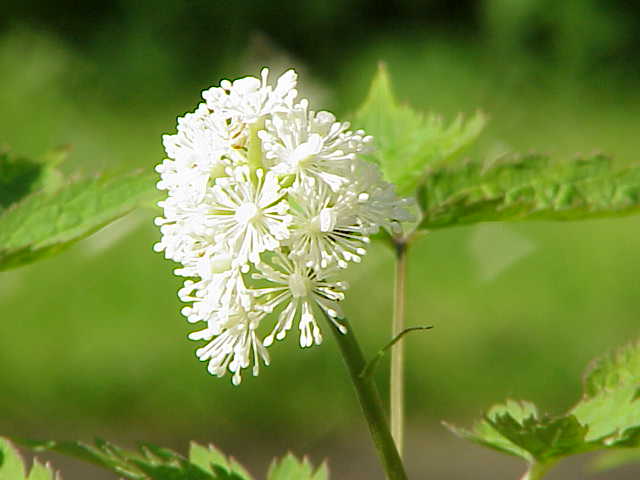
The flowering stems produce racemes measuring up to 50 cm long and reach approximately 75–250 cm in height. The flowers are cream to white and grow in tall plumes on wand-like stalks.[6][7][8]
The plant produces dry follicles measuring approximately 5–10 mm long, each containing several seeds. Seeds develop inside capsules from August through October.[9][10]
The species can be propagated by dividing underground rhizomes in spring or fall. Seed propagation requires alternating warm, cold, and warm temperatures to break dormancy, and average seed germination is approximately 20%.[11][12][13]
A rhizome may contain 15 or more buds. Plants propagated from rhizome divisions can produce harvestable roots faster than plants started from seed.[14][15]
Habitat
Black cohosh grows in various woodland habitats, particularly rich woodlands and small woodland openings. It also grows well along forest edges.[16][17][18]
The species generally grows in shaded or partially shaded natural habitats, although it can tolerate full sun. It prefers rich, moist soil containing substantial organic matter.[19][20]
Soils with a pH between 5 and 6 are considered ideal for cultivation.[21]
Behaviour
The flowers have a sweet but unpleasant smell that attracts flies, gnats, and beetles. Mature seed capsules produce a rattling sound when shaken.[22][23]
Uses
Native Americans traditionally used the roots and rhizomes medicinally, including to address gynecological problems and snake bites. Nineteenth-century physicians used the plant to treat fever, menstrual cramps, and arthritis.[24][25][26]
Traditional and folk applications included treating sore throats and bronchitis. The plant has also been used as an alternative to conventional hormone replacement therapy for menopause and premenstrual syndrome.[27][28]
Extracts from black cohosh are manufactured into herbal medicines and dietary supplements. The underground rhizomes and roots are the principal plant parts used in herbal medicine.[29][30]
The species has received approval as an herbal medicine in several European countries and in China, Malaysia, Thailand, and Argentina.[31]
Conservation
Most commercial black cohosh materials are harvested from wild populations.[32]
Similar species
Blue cohosh is not closely related to black cohosh and belongs to the Berberidaceae family.[33]
Classification of the Black Cohosh
| Kingdom | Plantae |
|---|---|
| Subkingdom | Pteridobiotina |
| Phylum | Tracheophyta |
| Class | Magnoliopsida |
| Order | Ranunculales |
| Family | Ranunculaceae (Crowfoot Family) |
| Subfamily | Ranunculoideae |
| Tribe | Helleboreae |
| Genus | Actaea (Cohosh) |
| Species | Actaea racemosa L. |
Where the Black Cohosh is found
Checklists and occurrence records place Actaea racemosa in 3 countries across Europe and North America. GBIF holds 11,342 georeferenced records of it.
Countries where it is native or its origin is not stated
Countries where it has been introduced
Regions and cities with the most records
- Pennsylvania, United States 1,815
- Virginia, United States 1,588
- North Carolina, United States 1,082
- Ohio, United States 600
- New York, United States 519
- Maryland, United States 509
- Tennessee, United States 507
- Georgia, United States 306
- New Jersey, United States 281
- West Virginia, United States 239
- McLean, United States 214
- Bethesda, United States 198
- Tysons, United States 191
- Idylwood, United States 189
- Arlington, United States 188
- Front Royal, United States 187
- Potomac, United States 187
- West Falls Church, United States 183
- Limerick, United States 182
- Shaw, United States 181
- Brightwood, United States 179
- Merrifield, United States 179
- Kentucky, United States 178
- Mount Vernon Triangle, United States 178
- Adams Morgan, United States 177
- Langley Park, United States 177
- Mount Pleasant, United States 177
- Northwest One, United States 177
- Silver Spring, United States 177
- Downtown DC, United States 176
- Chillum, United States 175
- NoMa, United States 175
- Baileys Crossroads, United States 174
- Foggy Bottom, United States 173
- Vienna, United States 173
- Central 14th Street / Spring Road, United States 172
5 more countries have a few records outside this range
These countries hold a few records of Actaea racemosa but lie outside the range the checklists give for it. Such records are often zoo or garden specimens, museum material or vagrants, so the species is not counted as occurring there.
Range as the checklists state it
Germany [I]; Canada (Ontario, Québec); USA (Alabama, Arkansas, Connecticut, District of Columbia, Delaware, Georgia, Iowa, Illinois, Indiana, Kentucky, Massachusetts, Maryland, Maine, Michigan, Missouri, Mississippi, North Carolina, New Jersey, New York, Ohio, Pennsylvania, South Carolina, Tennessee, Virginia, West Virginia)
A number beside a place is its count of GBIF occurrence records. A place without a number comes from a checklist alone. Records show where a species has been observed or collected, which can include escapes and vagrants.
Common names
English
- Black Cohosh
- Black Baneberry
- Black Snakeroot
Names in 4 other languages
- Chinese
- 总序类叶升麻
- Finnish
- tähkäkimikki
- French
- cimicaire à grappes
- Swedish
- läkesilverax
Synonyms
15 other scientific names have been used for this species and are now treated as synonyms of Actaea racemosa.
- Actaea gyrostachya Wender.
- Actaea monogyna Walter
- Actaea orthostachya Wender.
- Actaea racemosa var. racemosa
- Botrophis actaeoides Raf. ex Fisch. & C.A.Mey.
- Botrophis pumila Raf.
- Botrophis serpentaria Raf.
- Cimicifuga racemosa (L.) Nutt.
- Cimicifuga serpentaria Pursh
- Cimicifuga serpentaria var. orthostachya Wender.
- Macrotrys actaeoides Raf.
- Macrotrys racemosa (L.) Sweet
- Megotrys serpentaria Raf.
- Thalictrodes racemosa (L.) Kuntze
- Cimicifuga americana Muhl. ambiguous synonym
Subspecies and varieties
- Actaea racemosa var. dissecta variety
Related species
-
 White BaneberryActaea pachypoda
-
 Red BaneberryActaea rubra
-
 BaneberryActaea spicata
-
 Summer CohoshActaea podocarpa
-
 Actaea elata
-
 Actaea japonica
-
 Actaea heracleifolia
-
 Appalachian Black CohoshActaea rubifolia
Compare
Questions and answers
What is the scientific name of the Black Cohosh?
The scientific name of the Black Cohosh is Actaea racemosa. Written with its author, the full name is Actaea racemosa L..
Which family does the Black Cohosh belong to?
Actaea racemosa belongs to the family Ranunculaceae, in the order Ranunculales and the class Magnoliopsida.
Where is the Black Cohosh found?
Checklists and occurrence records place Actaea racemosa in 3 countries, including United States and Canada.
What other names does the Black Cohosh have?
Actaea racemosa is also known in English as Black Baneberry and Black Snakeroot.
Where does black cohosh grow?
Black cohosh is native to eastern North America, with a documented range extending from Maine and Ontario south to Georgia and west to Missouri and Indiana. It grows in rich woodlands, small woodland openings, and along forest edges. In North Carolina, it occurs at elevations reaching 4,000 feet and is most common in the western part of the state.[16][34][35][18]
What did Native Americans use black cohosh for?
Native Americans traditionally used its roots and rhizomes medicinally to address gynecological problems and snake bites.[24][25]
Does black cohosh like sun or shade?
Black cohosh generally grows in shaded or partially shaded natural habitats, although it can tolerate full sun.[19]
Sources
Passages the profile rests on
- Actaea racemosa is a smooth, herbaceous perennial with large compound leaves arising from an underground rhizome. Source passage: “Black cohosh is a smooth (glabrous) herbaceous perennial plant that produces large, compound leaves from an underground rhizome” — English Wikipedia
- Its compound leaves have three leaflets arranged in repeated divisions and coarsely toothed margins. Source passage: “forming repeated sets of three leaflets (tripinnately compound) having a coarsely toothed (serrated) margin.” — English Wikipedia
- The leaves are large and have three pinnately compound divisions with irregularly toothed leaflets. Source passage: “The leaves are large with three pinnately compound divisions and irregularly toothed leaflets.” — content.ces.ncsu.edu
- The underground rhizome is dark brown to black, thick, and knobby, with large buds on its upper surface. Source passage: “The underground rhizome is dark brown to black in color; is thick and knobby; and produces large buds on the upper surface.” — content.ces.ncsu.edu
- Fibrous roots cover the rhizome and are generally concentrated on its lower portion. Source passage: “The rhizomes are covered with fibrous roots which are usually concentrated on the bottom portion of the rhizome.” — content.ces.ncsu.edu
- The flowering stems produce racemes measuring up to 50 cm long. Source passage: “forming racemes up to 50 cm (20 in) long.” — English Wikipedia
- The flowering stems reach approximately 75–250 cm in height. Source passage: “The flowers are produced in late spring and early summer on a tall stem, 75–250 cm (30–98 in) tall” — English Wikipedia
- The plant produces cream to white flowers in tall plumes on wand-like stalks. Source passage: “Tall plumes of cream to white flowers, on wand-like flower stalks” — content.ces.ncsu.edu
- The plant produces dry follicles measuring approximately 5–10 mm long, each containing several seeds. Source passage: “The fruit is a dry follicle 5–10 mm (0.20–0.39 in) long, with one carpel, containing several seeds.” — English Wikipedia
- Seeds develop inside capsules from August through October. Source passage: “From August to October, seeds develop in capsules” — content.ces.ncsu.edu
- The species can be propagated by dividing underground rhizomes in spring or fall. Source passage: “Black cohosh is most easily propagated by dividing the underground rhizomes in spring or fall.” — content.ces.ncsu.edu
- Seed propagation requires exposure to alternating warm, cold, and warm temperatures to break dormancy. Source passage: “Black cohosh seed have a dormancy that must be broken by exposure to a warm-cold-warm stratification cycle.” — content.ces.ncsu.edu
- Average seed germination is approximately 20%. Source passage: “average seed germination is often about 20%.” — content.ces.ncsu.edu
- A rhizome may contain 15 or more buds. Source passage: “There can be up to 15 buds or more on the rhizome of one black cohosh plant.” — content.ces.ncsu.edu
- Plants propagated from rhizome divisions can produce harvestable roots faster than plants started from seed. Source passage: “rhizome divisions provide a more reliable and uniform plant stand and allow for a faster harvestable root.” — content.ces.ncsu.edu
- The species grows in various woodland habitats and is frequently found in small woodland openings. Source passage: “It grows in a variety of woodland habitats, and is often found in small woodland openings.” — English Wikipedia
- The species naturally occurs in rich woodlands. Source passage: “a native medicinal plant found in rich woodlands” — content.ces.ncsu.edu
- The species grows well along forest edges. Source passage: “Black cohosh grows well on the forest edge.” — content.ces.ncsu.edu
- The species generally grows in shaded or partially shaded natural habitats, although it can tolerate full sun. Source passage: “In its natural habitat, it is usually found in shaded or partially shaded areas, although it will grow in full sun.” — content.ces.ncsu.edu
- The plant prefers rich, moist soil containing substantial organic matter. Source passage: “Black cohosh prefers a rich, moist, soil that is high in organic matter.” — content.ces.ncsu.edu
- Soils with a pH between 5 and 6 are considered ideal for cultivation. Source passage: “Soils with pH of 5 to 6 are ideal for growing black cohosh.” — content.ces.ncsu.edu
- The flowers have a sweet but unpleasant smell that attracts flies, gnats, and beetles. Source passage: “The flowers have a distinctly sweet, fetid smell that attracts flies, gnats, and beetles.” — English Wikipedia
- The mature seed capsules produce a rattling sound when shaken. Source passage: “that make a rattling sound when shaken.” — content.ces.ncsu.edu
- Native Americans traditionally used the plant's roots and rhizomes medicinally. Source passage: “The roots and rhizomes are used in traditional medicine by Native Americans.” — English Wikipedia
- Native Americans used the species to address gynecological problems and snake bites. Source passage: “Native Americans used black cohosh for a variety of medical conditions ranging from gynecological problems to snake bites.” — content.ces.ncsu.edu
- Nineteenth-century physicians used the plant to treat fever, menstrual cramps, and arthritis. Source passage: “Physicians made use of it in the 19th century to treat fever, menstrual cramps, and arthritis.” — content.ces.ncsu.edu
- Traditional and folk applications included treating sore throats and bronchitis. Source passage: “Other traditional and folk uses were for treatment of sore throats and bronchitis.” — content.ces.ncsu.edu
- The plant has been used as an alternative to conventional hormone replacement therapy for menopause and premenstrual syndrome. Source passage: “In recent years, this material has been used as an alternative to mainstream hormone replacement therapy for treatment of menopause and premenstrual syndrome.” — content.ces.ncsu.edu
- Extracts from the species are manufactured into herbal medicines and dietary supplements. Source passage: “Its extracts are manufactured as herbal medicines or dietary supplements.” — English Wikipedia
- The underground rhizomes and roots are the principal plant parts used in herbal medicine. Source passage: “Extracts from the underground parts of the plant — the rhizome (Cimicifugae racemosae rhizoma) and the root (Cimicifugae racemosae radix) — are used in herbal medicine.” — English Wikipedia
- The species has received approval as an herbal medicine in several European countries and in China, Malaysia, Thailand, and Argentina. Source passage: “Black cohosh products have received regulatory approval as herbal medicines across much of Europe, as well as in China, Malaysia, Thailand, Argentina, and several other countries.” — English Wikipedia
- Most commercial black cohosh materials are harvested from wild populations. Source passage: “Most black cohosh materials are harvested from the wild.” — English Wikipedia
- Blue cohosh is not closely related to black cohosh and belongs to the Berberidaceae family. Source passage: “Blue cohosh (Caulophyllum thalictroides), despite its similar common name belongs to another family, the Berberidaceae, is not closely related to black cohosh” — English Wikipedia
- Its documented native range extends from Maine and Ontario south to Georgia and west to Missouri and Indiana. Source passage: “from as far north as Maine and Ontario, south to Georgia, and west to Missouri and Indiana.” — content.ces.ncsu.edu
- In North Carolina, the species occurs at elevations reaching 4,000 feet and is most common in the western part of the state. Source passage: “In North Carolina it can be found at elevations up to 4,000 feet and is most common in the western part of the state.” — content.ces.ncsu.edu
Data
- Catalogue of Life, 2026-10-16 XR cc by
- Global Biodiversity Information Facility CC BY 4.0
- Wikidata CC0
- GeoNames CC BY 4.0
- Wikimedia Commons per image; credit shown with each image
- Within the Catalogue of Life, this name comes from Synonymic Checklists of the Vascular Plants of the World cc by
References
- L. (1753). Sp. Pl. [Linnaeus] 1: 504 (1753). where the name was published
This species in other databases
Page built on 26 November 2026. See how the catalog is made and all sources and licences.
Cite this page
ScientificNames.org. (2026). Actaea racemosa (Black Cohosh). Retrieved November 26, 2026, from https://scientificnames.org/species/actaea-racemosa
“Actaea racemosa (Black Cohosh).” ScientificNames.org, 2026, scientificnames.org/species/actaea-racemosa. Accessed 26 Nov. 2026.
ScientificNames.org. “Actaea racemosa (Black Cohosh).” Accessed November 26, 2026. https://scientificnames.org/species/actaea-racemosa.
@misc{scientificnames_actaea_racemosa_black_cohosh,
  author = {{ScientificNames.org}},
  title = {Actaea racemosa (Black Cohosh)},
  year = {2026},
  url = {https://scientificnames.org/species/actaea-racemosa},
  note = {Accessed 2026-11-26}
}