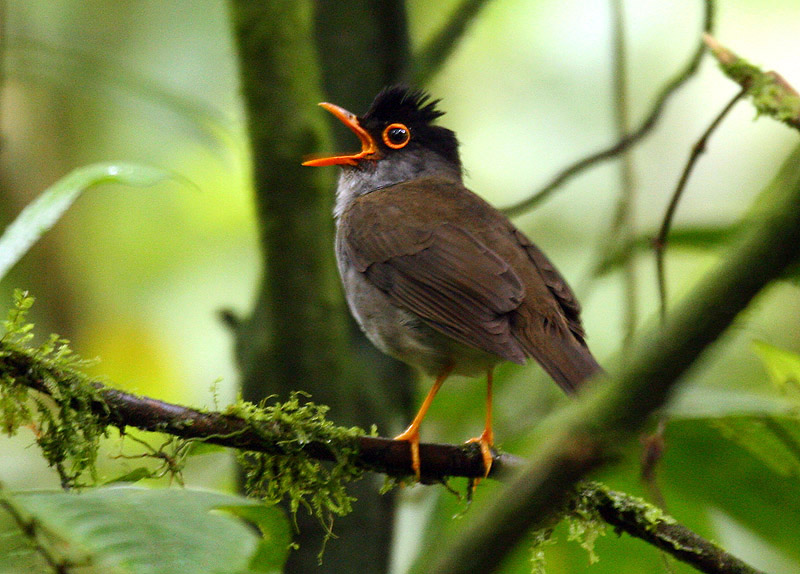
| Appearance | - Adult males of the nominate subspecies have a black crown, dark gray face, bright orange eye-ring, and olive-brown upperparts. English Wikipedia
- Adult males have a white throat with faint dark streaks, pale grayish brown breast and flanks, and a white belly and vent. English Wikipedia
- Adult females have a browner head and breast than adult males. English Wikipedia
- All subspecies have bright orange bills, legs, and feet. English Wikipedia
- The species has a plain breast. ebird.org
- The C. m. cantator subspecies has a grayer face and throat and an olive wash on its breast compared with the nominate subspecies. English Wikipedia
- The C. m. yaegeri subspecies has a pronounced reddish wash on its back. English Wikipedia
- The C. m. carrikeri subspecies has dark reddish upperparts and the darkest gray underparts among the subspecies. English Wikipedia
| - The Veery has a plump body, a round head, a straight narrow bill, and relatively long wings and legs. pages.vassar.edu
- Adult Veeries have predominantly light brown upperparts and white underparts with a light tawny, faintly spotted breast. English Wikipedia
- Veeries have pink legs and a poorly defined eye ring. English Wikipedia
- Veeries have a faint white ring around their eyes. pages.vassar.edu
- Eastern Veeries have more cinnamon-colored upperparts, whereas western individuals have more olive-brown upperparts. English Wikipedia
- There is little to no difference in appearance between male and female Veeries. pages.vassar.edu
|
|---|
| Size | | |
|---|
| Habitat | - The species primarily inhabits lowland and montane evergreen forests in tropical and subtropical zones. English Wikipedia
- The species also occurs in pine-oak forests in Guatemala and Honduras. English Wikipedia
- The species inhabits evergreen forests in foothills and highlands. ebird.org
- One reported elevational range for the species is 600–1,800 m. English Wikipedia
- In Guatemala and Honduras, the reported elevational range is 750–1,800 m. English Wikipedia
- In Costa Rica, the species occurs at elevations of 300–1,000 m on the Caribbean slope. English Wikipedia
- In Costa Rica, the species occurs at elevations of 700–1,300 m on the Pacific slope. English Wikipedia
| - Veeries breed in humid deciduous forests across southern Canada and the northern United States. English Wikipedia
- Breeding habitat includes dense understory vegetation near water sources such as streams. English Wikipedia
- Veeries prefer deciduous forests in riparian regions. pages.vassar.edu
- Where rivers are absent, Veeries seek wetlands and damp regions. pages.vassar.edu
- Veeries favor habitats with abundant understory vegetation. pages.vassar.edu
|
|---|
| Diet | | |
|---|
| Behaviour | - The species forages in the forest understory and on the ground by turning over leaf litter. English Wikipedia
- The species is usually elusive and is heard more frequently than it is seen. ebird.org
- The species is mostly resident throughout the year. English Wikipedia
- Individuals in the northernmost part of the range show evidence of moving south during winter. English Wikipedia
- Elevational movements have been recorded in Veracruz. English Wikipedia
- The species sings mainly at dawn, dusk, and during the afternoon. English Wikipedia
- The species produces a rapid, thin, flute-like song with slightly tinny and fuzzy phrases. English Wikipedia
- The species gives harsh, complaining, upward-slurred calls. English Wikipedia
- The species produces a dry rattle or trill when agitated. English Wikipedia
- The species behaves aggressively toward ruddy-capped nightingale-thrushes. English Wikipedia
| - Veeries forage primarily on the forest floor by turning over leaves to uncover insects. English Wikipedia
- Veeries sometimes catch insects while flying. English Wikipedia
- Veeries also use fly-catching while hovering in the air to search for insects. pages.vassar.edu
- Male Veeries arrive at breeding grounds before females to establish territories. pages.vassar.edu
- Male Veeries use calls rather than songs to establish territorial boundaries. pages.vassar.edu
- Male Veeries defend their territories through chasing, bill snapping, wing or tail flicking, and high-pitched whistles. pages.vassar.edu
- Mature male Veeries may tolerate juvenile males nesting within their territories. pages.vassar.edu
- Male Veeries defend their territories vigorously against intruding males of the same age. pages.vassar.edu
- Veeries reduce their singing rate and duration when exposed to barred owl playback. English Wikipedia
- Veeries produce a flute-like song that spirals downward in pitch. English Wikipedia
- The most common Veery call is a harsh, descending sound represented as vee-er. English Wikipedia
|
|---|
| Reproduction | - The breeding season includes April and May in Mexico. English Wikipedia
- The breeding season extends from March through July in Costa Rica. English Wikipedia
- The species constructs a large cup-shaped nest from mosses, bark strips, and rootlets, lined with finer plant material. English Wikipedia
- The nest is typically placed in an understory plant fork approximately 1–3 m above the ground. English Wikipedia
- The species often places its nest near a stream. English Wikipedia
- The clutch contains two or three eggs. English Wikipedia
- The eggs range from pinkish white to bluish white and have reddish-brown speckles. English Wikipedia
| - Veeries construct cup-shaped nests on the ground or near the base of shrubs. English Wikipedia
- Veery nests consist of outer, inner, and lining layers. English Wikipedia
- Veery nests contain three to five greenish-blue eggs, which may have brown spots. English Wikipedia
- Female Veeries incubate their eggs for 10–14 days. English Wikipedia
- Both Veery parents feed their nestlings. English Wikipedia
- Young Veeries leave the nest approximately 10–12 days after hatching. English Wikipedia
- Female Veeries undertake nest construction. pages.vassar.edu
- In a study of six Veery nests, females tended single broods while males cared for nestlings in as many as three nests. pages.vassar.edu
- A study of six Veery nests found that five had more than one male caring for nestlings. pages.vassar.edu
- Veeries may exhibit polyandrous, monogamous, or other variable mating relationships. pages.vassar.edu
|
|---|
| Distribution | - The species occurs in Costa Rica, Guatemala, Honduras, Mexico, Nicaragua, and Panama. English Wikipedia
- The species has been recorded as a vagrant in Texas. English Wikipedia
- An individual of the nominate subspecies spent much of 2004 in Hidalgo County, Texas. English Wikipedia
| |
|---|
| Conservation | - The species is classified as Least Concern by the IUCN. English Wikipedia
- The species has a large geographic range, although its population size is unknown and believed to be decreasing. English Wikipedia
- No immediate threats have been identified for the species. English Wikipedia
- The species is considered common in Oaxaca and locally fairly common in Panama. English Wikipedia
- The species is rare and local in Guatemala but common in Honduras. English Wikipedia
- The species is common on Costa Rica's Caribbean slope and uncommon on its Pacific slope. English Wikipedia
| - The Montana Field Guide assigns the Veery a state breeding rank of S3B. fieldguide.mt.gov
- Veery populations declined across most of their range between 1966 and 2013 according to breeding bird survey trends. English Wikipedia
- Potential threats to Veeries include brown-headed cowbird nest parasitism, climate change, and alteration of Amazonian lowland forests. English Wikipedia
- Loss of woodland habitat is identified as a potential threat to Veeries. English Wikipedia
|
|---|
| Similar species | No checked fact yet | - The Veery belongs to a group of closely related species that includes the gray-cheeked thrush, Bicknell's thrush, Swainson's thrush, and hermit thrush. English Wikipedia
|
|---|
| Name origin | No checked fact yet | |
|---|