Species · Birds
Veery Catharus fuscescens
The scientific name of the Veery is Catharus fuscescens. It is a species of bird in the family Turdidae (thrush), order Passeriformes. The name dates from 1817.
- Scientific name
- Catharus fuscescens (Stephens, 1817)
- Common name
- Veery
- Genus
- Catharus
- Family
- Turdidae (Thrush)
- Order
- Passeriformes
- Class
- Aves
- Red List category
- LC Least Concern
- Environment
- terrestrial
- Recorded in
- 22 countries
- Name status
- accepted in the Catalogue of Life

Overview
Catharus fuscescens has light brown upperparts, white underparts, and a light tawny, faintly spotted breast.
Written 26 November 2026 from the sources listed below. Each statement was checked against the passage it cites; statements that could not be supported were removed.
Appearance
The Veery has a plump body, a round head, a straight narrow bill, and relatively long wings and legs. Adults have predominantly light brown upperparts and white underparts with a light tawny, faintly spotted breast.[1][2]
Veeries have pink legs and a faint white ring around their eyes. There is little to no difference in appearance between males and females.[3][4][5]
Eastern Veeries have more cinnamon-colored upperparts, whereas western individuals have more olive-brown upperparts.[6]
Veeries measure 16–19.5 cm in body length and typically weigh 26–39 g, with exceptional individuals reaching 54 g. Their average wingspan is 28.5 cm, and their tarsus measures 2.7–3.25 cm.[7][8][9][10]
Habitat
Veeries breed in humid deciduous forests across southern Canada and the northern United States. They prefer deciduous forests in riparian regions, particularly areas with dense understory vegetation near streams.[11][12][13][14]
Where rivers are absent, Veeries seek wetlands and damp regions.[15]
Diet
Veeries primarily eat insects and berries. Insects are a major food source during the breeding season, while fruit and berries make up most of their diet during late summer and fall.[16][17][18]
Behaviour
Veeries forage primarily on the forest floor by turning over leaves to uncover insects. They sometimes catch insects while flying or hovering in the air.[19][20][21]
Male Veeries arrive at breeding grounds before females to establish territories. They use calls rather than songs to establish territorial boundaries.[22][23]
Male Veeries defend their territories through chasing, bill snapping, wing or tail flicking, and high-pitched whistles. Mature males may tolerate juvenile males nesting within their territories but defend vigorously against intruding males of the same age.[24][25][26]
Veeries produce a flute-like song that spirals downward in pitch. Their most common call is a harsh, descending sound represented as vee-er.[27][28]
Veeries reduce their singing rate and duration when exposed to barred owl playback.[29]
Reproduction and life cycle
Female Veeries construct cup-shaped nests on the ground or near the base of shrubs. The nests consist of outer, inner, and lining layers.[30][31][32]
Veery nests contain three to five greenish-blue eggs, which may have brown spots. Females incubate their eggs for 10–14 days.[33][34]
Both parents feed their nestlings. Young Veeries leave the nest approximately 10–12 days after hatching.[35][36]
Veeries may exhibit polyandrous, monogamous, or other variable mating relationships. In a study of six nests, females tended single broods while males cared for nestlings in as many as three nests.[37][38]
A study of six Veery nests found that five had more than one male caring for nestlings.[39]
Conservation
Veery populations declined across most of their range between 1966 and 2013 according to breeding bird survey trends.[40]
Potential threats to Veeries include brown-headed cowbird nest parasitism, climate change, alteration of Amazonian lowland forests, and loss of woodland habitat.[41][42]
The Montana Field Guide assigns the Veery a state breeding rank of S3B.[43]
Similar species
The Veery belongs to a group of closely related species that includes the gray-cheeked thrush, Bicknell's thrush, Swainson's thrush, and hermit thrush.[44]
Classification of the Veery
| Kingdom | Animalia |
|---|---|
| Phylum | Chordata |
| Subphylum | Vertebrata |
| Infraphylum | Gnathostomata |
| Parvphylum | Osteichthyes |
| Megaclass | Tetrapoda |
| Class | Aves (Bird) |
| Order | Passeriformes (Passerine) |
| Family | Turdidae (Thrush) |
| Genus | Catharus (American Thrushes) |
| Species | Catharus fuscescens (Stephens, 1817) |
Where the Veery is found
Checklists and occurrence records place Catharus fuscescens in 22 countries across North America. GBIF holds 1,358,221 georeferenced records of it.
Countries
- Aruba 3
- Bahamas 29
- Belize 592
- Bermuda 45
- Bonaire, Saint Eustatius and Saba 8
- Brazil 499
- Canada 396,012
- Cayman Islands 26
- Colombia 2,210
- Costa Rica 793
- Cuba 123
- Curacao 8
- Dominican Republic 10
- Guatemala 47
- Honduras 59
- Jamaica 3
- Mexico 397
- Nicaragua 68
- Panama 612
- Puerto Rico 3
- Saint Pierre and Miquelon 14
- United States 956,660
Regions and cities with the most records
- Quebec, Canada 182,181
- Ontario, Canada 164,288
- New York, United States 162,661
- Pennsylvania, United States 78,880
- Massachusetts, United States 70,027
- Wisconsin, United States 60,681
- Vermont, United States 49,874
- Michigan, United States 49,716
- Connecticut, United States 47,761
- Ohio, United States 47,542
- New Jersey, United States 45,751
- Minnesota, United States 43,207
- Maine, United States 42,385
- Union City, United States 35,574
- Secaucus, United States 35,259
- Cliffside Park, United States 34,813
- North Bergen, United States 34,788
- West New York, United States 34,787
- Illinois, United States 34,546
- North Arlington, United States 33,903
- Newark, United States 33,788
- Harrison, United States 33,722
- Kearny, United States 33,470
- New York City, United States 32,931
- Manhattan, United States 32,719
- Hoboken, United States 32,647
- New Hampshire, United States 31,925
- Jersey City, United States 31,787
- Queens, United States 31,535
- Brooklyn, United States 31,479
- Bayonne, United States 30,889
- Fort Lee, United States 25,046
- Palisades Park, United States 24,063
- Rutherford, United States 23,726
- Belleville, United States 23,610
- Lyndhurst, United States 23,423
11 more countries have a few records outside this range
These countries hold a few records of Catharus fuscescens but lie outside the range the checklists give for it. Such records are often zoo or garden specimens, museum material or vagrants, so the species is not counted as occurring there.
Range as the checklists state it
North America
Caribbean
A number beside a place is its count of GBIF occurrence records. A place without a number comes from a checklist alone. Records show where a species has been observed or collected, which can include escapes and vagrants.
Common names
English
- Veery
- Tawny Thrush
- Wilson's Thrush
Names in 38 other languages
- Breton
- Milc'hwid rous
- Bulgarian
- Върбов дрозд
- Catalan
- Griveta bruna, griveta canyella
- Chinese
- 棕夜鸫, 棕色夜鶇
- Croatian
- kestenjasti drozd
- Czech
- drozd hnědavý
- Danish
- Rustrygget Skovdrossel, Skovdrossel
- Esperanto
- rusta turdo
- Estonian
- väikerästas
- Finnish
- Viirirastas, viitarastas
- French
- Grive fauve
- German
- Dickicht-Musendrossel, Weidenmusendrossel, Wilsondrossel
- Hebrew
- קיכלי חלוד-גב
- Hungarian
- Víri, vörhenyes fülemülerigó
- Icelandic
- Húmþröstur
- Irish
- Smólach odhar
- Italian
- Tordo usignolo bruno
- Japanese
- ビリアチャツグミ, ビリーチャツグミ
- Latvian
- rūsganais strazds
- Lithuanian
- Trumpasnapis strazdas, rudagalvis trumpasnapis strazdas
- Northern Sami
- Joranrásttis
- Norwegian
- viriskogtrost
- Norwegian Bokmål
- Veeryskogstrost
- Papiamento
- Chuchubi Garganta Hel
- Polish
- drozdek brunatny
- Portuguese
- Tordo-ruivo-americano, sabiazinho-norte-americano, sabiá-norte-americano, tordo-fulvo
- Russian
- Бурый короткоклювый дрозд, Бурый соловьиный дрозд, Веери
- Scottish Gaelic
- Veeree
- Serbian
- Viri drozdić
- Slovak
- drozd hnedkavý
- Slovenian
- obvodni cikovtnik
- Spanish
- Zorzal Canelo, Zorzal Dorsirrojizo, Zorzal Migratorio Colorado, Zorzal rojizo, Zorzal tropical, Zorzalito rojizo
- Swedish
- rostskogstrast
- Turkish
- Esmer Ardıç, Esmer Bülbül Ardıcı
- Ukrainian
- дрізд-короткодзьоб бурий
- Welsh
- brych llwyd bach
- grn
- Havía
- hat
- Griv pal
Synonyms
3 other scientific names have been used for this species and are now treated as synonyms of Catharus fuscescens.
- Hylocichla fuscescens Stephens, JF, 1817
- Hylocichla fuscescens fuscescens (Stephens, 1817)
- Turdus fuscescens Stephens, 1817
Subspecies and varieties
- Catharus fuscescens fuliginosus (Newfoundland Veery) subspecies
- Catharus fuscescens fuscescens (North-Eastern Veery) subspecies
- Catharus fuscescens salicicola (Willow Thrush) subspecies
- Catharus fuscescens subpallidus subspecies
Related species
-
 Hermit ThrushCatharus guttatus
-
 Swainson's ThrushCatharus ustulatus
-
 Bicknell's ThrushCatharus bicknelli
-
 Gray-cheeked ThrushCatharus minimus
-
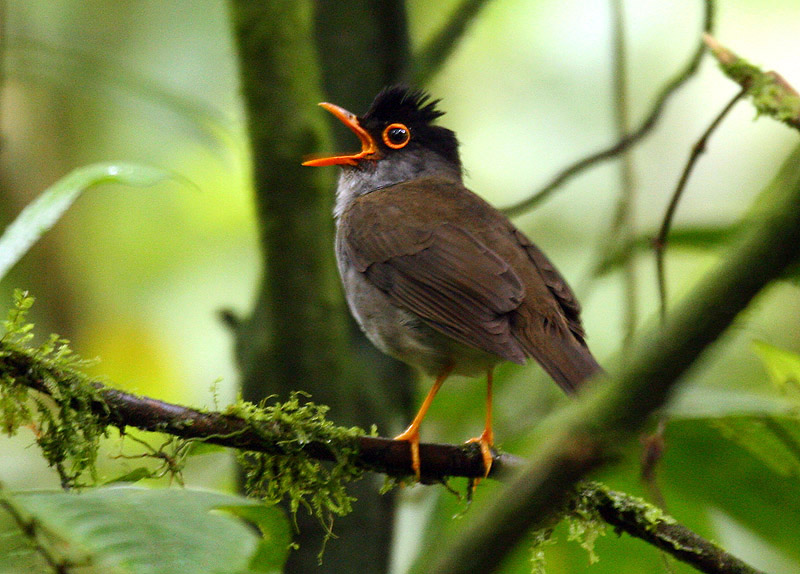 Black-headed Nightingale-thrushCatharus mexicanus
-
 Orange-billed Nightingale-thrushCatharus aurantiirostris
-
 Slaty-backed Nightingale-thrushCatharus fuscater
-
 Black-billed Nightingale-thrushCatharus gracilirostris
Compare
Questions and answers
What is the scientific name of the Veery?
The scientific name of the Veery is Catharus fuscescens. Written with its author, the full name is Catharus fuscescens (Stephens, 1817).
Which family does the Veery belong to?
Catharus fuscescens belongs to the family Turdidae, in the order Passeriformes and the class Aves.
Where is the Veery found?
Checklists and occurrence records place Catharus fuscescens in 22 countries, including United States, Canada, Colombia, Costa Rica, Panama and Belize.
What is the conservation status of the Veery?
The IUCN Red List category recorded for Catharus fuscescens is Least Concern (LC).
What other names does the Veery have?
Catharus fuscescens is also known in English as Tawny Thrush and Wilson's Thrush.
What does the word "veery" mean?
The English name Veery may imitate the bird's call.[45]
Sources
Passages the profile rests on
- The Veery has a plump body, a round head, a straight narrow bill, and relatively long wings and legs. Source passage: “The Veery Thrush has a plump body, round head, a straight, narrow bill, and fairly long wings and legs.” — pages.vassar.edu
- Adult Veeries have predominantly light brown upperparts and white underparts with a light tawny, faintly spotted breast. Source passage: “Adults are mainly light brown on the upperparts. The underparts are white; the breast is light tawny with faint brownish spots.” — English Wikipedia
- Veeries have pink legs and a poorly defined eye ring. Source passage: “Veeries have pink legs and a poorly defined eye ring.” — English Wikipedia
- Veeries have a faint white ring around their eyes. Source passage: “Veeries also have a faint white ring around their eyes” — pages.vassar.edu
- There is little to no difference in appearance between male and female Veeries. Source passage: “Between sexes, there is little to no difference in their appearance and sizes” — pages.vassar.edu
- Eastern Veeries have more cinnamon-colored upperparts, whereas western individuals have more olive-brown upperparts. Source passage: “Birds in the eastern portions of the species' breeding range are more cinnamon on the upper parts; western birds are more olive-brown.” — English Wikipedia
- Veeries measure 16–19.5 cm in body length. Source passage: “This species measures 16–19.5 cm (6.3–7.7 in) in length.” — English Wikipedia
- Veeries typically weigh 26–39 g, with exceptional individuals reaching 54 g. Source passage: “Its mass is 26–39 g (0.92–1.38 oz), exceptionally up to 54 g (1.9 oz).” — English Wikipedia
- The average wingspan of a Veery is 28.5 cm. Source passage: “The wingspan averages 28.5 cm (11.2 in).” — English Wikipedia
- The tarsus of a Veery measures 2.7–3.25 cm. Source passage: “the tarsus is 2.7–3.25 cm (1.06–1.28 in).” — English Wikipedia
- Veeries breed in humid deciduous forests across southern Canada and the northern United States. Source passage: “The breeding habitat is humid deciduous forest across southern Canada and the northern United States.” — English Wikipedia
- Breeding habitat includes dense understory vegetation near water sources such as streams. Source passage: “Breeding habitat includes dense growth and dense understory close to a water source, such as a stream.” — English Wikipedia
- Veeries prefer deciduous forests in riparian regions. Source passage: “The Veery has a strong preference for deciduous forests in riparian regions” — pages.vassar.edu
- Veeries favor habitats with abundant understory vegetation. Source passage: “Since this thrush usually spends most of its time on or close to the ground, it sticks to habitats with lots of understory.” — pages.vassar.edu
- Where rivers are absent, Veeries seek wetlands and damp regions. Source passage: “if no rivers are present in a certain location, the Veery looks for wetlands and damp regions.” — pages.vassar.edu
- Veeries primarily eat insects and berries. Source passage: “They mainly eat insects and berries.” — English Wikipedia
- Insects are a major food source for Veeries during the breeding season. Source passage: “Insects are a main food source during the breeding season” — English Wikipedia
- Veeries consume mostly fruit and berries during late summer and fall. Source passage: “fruit and berries may compose most of the diet during the late summer and fall.” — English Wikipedia
- Veeries forage primarily on the forest floor by turning over leaves to uncover insects. Source passage: “They forage on the forest floor, flipping leaves to uncover insects;” — English Wikipedia
- Veeries sometimes catch insects while flying. Source passage: “they may fly up to catch insects in flight.” — English Wikipedia
- Veeries also use fly-catching while hovering in the air to search for insects. Source passage: “Another method used for foraging is fly-catching, where the bird can be seen hovering in the air in search for insects” — pages.vassar.edu
- Male Veeries arrive at breeding grounds before females to establish territories. Source passage: “Male birds will arrive to breeding areas in the spring, prior to females, in order to set up a territorial boundary from other Veeries.” — pages.vassar.edu
- Male Veeries use calls rather than songs to establish territorial boundaries. Source passage: “Instead of using song, Veeries use calls to create their own boundary” — pages.vassar.edu
- Male Veeries defend their territories through chasing, bill snapping, wing or tail flicking, and high-pitched whistles. Source passage: “To protect their own territory from other birds, the male Veery will use agonistic behaviors such as chasing, snapping their bills, pointing their bill up accompanied by an upward stance, flicking their wings or tail, and a high pitch whistle” — pages.vassar.edu
- Mature male Veeries may tolerate juvenile males nesting within their territories. Source passage: “Mature males Veeries are tolerant of juvenile males nesting in their territory.” — pages.vassar.edu
- Male Veeries defend their territories vigorously against intruding males of the same age. Source passage: “As for when a male of the same age intrudes a territory, the Veery will vigorously defend” — pages.vassar.edu
- Veeries produce a flute-like song that spirals downward in pitch. Source passage: “This bird has a breezy, downward-spiraling, flute-like song” — English Wikipedia
- The most common Veery call is a harsh, descending sound represented as vee-er. Source passage: “The most common call is a harsh, descending vee-er, which gave the bird its name.” — English Wikipedia
- Veeries reduce their singing rate and duration when exposed to barred owl playback. Source passage: “Veeries have been shown to decrease the rate and duration of singing when exposed to barred owl playback” — English Wikipedia
- Veeries construct cup-shaped nests on the ground or near the base of shrubs. Source passage: “They make a cup nest on the ground or near the base of a shrub.” — English Wikipedia
- Veery nests consist of outer, inner, and lining layers. Source passage: “The nest consists of three structural layers, including outer, inner, and nest lining layers.” — English Wikipedia
- Female Veeries undertake nest construction. Source passage: “The construction of the nest is completely undertaken by the female” — pages.vassar.edu
- Veery nests contain three to five greenish-blue eggs, which may have brown spots. Source passage: “Nests contain three to five greenish-blue eggs that may or may not have brown spots.” — English Wikipedia
- Female Veeries incubate their eggs for 10–14 days. Source passage: “The eggs are incubated for 10 to 14 days by the female” — English Wikipedia
- Both Veery parents feed their nestlings. Source passage: “while both parents feed nestlings.” — English Wikipedia
- Young Veeries leave the nest approximately 10–12 days after hatching. Source passage: “Young Veeries can leave the nest between 10 and 12 days after they hatch.” — English Wikipedia
- In a study of six Veery nests, females tended single broods while males cared for nestlings in as many as three nests. Source passage: “found that all females tended a single brood, while males were observed caring for nestlings in up to three nests.” — pages.vassar.edu
- Veeries may exhibit polyandrous, monogamous, or other variable mating relationships. Source passage: “This indicates that there may be some variability in the mating system for Veeries, and one set mating system may not be correct.” — pages.vassar.edu
- A study of six Veery nests found that five had more than one male caring for nestlings. Source passage: “Five of the six nests studied had more than one male care for the nestlings.” — pages.vassar.edu
- Veery populations declined across most of their range between 1966 and 2013 according to breeding bird survey trends. Source passage: “breeding bird survey trend results indicate that veery populations declined across most of its range from 1966 to 2013.” — English Wikipedia
- Potential threats to Veeries include brown-headed cowbird nest parasitism, climate change, and alteration of Amazonian lowland forests. Source passage: “Threats to the veery include nest parasitism by brown-headed cowbirds, climate change, and alteration of Amazonian lowland forests.” — English Wikipedia
- Loss of woodland habitat is identified as a potential threat to Veeries. Source passage: “Other potential threats include the loss of woodland habitat, squirrels, chipmunks, and raptors.” — English Wikipedia
- The Montana Field Guide assigns the Veery a state breeding rank of S3B. Source passage: “Veery (Catharus fuscescens) Conservation Status Summary State Rank: S3B” — fieldguide.mt.gov
- The Veery belongs to a group of closely related species that includes the gray-cheeked thrush, Bicknell's thrush, Swainson's thrush, and hermit thrush. Source passage: “also including the gray-cheeked thrush (C. minimus), Bicknell's thrush (C. bicknelli), Swainson's thrush (C. ustulatus), and hermit thrush (C. guttatus).” — English Wikipedia
- The English name Veery may imitate the bird's call. Source passage: “The English name may imitate the call.” — English Wikipedia
- Veeries are very rare vagrants in western Europe. Source passage: “They are very rare vagrants to western Europe.” — English Wikipedia
Data
- Catalogue of Life, 2026-10-16 XR cc by
- Global Biodiversity Information Facility CC BY 4.0
- Wikidata CC0
- GeoNames CC BY 4.0
- Wikimedia Commons per image; credit shown with each image
- Within the Catalogue of Life, this name comes from The Integrated Taxonomic Information System cc0
References
- Gen. Zool., 10(1): 182. 1817 where the name was published
- Banks, R. C., R. W. McDiarmid, and A. L. Gardner. (1987). Checklist of Vertebrates of the United States, the U.S. Territories, and Canada. Resource Publication, No. 166.
- Gill, Frank, & and Minturn Wright. (2006). Birds of the World: Recommended English Names.
This species in other databases
- Catalogue of Life 5XFQZ
- Wikidata Q1047971
- iNaturalist 12901
- WoRMS urn:lsid:marinespecies.org:taxname:1484348
- Avibase veery
Page built on 28 November 2026. See how the catalog is made and all sources and licences.
Cite this page
ScientificNames.org. (2026). Catharus fuscescens (Veery). Retrieved November 28, 2026, from https://scientificnames.org/species/catharus-fuscescens
“Catharus fuscescens (Veery).” ScientificNames.org, 2026, scientificnames.org/species/catharus-fuscescens. Accessed 28 Nov. 2026.
ScientificNames.org. “Catharus fuscescens (Veery).” Accessed November 28, 2026. https://scientificnames.org/species/catharus-fuscescens.
@misc{scientificnames_catharus_fuscescens_veery,
  author = {{ScientificNames.org}},
  title = {Catharus fuscescens (Veery)},
  year = {2026},
  url = {https://scientificnames.org/species/catharus-fuscescens},
  note = {Accessed 2026-11-28}
}