Comparison

Black Petrel vs Manx Shearwater

Black Petrel (Procellaria parkinsoni) and Manx Shearwater (Puffinus puffinus) both belong to the family Procellariidae (fulmars) and part ways below it.
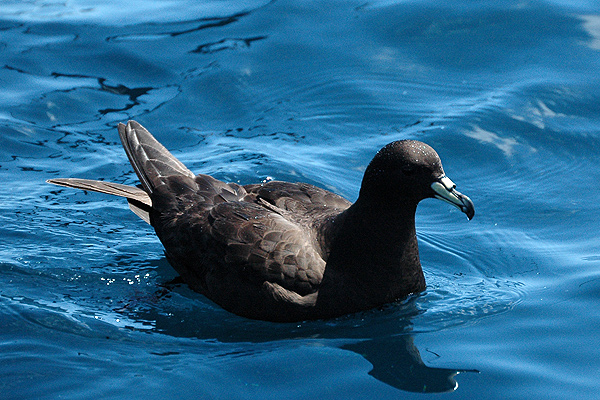
Black Petrel

Black Petrel

Procellaria parkinsoni

Aviceda at English Wikipedia (Original text: Tom (talk)), CC BY 3.0, via Wikimedia Commons

Manx Shearwater

Manx Shearwater

Puffinus puffinus

Martin Reith, CC BY-SA 3.0, via Wikimedia Commons

Side by side

Black PetrelManx Shearwater
Scientific nameProcellaria parkinsoni G. R. Gray, 1862Puffinus puffinus (Brünnich, 1764)
English nameBlack PetrelManx Shearwater
GroupBirdsBirds
ClassAves BirdAves Bird
OrderProcellariiformes PetrelsProcellariiformes Petrels
FamilyProcellariidae FulmarsProcellariidae Fulmars
GenusProcellaria Procellaria PetrelsPuffinus Small Shearwaters
Named in18621764
Red List categoryVulnerableLeast Concern
Environmentmarine, terrestrialmarine, terrestrial
Countries on record9 countries48 countries
GBIF occurrence records3,433 records190,288 records

Rows where the two agree are shown in grey.

Where each is found

Only Black Petrel (9)

Only Manx Shearwater (48)

From Catalogue of Life checklists and GBIF occurrence records. A country missing from a list means no record is held, which is not proof of absence.

Checked facts

Black PetrelManx Shearwater
Appearance
  • The Manx shearwater has black upperparts and white underparts. English Wikipedia
  • The species has long, narrow wings and a characteristic tube-shaped nose. English Wikipedia
  • The species flies with its wings held at right angles to its body, resembling a cross. English Wikipedia
Size
Habitat
  • The species breeds on Great Barrier Island and Little Barrier Island off New Zealand's North Island. English Wikipedia
  • The species is entirely marine and typically flies within 10 metres of the sea surface. English Wikipedia
  • The species nests in burrows on small islands. English Wikipedia
  • Manx shearwater nesting burrows may be excavated by European rabbits or dug by the birds themselves. English Wikipedia
Diet
  • The Black Petrel's diet is dominated by squid, with tunicates as supplementary food. iucnredlist.org
Behaviour
  • Male and female Black Petrels forage separately and in different locations. English Wikipedia
  • Black Petrels may feed during either daylight or nighttime. English Wikipedia
  • Black Petrels aggressively follow fishing boats and longline hooks while foraging. English Wikipedia
  • The species can dive to depths of approximately 20 metres when pursuing fishing bait. English Wikipedia
  • A recorded foraging trip by a Great Barrier Island bird lasted 39 days. English Wikipedia
  • Adults return to their breeding colony in mid-October to clean burrows and reunite with their mates. English Wikipedia
  • Male Black Petrels return to the same burrow annually. English Wikipedia
  • Adult Black Petrels and chicks migrate to waters off the Ecuadorian coast for winter. English Wikipedia
  • Juvenile Black Petrels remain at sea in the western Pacific for three to four years before becoming ready to breed. English Wikipedia
  • The species flies with stiff wings, alternating between sides with relatively few wingbeats. English Wikipedia
  • Manx shearwaters are mainly silent at sea, including when gathered near breeding colonies. English Wikipedia
  • The species makes nocturnal visits to nesting burrows and vocalises during these visits. English Wikipedia
  • Juveniles undertake their first southward migration without their parents. English Wikipedia
  • Juveniles can travel up to 2,000 km within a few days of leaving the nest. English Wikipedia
  • Individuals can return directly to their burrows after being released hundreds of kilometres away, including at inland locations. English Wikipedia
Reproduction
  • The Black Petrel's breeding season extends from October to June in the Hauraki Gulf. English Wikipedia
  • Female Black Petrels lay a single egg after pairs return to the colony in late November. English Wikipedia
  • Both parents share incubation of the egg for approximately 57 days. English Wikipedia
  • Eggs can hatch between late January and February. English Wikipedia
  • Black Petrel chicks fledge approximately 107 days after hatching. English Wikipedia
  • Chick fledging occurs from mid-April through late June. English Wikipedia
  • Approximately 75% of Black Petrel chicks survive to fledging. English Wikipedia
  • Pre-breeding birds return to the breeding colony at approximately four years of age to find a mate. English Wikipedia
Distribution
  • The Black Petrel is endemic to New Zealand. English Wikipedia
  • The species formerly occurred throughout New Zealand's North Island and in Northwest Nelson on the South Island. English Wikipedia
  • The species disperses at sea as far as Australia and Ecuador. English Wikipedia
  • The species breeds on islands in the North Atlantic, including the United Kingdom, Ireland, Iceland, the Faroe Islands, France, the Isle of Man, the Channel Islands, the Azores, the Canary Islands and Madeira. English Wikipedia
  • The species migrates to the South Atlantic outside the breeding season, wintering mainly off Brazil and Argentina. English Wikipedia
  • Smaller wintering populations occur off southwestern South Africa. English Wikipedia
Conservation
  • The Black Petrel is classified as Nationally Vulnerable under New Zealand's Department of Conservation threat classification system. English Wikipedia
  • The IUCN classifies the Black Petrel as Vulnerable. English Wikipedia
  • Research at breeding colonies indicates that the species' population is declining by at least 1.4% annually. English Wikipedia
  • Commercial and recreational fishing in New Zealand and overseas causes mortality among Black Petrels. English Wikipedia
  • Commercial fishing was estimated to have killed between 725 and 1,524 Black Petrels annually from 2003 to 2009. English Wikipedia
  • Feral pigs on Great Barrier Island dig up Black Petrel burrows and consume eggs and chicks. English Wikipedia
  • Feral cats can kill adult Black Petrels on the ground or at their nests, as well as their chicks. English Wikipedia
  • The European population is estimated at 350,000–390,000 breeding pairs. English Wikipedia
  • The European population accounts for approximately 95% of the global population. English Wikipedia
  • The species is classified as Least Concern by the International Union for Conservation of Nature. English Wikipedia
  • Artificial lighting causes newly fledged birds to become grounded in built-up areas. English Wikipedia
  • Introduced rats and cats threaten breeding populations, but populations can recover after these mammals are removed from islands. English Wikipedia
UsesNo checked fact yet
  • Manx shearwater chicks have historically been harvested for human consumption. English Wikipedia
  • Between approximately 1,000 and 5,000 chicks are legally harvested annually for food in the Faroe Islands. English Wikipedia
Name origin
  • The specific epithet parkinsoni commemorates the artist and collector Sydney Parkinson. English Wikipedia
  • The Māori names recorded for the Black Petrel are tāiko and tākoketai. English Wikipedia
  • The English name Manx shearwater refers to the species' nesting on the Calf of Man. English Wikipedia

In brief

Black Petrel

The species is endemic to New Zealand and breeds on Great Barrier Island and Little Barrier Island off New Zealand's North Island. It has entirely black plumage, black legs and a black bill with pale sections. Full profile

Manx Shearwater

Puffinus puffinus has black upperparts, white underparts, long narrow wings and a characteristic tube-shaped nose. Full profile

Compare something else

Page built on 29 November 2026 from the data on the two species pages, where every source is listed.

Cite this page

ScientificNames.org. (2026). Black Petrel vs Manx Shearwater. Retrieved November 29, 2026, from https://scientificnames.org/compare/black-petrel-vs-manx-shearwater