Species · Birds
Black Petrel Procellaria parkinsoni
The scientific name of the Black Petrel is Procellaria parkinsoni. It is a species of bird in the family Procellariidae (fulmars), order Procellariiformes. The name dates from 1862.
- Scientific name
- Procellaria parkinsoni G. R. Gray, 1862
- Common name
- Black Petrel
- Genus
- Procellaria
- Family
- Procellariidae (Fulmars)
- Order
- Procellariiformes
- Class
- Aves
- Red List category
- VU Vulnerable
- Environment
- marine, terrestrial
- Recorded in
- 9 countries
- Name status
- accepted in the Catalogue of Life
Overview
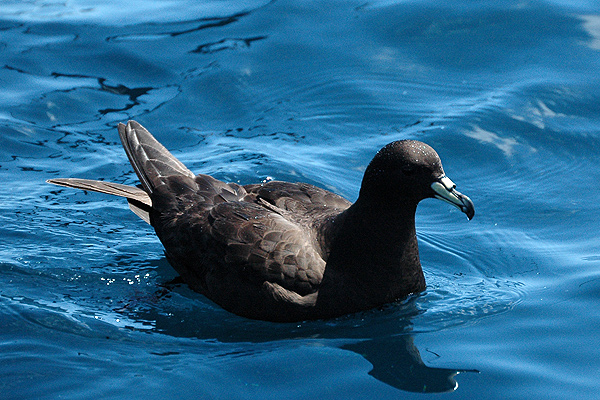
The species is endemic to New Zealand and breeds on Great Barrier Island and Little Barrier Island off New Zealand's North Island. It has entirely black plumage, black legs and a black bill with pale sections.
Written 26 November 2026 from the sources listed below. Each statement was checked against the passage it cites; statements that could not be supported were removed.
Appearance
The Black Petrel has entirely black plumage, black legs and a black bill with pale sections.[1][2]
Its overall body length is approximately 46 cm, and its average wingspan is approximately 115 cm. Adult males average approximately 720 g, while adult females average approximately 680 g.[3][4][5][6]
Habitat
The Black Petrel is endemic to New Zealand and breeds on Great Barrier Island and Little Barrier Island off New Zealand's North Island.[7][8]
The species formerly occurred throughout New Zealand's North Island and in Northwest Nelson on the South Island. At sea, it disperses as far as Australia and Ecuador.[9][10]
Diet
The Black Petrel's diet is dominated by squid, with tunicates as supplementary food.[11]
Behaviour
Male and female Black Petrels forage separately and in different locations. They may feed during daylight or nighttime.[12][13]
Black Petrels aggressively follow fishing boats and longline hooks while foraging. They can dive to depths of approximately 20 metres when pursuing fishing bait.[14][15]
A recorded foraging trip by a Great Barrier Island bird lasted 39 days.[16]
Adult Black Petrels and chicks migrate to waters off the Ecuadorian coast for winter. Juveniles remain at sea in the western Pacific for three to four years before becoming ready to breed.[17][18]
Pre-breeding birds return to the breeding colony at approximately four years of age to find a mate.[19]
Reproduction and life cycle
The Black Petrel's breeding season extends from October to June in the Hauraki Gulf. Adults return to their breeding colony in mid-October to clean burrows and reunite with their mates.[20][21]
Male Black Petrels return to the same burrow annually. Females lay a single egg after pairs return to the colony in late November.[22][23]
Both parents share incubation of the egg for approximately 57 days. Eggs can hatch between late January and February.[24][25]
Black Petrel chicks fledge approximately 107 days after hatching, with fledging occurring from mid-April through late June. Approximately 75% of chicks survive to fledging.[26][27][28]
Conservation
The Black Petrel is classified as Nationally Vulnerable under New Zealand's Department of Conservation threat classification system. The IUCN classifies the species as Vulnerable.[29][30]
Research at breeding colonies indicates that the population is declining by at least 1.4% annually.[31]
Commercial and recreational fishing in New Zealand and overseas causes mortality among Black Petrels. Commercial fishing was estimated to have killed between 725 and 1,524 Black Petrels annually from 2003 to 2009.[32][33]
Feral pigs on Great Barrier Island dig up Black Petrel burrows and consume eggs and chicks. Feral cats can kill adults on the ground or at their nests, as well as their chicks.[34][35]
Uses
The specific epithet parkinsoni commemorates the artist and collector Sydney Parkinson. The Māori names recorded for the Black Petrel are tāiko and tākoketai.[36][37]
Classification of the Black Petrel
| Kingdom | Animalia |
|---|---|
| Phylum | Chordata |
| Subphylum | Vertebrata |
| Infraphylum | Gnathostomata |
| Parvphylum | Osteichthyes |
| Megaclass | Tetrapoda |
| Class | Aves (Bird) |
| Order | Procellariiformes (Petrels) |
| Family | Procellariidae (Fulmars) |
| Genus | Procellaria (Procellaria Petrels) |
| Species | Procellaria parkinsoni G. R. Gray, 1862 |
Where the Black Petrel is found
Checklists and occurrence records place Procellaria parkinsoni in 9 countries across Oceania. GBIF holds 3,433 georeferenced records of it.
Countries
- Australia 708
- Chile 3
- Colombia 10
- Ecuador 124
- French Polynesia 58
- New Zealand 2,322
- Norfolk Island 63
- Peru 134
- Pitcairn 11
Regions and cities with the most records
- Auckland, New Zealand 300
- Wollongong, Australia 49
- New South Wales, Australia 32
- Northland, New Zealand 31
- Salinas, Ecuador 31
- La Libertad, Ecuador 21
- Santa Elena, Ecuador 21
- Waikato Region, New Zealand 17
- Auckland, New Zealand 15
- Remuera, New Zealand 14
- Tauranga, New Zealand 14
- Mount Eden, New Zealand 13
- Santa Elena, Ecuador 13
- Avondale, New Zealand 12
- Otahuhu, New Zealand 12
- Otara, New Zealand 12
- Manabí, Ecuador 11
- Papatoetoe, New Zealand 11
- Mangere, New Zealand 10
- Manukau City, New Zealand 10
- New Lynn, New Zealand 10
- Whangarei, New Zealand 8
- Bay of Plenty, New Zealand 6
- Galápagos, Ecuador 3
- Gold Coast, Australia 3
- Kingston, Norfolk Island 3
- Talara, Peru 3
4 more countries have a few records outside this range
These countries hold a few records of Procellaria parkinsoni but lie outside the range the checklists give for it. Such records are often zoo or garden specimens, museum material or vagrants, so the species is not counted as occurring there.
Range as the checklists state it
Australia
A number beside a place is its count of GBIF occurrence records. A place without a number comes from a checklist alone. Records show where a species has been observed or collected, which can include escapes and vagrants.
Common names
English
- Black Petrel
- Black (Parkinson's) Petrel
- Parkinson's Petrel
Names in 29 other languages
- Arabic
- بترل باركينسون, نوء أسود
- Catalan
- baldriga de Parkinson
- Chinese
- 黑風鸌, 黑风鹱
- Croatian
- Parkinsonova burnica, crni zovoj
- Czech
- buřňák Parkinsonův, buřňák černý
- Danish
- Sort Skråpe
- Dutch
- zwarte stormvogel
- Esperanto
- Parkinsona petrelo, nigra petrelo
- Estonian
- must-tormilind
- Finnish
- tummameriliitäjä
- French
- Puffin de Parkinson
- German
- Parkinson-Sturmvogel, Schwarzsturmvogel
- Hungarian
- fekete viharmadár
- Indonesian
- Petrel hitam
- Italian
- Petrello di Parkinson
- Japanese
- クロミズナギドリ
- Lithuanian
- Parkinsono audrašauklis
- Māori
- Tāiko
- Norwegian
- fjellpetrell
- Persian
- مرغ باران سیاه
- Polish
- burzyk czarny
- Portuguese
- pardela-de-parkinson, pardela-preta-setentrional
- Russian
- Чёрный буревестник
- Slovak
- víchrovec čierny, víchrovník čierny
- Spanish
- Fardela de Parkinson, Pardela de Parkinson, Petrel de Parkinson
- Swedish
- mindre sotpetrell
- Turkish
- Kara Yelkovan
- Ukrainian
- буревісник чорний
- Welsh
- pedryn du
Related species
-
 White-chinned PetrelProcellaria aequinoctialis
-
 Spectacled PetrelProcellaria conspicillata
-
 Grey PetrelProcellaria cinerea
-
 Westland PetrelProcellaria westlandica
-
 Manx ShearwaterPuffinus puffinus
-
 Southern Giant PetrelMacronectes giganteus
-
 Short-tailed ShearwaterArdenna tenuirostris
-
 Northern FulmarFulmarus glacialis
Compare
Questions and answers
What is the scientific name of the Black Petrel?
The scientific name of the Black Petrel is Procellaria parkinsoni. Written with its author, the full name is Procellaria parkinsoni G. R. Gray, 1862.
Which family does the Black Petrel belong to?
Procellaria parkinsoni belongs to the family Procellariidae, in the order Procellariiformes and the class Aves.
Where is the Black Petrel found?
Checklists and occurrence records place Procellaria parkinsoni in 9 countries, including New Zealand, Australia, Peru, Ecuador, Norfolk Island and French Polynesia.
What is the conservation status of the Black Petrel?
The IUCN Red List category recorded for Procellaria parkinsoni is Vulnerable (VU).
What other names does the Black Petrel have?
Procellaria parkinsoni is also known in English as Black (Parkinson's) Petrel and Parkinson's Petrel.
Are petrels aggressive?
Black Petrels aggressively follow fishing boats and longline hooks while foraging.[14]
Sources
Passages the profile rests on
- The Black Petrel has entirely black plumage. Source passage: “The plumage of the black petrel is all black” — English Wikipedia
- The species has black legs and a black bill with pale sections. Source passage: “as are its legs and bill except for pale sections on the bill.” — English Wikipedia
- The Black Petrel has an overall body length of approximately 46 cm. Source passage: “It has an overall length of 46 cm (18 in)” — English Wikipedia
- Its average wingspan is approximately 115 cm. Source passage: “a wingspan averaging 115 cm (45 in).” — English Wikipedia
- Adult males average approximately 720 g in weight. Source passage: “males average about 720 g (25 oz)” — English Wikipedia
- Adult females average approximately 680 g in weight. Source passage: “females around 680 g (24 oz).” — English Wikipedia
- The Black Petrel is endemic to New Zealand. Source passage: “It is endemic to New Zealand.” — English Wikipedia
- The species breeds on Great Barrier Island and Little Barrier Island off New Zealand's North Island. Source passage: “breeding only on Great Barrier Island and Little Barrier Island, off the North Island.” — English Wikipedia
- The species formerly occurred throughout New Zealand's North Island and in Northwest Nelson on the South Island. Source passage: “It was previously found throughout the North Island and Northwest Nelson in the South Island” — English Wikipedia
- The species disperses at sea as far as Australia and Ecuador. Source passage: “At sea it disperses as far as Australia and Ecuador.” — English Wikipedia
- The Black Petrel's diet is dominated by squid, with tunicates as supplementary food. Source passage: “Its diet is dominated by squid and supplemented by tunicates” — iucnredlist.org
- Male and female Black Petrels forage separately and in different locations. Source passage: “Females and males forage separately and in different places” — English Wikipedia
- Black Petrels may feed during either daylight or nighttime. Source passage: “They may feed at night or during the day” — English Wikipedia
- Black Petrels aggressively follow fishing boats and longline hooks while foraging. Source passage: “Birds will aggressively follow fishing boats and longline hooks” — English Wikipedia
- The species can dive to depths of approximately 20 metres when pursuing fishing bait. Source passage: “may dive up to 20m below the surface after baits.” — English Wikipedia
- A recorded foraging trip by a Great Barrier Island bird lasted 39 days. Source passage: “the longest recorded foraging trip for a bird from Great Barrier Island is 39 days.” — English Wikipedia
- Adult Black Petrels and chicks migrate to waters off the Ecuadorian coast for winter. Source passage: “Adults and chicks migrate to South America for winter (to waters off the Ecuador coast)” — English Wikipedia
- Juvenile Black Petrels remain at sea in the western Pacific for three to four years before becoming ready to breed. Source passage: “Juveniles will remain at sea in the West Pacific for 3–4 years until they are ready to breed” — English Wikipedia
- Pre-breeding birds return to the breeding colony at approximately four years of age to find a mate. Source passage: “At about four years old, pre-breeding birds will fly back to the colony to find a mate” — English Wikipedia
- The Black Petrel's breeding season extends from October to June in the Hauraki Gulf. Source passage: “Breeding takes place from October to June in the Hauraki Gulf.” — English Wikipedia
- Adults return to their breeding colony in mid-October to clean burrows and reunite with their mates. Source passage: “Adults return to the colony in mid-October to clean burrows, pair and mate with the same partner.” — English Wikipedia
- Male Black Petrels return to the same burrow annually. Source passage: “Males will return to the same burrow every year” — English Wikipedia
- Female Black Petrels lay a single egg after pairs return to the colony in late November. Source passage: “returning to the colony again in late November when the females lay a single egg.” — English Wikipedia
- Both parents share incubation of the egg for approximately 57 days. Source passage: “Both birds share incubation of the egg for 57 days” — English Wikipedia
- Eggs can hatch between late January and February. Source passage: “Eggs can hatch from late January through February.” — English Wikipedia
- Black Petrel chicks fledge approximately 107 days after hatching. Source passage: “Chicks fledge after 107 days (15 weeks)” — English Wikipedia
- Chick fledging occurs from mid-April through late June. Source passage: “from mid-April through to late June” — English Wikipedia
- Approximately 75% of Black Petrel chicks survive to fledging. Source passage: “about 75% of chicks survive to fledge.” — English Wikipedia
- The Black Petrel is classified as Nationally Vulnerable under New Zealand's Department of Conservation threat classification system. Source passage: “classified under the DOC Threat Classification System as Nationally Vulnerable” — English Wikipedia
- The IUCN classifies the Black Petrel as Vulnerable. Source passage: “by the International Union for Conservation of Nature or IUCN Red list: Vulnerable.” — English Wikipedia
- Research at breeding colonies indicates that the species' population is declining by at least 1.4% annually. Source passage: “the species is declining at a rate of at least 1.4% per year.” — English Wikipedia
- Commercial and recreational fishing in New Zealand and overseas causes mortality among Black Petrels. Source passage: “black petrels are caught by commercial and recreational fishers both in New Zealand and overseas.” — English Wikipedia
- Commercial fishing was estimated to have killed between 725 and 1,524 Black Petrels annually from 2003 to 2009. Source passage: “estimating that between 725 and 1524 birds may have been killed each year in the period 2003 to 2009.” — English Wikipedia
- Feral pigs on Great Barrier Island dig up Black Petrel burrows and consume eggs and chicks. Source passage: “feral pigs are known to dig up burrows and eat eggs and chicks” — English Wikipedia
- Feral cats can kill adult Black Petrels on the ground or at their nests, as well as their chicks. Source passage: “Feral cats can kill adults on the ground or at the nest as well as chicks.” — English Wikipedia
- The specific epithet parkinsoni commemorates the artist and collector Sydney Parkinson. Source passage: “The specific epithet parkinsoni was chosen to honour the artist and collector Sydney Parkinson.” — English Wikipedia
- The Māori names recorded for the Black Petrel are tāiko and tākoketai. Source passage: “(Māori: tāiko, or tākoketai)” — English Wikipedia
Data
- Catalogue of Life, 2026-10-16 XR cc by
- Global Biodiversity Information Facility CC BY 4.0
- Wikidata CC0
- GeoNames CC BY 4.0
- Wikimedia Commons per image; credit shown with each image
- Within the Catalogue of Life, this name comes from The Integrated Taxonomic Information System cc0
References
- Gray, & George Robert. (1862). A list of the Birds of New Zealand and the adjacent Islands. Ibis, Vol. 4, No. 15. where the name was published
- Gill, Frank, & and Minturn Wright. (2006). Birds of the World: Recommended English Names.
This species in other databases
- Catalogue of Life 4MMQ8
- Wikidata Q276087
- iNaturalist 4137
- WoRMS urn:lsid:marinespecies.org:taxname:225914
- Avibase parpet1
Page built on 28 November 2026. See how the catalog is made and all sources and licences.
Cite this page
ScientificNames.org. (2026). Procellaria parkinsoni (Black Petrel). Retrieved November 28, 2026, from https://scientificnames.org/species/procellaria-parkinsoni
“Procellaria parkinsoni (Black Petrel).” ScientificNames.org, 2026, scientificnames.org/species/procellaria-parkinsoni. Accessed 28 Nov. 2026.
ScientificNames.org. “Procellaria parkinsoni (Black Petrel).” Accessed November 28, 2026. https://scientificnames.org/species/procellaria-parkinsoni.
@misc{scientificnames_procellaria_parkinsoni_black_petrel,
  author = {{ScientificNames.org}},
  title = {Procellaria parkinsoni (Black Petrel)},
  year = {2026},
  url = {https://scientificnames.org/species/procellaria-parkinsoni},
  note = {Accessed 2026-11-28}
}