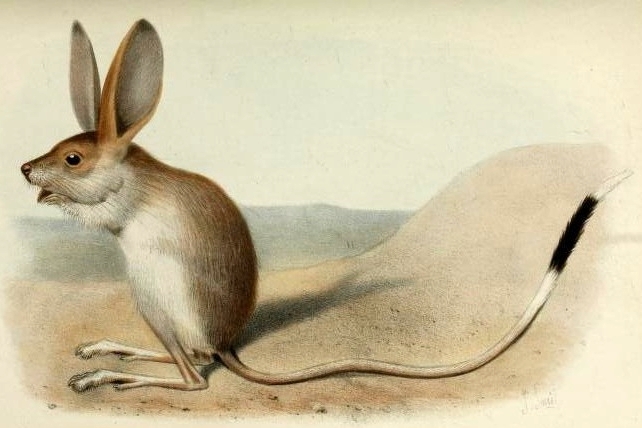
| Appearance | - Its dorsal pelage is cream-colored and blends into white ventral hairs along the sides of the body. animaldiversity.org
- Its eyelashes and long sensory hairs are gray or black, while its whiskers are white. animaldiversity.org
- Its tail tuft is black at the front and white at the rear. animaldiversity.org
- It has large, round eyes positioned close to relatively small, elongated oval ears. animaldiversity.org
- Its hind feet have three remaining long, laterally compressed toes covered underneath with thick, stiff hairs. animaldiversity.org
- Its hind-foot toe hairs are white near the skin and dark brown toward their outer edges. animaldiversity.org
- It has a skin fold that can cover its nose while burrowing. animaldiversity.org
- Its hind limbs are approximately four times as long as its forelimbs. animaldiversity.org
| - The long-eared jerboa has reddish-yellow to light russet upperparts and a white belly. animaldiversity.org
- The long-eared jerboa has ears approximately one-third longer than its head. animaldiversity.org
- The long-eared jerboa has a tail with short hairs and a terminal tuft of black and white hairs. animaldiversity.org
- The long-eared jerboa has five digits on each hind foot, with shorter lateral digits than central digits. animaldiversity.org
- The central metatarsals of the long-eared jerboa are fused over a short distance. animaldiversity.org
- The long-eared jerboa has tufts of bristly hairs covering its feet. animaldiversity.org
- The long-eared jerboa has thin, white incisors. animaldiversity.org
- The long-eared jerboa has a small premolar on each side of its upper jaw. animaldiversity.org
- Female long-eared jerboas have eight mammary glands. animaldiversity.org
|
|---|
| Size | | |
|---|
| Habitat | - It inhabits bare clayey or gravelly desert areas and other arid localities, rather than sandy areas with dunes. English Wikipedia
- It occurs in very arid rocky basins and areas of rolling or flat sand dunes interspersed with gravel plains. animaldiversity.org
- It has been reported from the shores of the Persian Gulf near Bushehr. animaldiversity.org
| - Long-eared jerboas have been collected in sandy valleys covered with low-growing bushes. animaldiversity.org
- The long-eared jerboa inhabits arid desert and semi-desert environments in the Mengxin and Aerjin Mountain regions. animaldiversity.org
- The long-eared jerboa also inhabits cold, high-elevation desert environments in the Qing-Zang Plateau region. animaldiversity.org
- Haloxylon ammodendron has been documented at some long-eared jerboa capture sites. animaldiversity.org
|
|---|
| Diet | - Its diet includes seeds and desert plants such as Artemisia aucheri, Anabasis aphylla and Peganum harmala. English Wikipedia
- It primarily eats leaves and sprouting vegetation during wet seasons. animaldiversity.org
- It primarily eats succulent roots, seeds and grains when rainfall is low or during summer. animaldiversity.org
| |
|---|
| Behaviour | - It is a solitary rodent that digs long tunnels in hard ground for shelter. English Wikipedia
- It is non-colonial and nocturnal, sleeping during the day and foraging at night. animaldiversity.org
- Its burrow tunnels are typically between 1.5 and 2.5 metres long. animaldiversity.org
- Its burrows generally have one entrance and several exits. animaldiversity.org
- It may create emergency exits by lightly packing a hole with soil and leaving it closed until needed. animaldiversity.org
- It does not store food or excrement inside its burrows. animaldiversity.org
- It may line its dens with camel fur or other soft materials during winter. animaldiversity.org
- During summer, it seals its burrow openings with approximately 50 centimetres of soil. animaldiversity.org
- It sometimes forages independently over distances of several miles at night. animaldiversity.org
- Individuals have sometimes been found sleeping together in the same burrow during the day. animaldiversity.org
- Individuals in Iran have been observed foraging above ground in late December at below-freezing temperatures. animaldiversity.org
- Daily periods of complete torpidity have been observed in captive individuals during colder winter months. animaldiversity.org
| - Long-eared jerboas are presumed to be mainly nocturnal. animaldiversity.org
- The long-eared jerboa locates flying insects using sound and captures them by leaping rapidly into the air. animaldiversity.org
- The long-eared jerboa belongs to a species whose mating system has not been established. animaldiversity.org
- The long-eared jerboa is gonochoric, with separate male and female sexes. animaldiversity.org
|
|---|
| Reproduction | | - Female long-eared jerboas nurse and care for their offspring at least until weaning. animaldiversity.org
|
|---|
| Distribution | - It is native to Central Asia and occurs in Turkmenistan, Uzbekistan, Afghanistan, Iran and Pakistan. English Wikipedia
| - The long-eared jerboa occurs from southernmost Mongolia into northwestern China. animaldiversity.org
|
|---|
| Conservation | - Its conservation status is assessed as Least Concern by the International Union for Conservation of Nature. English Wikipedia
- Its population is thought to be declining in parts of Turkmenistan and Uzbekistan because some habitat is being converted to cultivation. English Wikipedia
- Its overall population decline is considered small. English Wikipedia
| - The long-eared jerboa was identified as one of the ten focal species of the EDGE project in 2007. English Wikipedia
- Ongoing human disturbance is identified as a major threat to the long-eared jerboa. animaldiversity.org
- The long-eared jerboa's population has experienced an observed or probable reduction of at least 80 percent over ten years. animaldiversity.org
|
|---|
| Other | - Its skull resembles those of species in the subgenus Jaculus more than that of Jaculus orientalis. pmc.ncbi.nlm.nih.gov
| - The long-eared jerboa is the only recognized member of its genus, Euchoreutes. English Wikipedia
- The long-eared jerboa is also the only recognized member of its subfamily, Euchoreutinae. English Wikipedia
|
|---|