Species · Mammals
Long-eared Jerboa Euchoreutes naso
The scientific name of the Long-eared Jerboa is Euchoreutes naso. It is a species of mammal in the family Dipodidae (jerboa), order Rodentia. The name dates from 1891.
- Scientific name
- Euchoreutes naso Sclater, 1891
- Common name
- Long-eared Jerboa
- Genus
- Euchoreutes
- Family
- Dipodidae (Jerboa)
- Order
- Rodentia
- Class
- Mammalia
- Red List category
- LC Least Concern
- Recorded in
- 2 countries
- Name status
- accepted in the Catalogue of Life
Overview
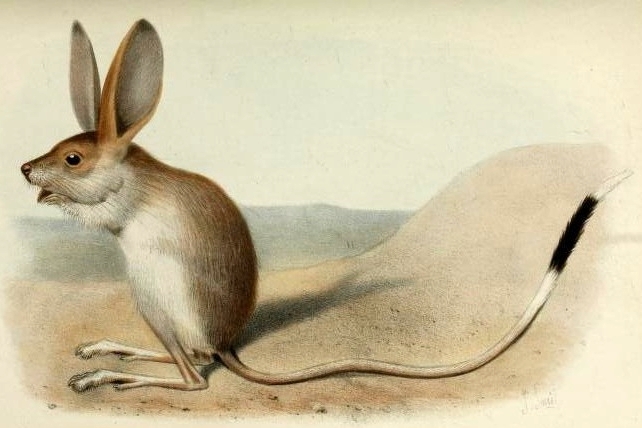
Euchoreutes naso occurs from southernmost Mongolia into northwestern China and inhabits arid desert, semi-desert, and cold, high-elevation desert environments. It is distinguished by ears approximately one-third longer than its head and a tail ending in a tuft of black and white hairs.
Written 26 November 2026 from the sources listed below. Each statement was checked against the passage it cites; statements that could not be supported were removed.
Conservation
The Long-eared Jerboa was identified as one of the ten focal species of the EDGE project in 2007. Ongoing human disturbance is identified as a major threat to the species.[1][2]
Its population has experienced an observed or probable reduction of at least 80 percent over ten years.[3]
Appearance
The Long-eared Jerboa has reddish-yellow to light russet upperparts and a white belly. Its ears are approximately one-third longer than its head.[4][5]
Its tail has short hairs and a terminal tuft of black and white hairs. Its feet are covered with tufts of bristly hairs.[6][7]
Each hind foot has five digits, with shorter lateral digits than central digits. The central metatarsals are fused over a short distance.[8][9]
The Long-eared Jerboa has thin, white incisors and a small premolar on each side of its upper jaw. Females have eight mammary glands.[10][11][12]
Its head and body length ranges from 70 to 90 mm. Its tail measures 150 to 162 mm, and its hind feet measure 40 to 46 mm.[13][14][15]
Habitat
The Long-eared Jerboa inhabits arid desert and semi-desert environments in the Mengxin and Aerjin Mountain regions. It also inhabits cold, high-elevation desert environments in the Qing-Zang Plateau region.[16][17]
Individuals have been collected in sandy valleys covered with low-growing bushes. Haloxylon ammodendron has been documented at some capture sites.[18][19]
Diet
The Long-eared Jerboa is insectivorous and eats flying insects.[20]
Behaviour
The Long-eared Jerboa is presumed to be mainly nocturnal. It locates flying insects using sound and captures them by leaping rapidly into the air.[21][22]
The species is gonochoric, with separate male and female sexes. Its mating system has not been established.[23][24]
Reproduction and life cycle
Female Long-eared Jerboas nurse and care for their offspring at least until weaning.[25]
Similar species
The Long-eared Jerboa is the only recognized member of its genus, Euchoreutes, and the only recognized member of its subfamily, Euchoreutinae.[26][27]
Classification of the Long-eared Jerboa
| Kingdom | Animalia |
|---|---|
| Phylum | Chordata |
| Subphylum | Vertebrata |
| Infraphylum | Gnathostomata |
| Parvphylum | Osteichthyes |
| Megaclass | Tetrapoda |
| Class | Mammalia (Mammal) |
| Subclass | Theria |
| Infraclass | Eutheria |
| Order | Rodentia (Rodent) |
| Suborder | Myomorpha (Mice) |
| Superfamily | Dipodoidea |
| Family | Dipodidae (Jerboa) |
| Subfamily | Euchoreutinae |
| Genus | Euchoreutes |
| Species | Euchoreutes naso Sclater, 1891 |
Where the Long-eared Jerboa is found
Checklists and occurrence records place Euchoreutes naso in 2 countries across Asia. GBIF holds 111 georeferenced records of it.
Countries
Regions and cities with the most records
Range as the checklists state it
Europe & Northern Asia (excluding China)
Southern Asia
A number beside a place is its count of GBIF occurrence records. A place without a number comes from a checklist alone. Records show where a species has been observed or collected, which can include escapes and vagrants.
Common names
English
- Long-eared Jerboa
Names in 11 other languages
- Chinese
- Chang'Er Tiaoshu
- Czech
- tarbíček dlouhouchý
- Dutch
- Grootoorspringmuis
- Finnish
- korvajerbo
- German
- Riesenohr-Springmaus, Riesenohrspringmaus
- Japanese
- オオミミトビネズミ
- Mongolian
- Sooton Alagdaakhai, Sooton Alagdai
- Norwegian Bokmål
- Langørejerboa, Langørespringmus
- Polish
- Skoczek długouchy, skocznik długouchy
- Russian
- Длинноухий тушканчик
- Spanish
- Jerbo de orejas largas
Synonyms
2 other scientific names have been used for this species and are now treated as synonyms of Euchoreutes naso.
- Euchoreutes naso alashanicus A. B. Howell, 1928
- Fuchoreutes naso Sclater, 1891
Related species
-
 Baluchistan Pygmy JerboaSalpingotulus michaelis
-
 Lesser Egyptian JerboaJaculus jaculus
-
 Meadow Jumping MouseZapus hudsonius
-
 Woodland Jumping MouseNapaeozapus insignis
-
 Greater Egyptian JerboaJaculus orientalis
-
 Northern Birch MouseSicista betulina
-
 Five-toed Pygmy JerboaCardiocranius paradoxus
-
 Western Jumping MouseZapus princeps
Compare
Questions and answers
What is the scientific name of the Long-eared Jerboa?
The scientific name of the Long-eared Jerboa is Euchoreutes naso. Written with its author, the full name is Euchoreutes naso Sclater, 1891.
Which family does the Long-eared Jerboa belong to?
Euchoreutes naso belongs to the family Dipodidae, in the order Rodentia and the class Mammalia.
Where is the Long-eared Jerboa found?
Checklists and occurrence records place Euchoreutes naso in 2 countries: Mongolia and China.
What is the conservation status of the Long-eared Jerboa?
The IUCN Red List category recorded for Euchoreutes naso is Least Concern (LC).
What does the long-eared jerboa eat?
The Long-eared Jerboa is insectivorous and eats flying insects.[20]
What is a jerboas habitat?
The Long-eared Jerboa inhabits arid desert, semi-desert, and cold, high-elevation desert environments in the Mengxin and Aerjin Mountain regions and the Qing-Zang Plateau region.[16][17]
What do jerboas eat?
The Long-eared Jerboa eats flying insects.[20]
Sources
Passages the profile rests on
- The long-eared jerboa was identified as one of the ten focal species of the EDGE project in 2007. Source passage: “The long-eared jerboa was identified as one of the top-10 "focal species" in 2007 by the Evolutionarily Distinct and Globally Endangered (EDGE) project.” — English Wikipedia
- Ongoing human disturbance is identified as a major threat to the long-eared jerboa. Source passage: “The major threat to long-eared jerboas, according to IUCN, is ongoing human disturbance.” — animaldiversity.org
- The long-eared jerboa's population has experienced an observed or probable reduction of at least 80 percent over ten years. Source passage: “The IUCN states that the population has undergone an observed or probable reduction of at least eighty percent over the last ten years due to either a decline in area of occupancy, extent of occurrence, and/or quality of their habitat.” — animaldiversity.org
- The long-eared jerboa has reddish-yellow to light russet upperparts and a white belly. Source passage: “Upper parts are reddish yellow to a light russet color. The belly is white.” — animaldiversity.org
- The long-eared jerboa has ears approximately one-third longer than its head. Source passage: “Long-eared jerboas have ears that are 1/3 longer than their heads.” — animaldiversity.org
- The long-eared jerboa has a tail with short hairs and a terminal tuft of black and white hairs. Source passage: “The tail is covered with short hairs that are similar in color to the rest of the body except for the terminal tuft, which is white and black.” — animaldiversity.org
- The long-eared jerboa has tufts of bristly hairs covering its feet. Source passage: “The feet are covered with tufts of bristly hairs.” — animaldiversity.org
- The long-eared jerboa has five digits on each hind foot, with shorter lateral digits than central digits. Source passage: “The hind foot is 40 to 46 mm in length, with five digits. The two lateral digits are shorter than the three central ones.” — animaldiversity.org
- The central metatarsals of the long-eared jerboa are fused over a short distance. Source passage: “The central metatarsals are fused for a small distance.” — animaldiversity.org
- The long-eared jerboa has thin, white incisors. Source passage: “The incisors are thin and white.” — animaldiversity.org
- The long-eared jerboa has a small premolar on each side of its upper jaw. Source passage: “A small premolar can be found on each side of the upper jaw.” — animaldiversity.org
- Female long-eared jerboas have eight mammary glands. Source passage: “Females have eight mammae.” — animaldiversity.org
- The long-eared jerboa has a head and body length ranging from 70 to 90 mm. Source passage: “body length is from 70 to 90 mm.” — animaldiversity.org
- The long-eared jerboa has a tail measuring 150 to 162 mm in length. Source passage: “Long-eared jerboa tail length is 150 to 162 mm” — animaldiversity.org
- The long-eared jerboa has hind feet measuring 40 to 46 mm in length. Source passage: “The hind foot is 40 to 46 mm in length, with five digits.” — animaldiversity.org
- The long-eared jerboa inhabits arid desert and semi-desert environments in the Mengxin and Aerjin Mountain regions. Source passage: “Their range includes the Mengxin and Aerjin Mountain regions, which are arid and classified as desert or semi desert.” — animaldiversity.org
- The long-eared jerboa also inhabits cold, high-elevation desert environments in the Qing-Zang Plateau region. Source passage: “Their range also extends into the Qing-Zang Plateau region, a cold, high elevation desert area.” — animaldiversity.org
- Long-eared jerboas have been collected in sandy valleys covered with low-growing bushes. Source passage: “Specimens of long-eared jerboas have been collected in sandy valleys that are covered with low growing bushes.” — animaldiversity.org
- Haloxylon ammodendron has been documented at some long-eared jerboa capture sites. Source passage: “Haloxylon ammodendron is a low-growing shrub that has been documented at some capture sites.” — animaldiversity.org
- The long-eared jerboa is insectivorous and eats flying insects. Source passage: “Long-eared jerboas eat flying insects, using sound to locate insects and capture them by performing fast leaps into the air.” — animaldiversity.org
- Long-eared jerboas are presumed to be mainly nocturnal. Source passage: “Long-eared jerboas are presumed to be mainly nocturnal, as are other jerboas .” — animaldiversity.org
- The long-eared jerboa locates flying insects using sound and captures them by leaping rapidly into the air. Source passage: “Long-eared jerboas eat flying insects, using sound to locate insects and capture them by performing fast leaps into the air.” — animaldiversity.org
- The long-eared jerboa belongs to a species whose mating system has not been established. Source passage: “Mating systems for long-eared jerboas are not known.” — animaldiversity.org
- The long-eared jerboa is gonochoric, with separate male and female sexes. Source passage: “gonochoric/gonochoristic/dioecious (sexes separate)” — animaldiversity.org
- Female long-eared jerboas nurse and care for their offspring at least until weaning. Source passage: “Like most mammals, females nurse and care for their young at least until they are weaned.” — animaldiversity.org
- The long-eared jerboa is the only recognized member of its genus, Euchoreutes. Source passage: “It is distinct enough that authorities consider it to be the only member of both its genus, Euchoreutes, and subfamily, Euchoreutinae.” — English Wikipedia
- The long-eared jerboa is also the only recognized member of its subfamily, Euchoreutinae. Source passage: “It is distinct enough that authorities consider it to be the only member of both its genus, Euchoreutes, and subfamily, Euchoreutinae.” — English Wikipedia
Data
- Catalogue of Life, 2026-10-16 XR cc by
- Global Biodiversity Information Facility CC BY 4.0
- Wikidata CC0
- GeoNames CC BY 4.0
- Wikimedia Commons per image; credit shown with each image
- Within the Catalogue of Life, this name comes from The Integrated Taxonomic Information System cc0
References
- Proc. Zool. Soc. Lond. vol.1890 p.610 where the name was published
- Ellerman, J. R., and T. C. S. Morrison-Scott. (1951). Checklist of Palaearctic and Indian Mammals 1758 to 1946.
- Wilson, Don E., and DeeAnn M. Reeder, eds. (1993). Mammal Species of the World: A Taxonomic and Geographic Reference, 2nd Ed., 3rd Printing.
- Wilson, Don E., and F. Russell Cole. (2000). Common Names of Mammals of the World.
- Holden, Mary Ellen, and Guy G. Musser / Wilson, Don E., and DeeAnn M. Reeder, eds. (2005). Family Dipodidae. Mammal Species of the World: A Taxonomic and Geographic Reference, 3rd Ed., Vol. 2.
This species in other databases
Page built on 28 November 2026. See how the catalog is made and all sources and licences.
Cite this page
ScientificNames.org. (2026). Euchoreutes naso (Long-eared Jerboa). Retrieved November 28, 2026, from https://scientificnames.org/species/euchoreutes-naso
“Euchoreutes naso (Long-eared Jerboa).” ScientificNames.org, 2026, scientificnames.org/species/euchoreutes-naso. Accessed 28 Nov. 2026.
ScientificNames.org. “Euchoreutes naso (Long-eared Jerboa).” Accessed November 28, 2026. https://scientificnames.org/species/euchoreutes-naso.
@misc{scientificnames_euchoreutes_naso_long_eared_jerboa,
  author = {{ScientificNames.org}},
  title = {Euchoreutes naso (Long-eared Jerboa)},
  year = {2026},
  url = {https://scientificnames.org/species/euchoreutes-naso},
  note = {Accessed 2026-11-28}
}