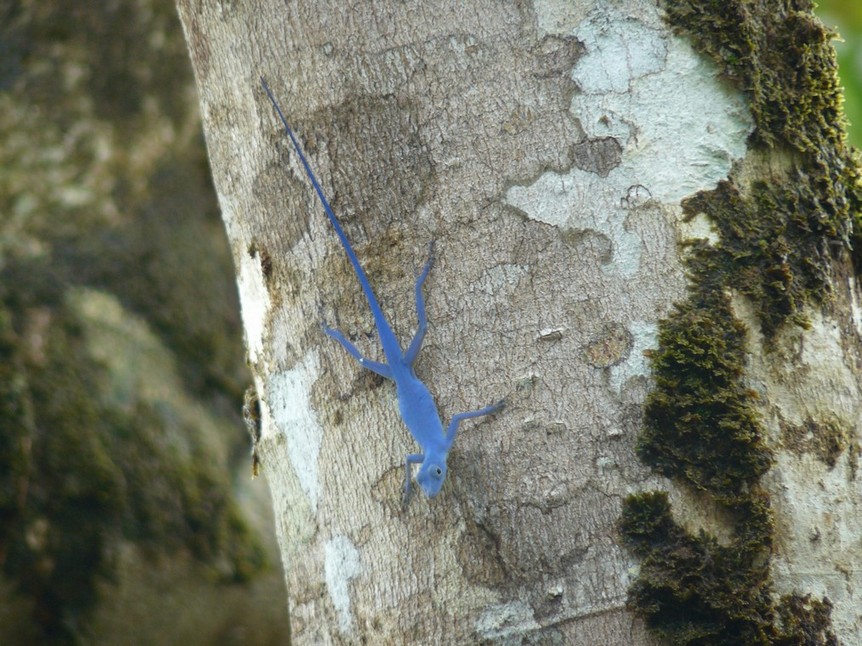
| Appearance | | - The brown anole is generally light brown with darker brown to black markings on its back and tan to light-colored lines along its sides. English Wikipedia
- Individuals can change their body coloration to shades of brown, black, or gray, and some develop yellowish dots when excited. English Wikipedia
- The species has a throat dewlap that is typically red or yellow. English Wikipedia
- The brown anole has a tail ridge that extends toward its head. English Wikipedia
- Female brown anoles exhibit variation in their dorsal patterns, including male-like chevrons and striped patterns. English Wikipedia
|
|---|
| Size | | |
|---|
| Habitat | - The species' preferred natural habitat is forest. English Wikipedia
- The species occurs in forest habitats from sea level to 100 metres in altitude. English Wikipedia
- The species occupies higher perches within its arboreal habitat. English Wikipedia
- The species is commonly observed on open tree branches in an inhabited area of Gorgona Island. English Wikipedia
- The species also uses tree trunks as perching locations. English Wikipedia
| - The brown anole typically occupies the ground and prefers small plants and shrubs rather than trees. English Wikipedia
- The species occurs in both urban and suburban environments. English Wikipedia
- Brown anoles bask in warm weather and seek sheltered areas in cold weather. English Wikipedia
- Juvenile brown anoles with high body temperatures use perches closer to the ground. English Wikipedia
|
|---|
| Diet | No checked fact yet | - The brown anole eats small arthropods including crickets, moths, ants, grasshoppers, cockroaches, mealworms, beetles, flies, earwigs, butterflies, and spiders. English Wikipedia
- The species also consumes earthworms and snails. English Wikipedia
- Brown anoles sometimes consume other lizards, including skinks, geckos, curly-tailed lizards, and Carolina anoles. English Wikipedia
- The species sometimes eats lizard eggs and hatchlings, including those of its own species. English Wikipedia
- Brown anoles near water consume aquatic arthropods and small fish. English Wikipedia
- The species occasionally consumes figs and other plant material. English Wikipedia
|
|---|
| Behaviour | No checked fact yet | - Brown anoles are more wary of humans than most other anole species. English Wikipedia
- Male brown anoles defend ground territories beneath the perches on which they rest. English Wikipedia
- Male brown anoles use displays to intimidate competing males within their ground territories. English Wikipedia
- Smaller males are more likely than larger males to migrate to new territories following male competition. English Wikipedia
- Female brown anoles are more likely to move into territories with lower female densities when their original territories contain many females. English Wikipedia
- Brown anoles can detach their tails when grabbed by predators, and the detached tail continues twitching. English Wikipedia
- Brown anoles molt in small pieces rather than shedding their skin in one large piece. English Wikipedia
|
|---|
| Reproduction | | - Female brown anoles reproduce during the warmer parts of the year. English Wikipedia
- A female brown anole lays one egg per clutch in damp environments. English Wikipedia
- Females generally lay eggs approximately two weeks apart and produce 15–18 eggs during one breeding season. English Wikipedia
- Brown anole eggs hatch approximately four weeks after being laid. English Wikipedia
- Both male and female brown anoles reach sexual maturity within one year of hatching. English Wikipedia
- Newly hatched brown anoles are independent of their parents. English Wikipedia
- Male brown anoles extend their dewlaps and bob their heads to indicate mating availability. English Wikipedia
- Female brown anoles are more likely to engage in mating behaviors when precipitation is present. English Wikipedia
|
|---|
| Distribution | - The species is restricted to Gorgona Island in the Colombian Pacific. English Wikipedia
- The species occurs exclusively on Gorgona Island in Colombia. inaturalist.org
| - The brown anole is native to Cuba, the Bahamas, Little Cayman, Cayman Brac, Jamaica, the Swan Islands, and parts of Central America. English Wikipedia
- The species has been introduced to Florida, southern Georgia, Texas, Louisiana, Tennessee, Mississippi, Alabama, Hawaii, North Carolina, and Southern California. English Wikipedia
- The brown anole has also been introduced to Singapore and Taiwan. English Wikipedia
|
|---|
| Conservation | - The species is classified as near threatened in document 1. English Wikipedia
- The species is described as highly threatened in document 3. inaturalist.org
- Estimating the species' population accurately has been difficult because of its isolated environment and elusive nature. English Wikipedia
- The species commonly falls prey to introduced western basilisk lizards. English Wikipedia
- Introduced rats, cats, and capuchin monkeys may also prey on the species. English Wikipedia
- Construction of a prison in the 1950s caused the greatest reported damage to the species' habitat. English Wikipedia
- Gorgona Island has been entirely protected as a national park since 1984. English Wikipedia
- Captive breeding has been proposed as a possible conservation measure for the species. English Wikipedia
| - The brown anole is considered highly invasive. English Wikipedia
- In introduced areas, brown anoles can attain high population densities and rapidly expand their geographic range. English Wikipedia
- The species competes with and consumes native lizard species in introduced environments. English Wikipedia
- Brown anoles have been associated with changes in the behavior and reduced populations of Carolina anoles in the United States. English Wikipedia
- Brown anoles can reach population densities exceeding 12,000 individuals per hectare within four years of introduction. pmc.ncbi.nlm.nih.gov
- The species has been associated with changes to native ant communities and predation on native lizards in Taiwan. pmc.ncbi.nlm.nih.gov
- The brown anole has been reported to transmit parasites among lizard populations in Hawaii. English Wikipedia
|
|---|
| Similar species | No checked fact yet | - Anolis nelsoni is identified as the species most closely related to Anolis sagrei. English Wikipedia
- The brown anole has a shorter snout than the green anole. English Wikipedia
|
|---|