Species · Reptiles
Blue Anole Anolis gorgonae
The scientific name of the Blue Anole is Anolis gorgonae. It is a species of reptile in the family Anolidae (anoles), order Squamata. The name dates from 1905.
Overview
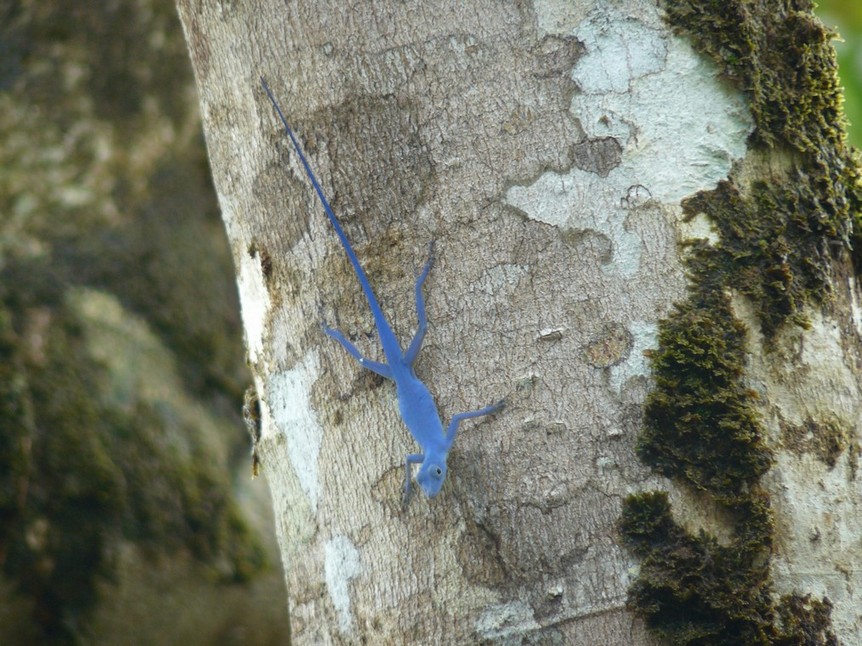
The blue anole (Anolis gorgonae) is a species of lizard in the family Dactyloidae. A. gorgonae falls into the genus Dactyloa, which are all highly arboreal, but differ in size, coloration, and perch preferences. The blue anole specifically occupies higher perches. It is a small species which is "near threatened" and found only on the island of Gorgona, in the Colombian Pacific.
Classification of the Blue Anole
| Kingdom | Animalia |
|---|---|
| Phylum | Chordata |
| Subphylum | Vertebrata |
| Infraphylum | Gnathostomata |
| Parvphylum | Osteichthyes |
| Megaclass | Tetrapoda |
| Class | Reptilia (Reptile) |
| Order | Squamata (Snakes) |
| Suborder | Iguania (Iguanas) |
| Family | Anolidae (Anoles) |
| Genus | Anolis (Anoles) |
| Species | Anolis gorgonae Barbour, 1905 |
Where the Blue Anole is found
Checklists and occurrence records place Anolis gorgonae in 1 country across South America. GBIF holds 25 georeferenced records of it.
Countries
Range as the checklists state it
Colombia (Gorgona Island)
A number beside a place is its count of GBIF occurrence records. A place without a number comes from a checklist alone. Records show where a species has been observed or collected, which can include escapes and vagrants.
Common names
English
- Blue Anole
- Gorgona Blue Anole
Names in 1 other language
- Russian
- Анолис-горгона
Synonyms
One other scientific name has been used for this species and is now treated as a synonym of Anolis gorgonae.
- Dactyloa gorgonae (Barbour, 1905)
Related species
-
 Green AnoleAnolis carolinensis
-
 Brown AnoleAnolis sagrei
-
 Knight AnoleAnolis equestris
-
 Crested AnoleAnolis cristatellus
-
 Western Bearded AnoleAnolis barbatus
- Water AnoleAnolis aquaticus
-
 Allison's AnoleAnolis allisoni
-
 Graham's AnoleAnolis grahami
Compare
Questions and answers
What is the scientific name of the Blue Anole?
The scientific name of the Blue Anole is Anolis gorgonae. Written with its author, the full name is Anolis gorgonae Barbour, 1905.
Which family does the Blue Anole belong to?
Anolis gorgonae belongs to the family Anolidae, in the order Squamata and the class Reptilia.
Where is the Blue Anole found?
Checklists and occurrence records place Anolis gorgonae in 1 country: Colombia.
What is the conservation status of the Blue Anole?
The IUCN Red List category recorded for Anolis gorgonae is Near Threatened (NT).
What other names does the Blue Anole have?
Anolis gorgonae is also known in English as Gorgona Blue Anole.
Sources
Data
- Catalogue of Life, 2026-10-16 XR cc by
- Global Biodiversity Information Facility CC BY 4.0
- Wikidata CC0
- English Wikipedia CC BY-SA 4.0
- GeoNames CC BY 4.0
- Wikimedia Commons per image; credit shown with each image
- Within the Catalogue of Life, this name comes from The Reptile Database cc by
References
- Barbour, T. in: Bangs, Outram; Brown, Wilmont W.; Thayer, John E.; Barbour, Thomas. (1905). The Vertebrata of Gorgona Island, Colombia. 1 Introduction. Mammalia. 2. Physical aspect and climate; Fauna. 3 Aves. 4 Reptilia; Amphibia. Bull. Mus. Comp. Zool. Harvard 46 (5): 87-102.
- Losos, J. B. (2009). Lizards in an Evolutionary Tree: Ecology and Adaptive Radiation of Anoles. Berkeley: University of California Press, 528 Pp.
- CASTRO-HERRERA, F., & ANYELET VALENCIA-AGUILAR, D. V.-M. (2012). Diversidad de Anfibios y Reptiles del Parque Nacional Natural Isla Gorgona. Universidad Del Valle, Santiago de Cali, Valle Del Cauca, 112 Pp.
- NICHOLSON, KIRSTEN E.; BRIAN I. CROTHER, CRAIG GUYER & JAY M. SAVAGE. (2012). It is time for a new classification of anoles (Squamata: Dactyloidae). Zootaxa 3477: 1–108.
- Poe, S. (2013). 1986 Redux: New genera of anoles (Squamata: Dactyloidae) are unwarranted. Zootaxa 3626 (2): 295–299.
- Meiri, Shai; Aaron M. Bauer, Allen Allison, Fernando Castro-Herrera, Laurent Chirio, Guarino Colli, Indraneil Das, Tiffany M. Doan, Frank Glaw, Lee L. Grismer, Marinus Hoogmoed, Fred Kraus, Matthew LeBreton, Danny Meirte, Zoltán T. Nagy, Cristiano de C. Nogueira, Paul Oliver, Olivier S. G. Pauwels, Daniel Pincheira-Donoso, Glenn Shea, Roberto Sindaco, Oliver J. S. Tallowin, Omar Torres-Carvajal, Jean-Francois Trape, Peter Uetz, Philipp Wagner, Yuezhao Wang, Thomas Ziegler, and Uri Roll. (2017). Extinct, obscure or imaginary: the lizard species with the smallest ranges. Diversity and Distributions 24 (2): 262-273.
- NICHOLSON, KIRSTEN E.; BRIAN I. CROTHER, CRAIG GUYER & JAY M. SAVAGE. (2018). Translating a clade based classification into one that is valid under the international code of zoological nomenclature: the case of the lizards of the family Dactyloidae (Order Squamata). Zootaxa 4461 (4): 573–586.
- Phillips, JG, SE Burton, MM Womack, Pulver, E., & and KE Nicholson. (2019). Biogeography, systematics, and ecomorphology of Pacific island anoles. Diversity 11: 141.
- Mendez-Galeano, Miguel Angel; Martha Lucia Calderon Espinosa, María Alejandra Pinto Erazo & Philipp Böning. (2024). Umwelt-DNA als Nachweismethode für den endemischen Anolis gorgonae auf der Insel Gorgona, Kolumbien. Elaphe 2024 (3): 96-97.
- Rodríguez-Rodríguez, J. D., & Calderón-Espinosa, M. L. (2024). Sexual dimorphism and female ecomorphology in Anolis (Squamata: Anolidae): knowledge of female morphology increases the understanding of Anolis diversification. Biological Journal of the Linnean Society, Blae019.
- Poe, & Steven. (2025). A Guide to the Anolis Lizards (Anoles) of Mainland Central and South America. Princeton University Press, 432 Pp.
This species in other databases
Page built on 25 November 2026. See how the catalog is made and all sources and licences.
Cite this page
ScientificNames.org. (2026). Anolis gorgonae (Blue Anole). Retrieved November 25, 2026, from https://scientificnames.org/species/anolis-gorgonae
“Anolis gorgonae (Blue Anole).” ScientificNames.org, 2026, scientificnames.org/species/anolis-gorgonae. Accessed 25 Nov. 2026.
ScientificNames.org. “Anolis gorgonae (Blue Anole).” Accessed November 25, 2026. https://scientificnames.org/species/anolis-gorgonae.
@misc{scientificnames_anolis_gorgonae_blue_anole,
  author = {{ScientificNames.org}},
  title = {Anolis gorgonae (Blue Anole)},
  year = {2026},
  url = {https://scientificnames.org/species/anolis-gorgonae},
  note = {Accessed 2026-11-25}
}