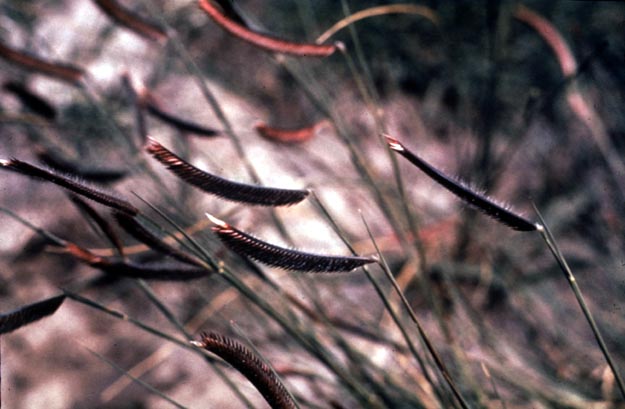
| Appearance | - Sixweeks grama is a short-lived, warm-season, native annual bunchgrass. fs.usda.gov
- Its stems grow in tufts and may lie prostrate or spread along the ground. fs.usda.gov
- The leaves occur sparsely along the stems. fs.usda.gov
- The fruit is an awned caryopsis. fs.usda.gov
- The fruit's awns range from very small to as long as the fruit body. fs.usda.gov
- The inflorescence consists of 2–9 persistent branches, each bearing 7–40 closely arranged spikelets. fs.usda.gov
| - Blue grama has green to greyish leaves that are less than 3 mm wide. English Wikipedia
- The leaves of blue grama are 25 to 250 mm long. English Wikipedia
- Blue grama produces comb-like flower spikes that usually number two and extend at a sharp angle from the flowering stem. English Wikipedia
- Each blue grama spike contains between 20 and 90 spikelets. English Wikipedia
- Each spikelet contains one fertile floret and one or two reduced sterile florets. English Wikipedia
- The fertile floret has a lemma with three short awns at its tip. English Wikipedia
- Pollinated fertile florets produce brown oblong-elliptic seeds measuring 2.5 to 3 mm long. English Wikipedia
- The mature spikelet detaches while its two glumes remain attached. English Wikipedia
|
|---|
| Size | - The plant grows to approximately 0.3 meters in height. fs.usda.gov
- Its leaves measure 1–6 cm long and 1–1.5 mm wide. fs.usda.gov
- The fruit measures 4.0–6.5 mm in length. fs.usda.gov
- The fruit weighs approximately 0.03 milligrams. fs.usda.gov
- The spikelets measure 2.5–4 mm in length. fs.usda.gov
| |
|---|
| Habitat | - In the Santa Teresa Mountains, sixweeks grama grows in the understory of Madrean evergreen woodlands. fs.usda.gov
- In southern Arizona and parts of the Colorado Plateau, sixweeks grama occurs in ponderosa pine and pointleaf manzanita forests at less than 1% density or cover. fs.usda.gov
- In California, sixweeks grama occurs in habitats ranging from creosotebush scrub to pinyon-juniper woodland. fs.usda.gov
- In Joshua Tree National Monument, California, the species occurs below 3,900 feet with creosotebush and desertholly. fs.usda.gov
- In Joshua Tree National Monument, sixweeks grama grows with singleleaf pinyon and junipers at approximately 5,000 feet. fs.usda.gov
- In Nevada, sixweeks grama occurs in the southern state's creosotebush belt. fs.usda.gov
- In New Mexico, sixweeks grama occurs in the Chihuahuan Desert's creosotebush and desert grassland communities. fs.usda.gov
- In Utah, sixweeks grama grows in desert shrub and creosote bush communities. fs.usda.gov
- The species can occur in disturbed habitats, including roadsides, railways, and overgrazed pastures. English Wikipedia
| - Blue grama is an important component of shortgrass prairie ecosystems. fs.usda.gov
- Blue grama occurs in the understory of southwestern evergreen oak woodlands. fs.usda.gov
- Blue grama occurs in ponderosa pine communities. fs.usda.gov
- Blue grama commonly occurs in pinyon-juniper communities. fs.usda.gov
- Blue grama occurs in semi-desert grasslands of the southwestern United States. fs.usda.gov
- Blue grama thrives in arid environments such as the Gila region. nps.gov
|
|---|
| Diet | - Seeds of sixweeks grama are eaten by birds, including small animals such as prairie dogs and desert kangaroo rats. English Wikipedia
- Harvester ants in Arizona consume sixweeks grama seeds. English Wikipedia
| - Blue grama provides forage for deer and small mammals. nps.gov
|
|---|
| Behaviour | - The lightweight seeds of sixweeks grama are dispersed by wind. English Wikipedia
- Birds, small mammals, and ungulates disperse the seeds when their awns attach to fur and feathers. fs.usda.gov
| - Established blue grama plants tolerate grazing, cold, and drought. English Wikipedia
- Blue grama rapidly uses available water and becomes dormant during unfavorable conditions. English Wikipedia
- Prolonged drought reduces the number and extent of blue grama roots. English Wikipedia
- Blue grama recovers slowly following disturbance, with recovery depending on disturbance type and extent. English Wikipedia
|
|---|
| Reproduction | - Sixweeks grama can reproduce as an annual or perennial, sprouting from seed or its root crown following summer rainfall. English Wikipedia
- Flowering generally begins in July and continues through October. English Wikipedia
- Sixweeks grama is probably wind-pollinated. fs.usda.gov
- At elevations below 300 meters in Joshua Tree National Monument, the species produces seeds within four weeks of germination. fs.usda.gov
- At elevations above 300 meters in Joshua Tree National Monument, seed production occurs within six weeks of germination. fs.usda.gov
| - Blue grama can establish readily from seed but relies more heavily on vegetative reproduction through tillers. English Wikipedia
- Blue grama seed production is slow and depends on soil moisture and temperature. English Wikipedia
- Successful blue grama seedling establishment requires some soil moisture during adventitious root development. English Wikipedia
- Blue grama seedling establishment, survival, and growth are greatest when seedlings are isolated from neighboring adult plants. English Wikipedia
|
|---|
| Lifespan | No checked fact yet | |
|---|
| Distribution | - Sixweeks grama is native to North America, occurring from the southwestern United States south to Oaxaca in southern Mexico. English Wikipedia
- The species has also been recorded in Argentina. English Wikipedia
| - Blue grama is native to North America. English Wikipedia
- Blue grama occurs from Alberta, Canada, south through the Rocky Mountains and Great Plains to the northern Mexican Plateau. English Wikipedia
- Blue grama occurs as far west as Southern California and extends east to Missouri and Texas. English Wikipedia
|
|---|
| Conservation | No checked fact yet | - Blue grama is globally secure but vulnerable to extinction in some localized areas. fs.usda.gov
- Blue grama is classified as an imperiled state priority plant in Idaho. fs.usda.gov
- Blue grama is classified as critically imperiled in Missouri. fs.usda.gov
|
|---|
| Uses | - Although palatable, sixweeks grama is not considered good livestock forage because of its small size and short green period. English Wikipedia
| - Blue grama is valued as livestock forage and is described as the most valuable grama grass. English Wikipedia
- Blue grama is used in perennial gardens and native plant landscaping. English Wikipedia
- Blue grama is used in habitat restoration projects. English Wikipedia
- Blue grama is used for erosion control along residential areas, civic spaces, and highways. English Wikipedia
- Blue grama flowers are used in dried flower arrangements. English Wikipedia
- The Zuni people use blue grama bunches as hairbrushes and brooms. English Wikipedia
- The Costanoan or Ohlone people have used the hollow stems of blue grama as drinking straws. English Wikipedia
- The Navajo people have used blue grama as feed for sheep and horses. English Wikipedia
- Blue grama is the official state grass of Colorado and New Mexico. English Wikipedia
|
|---|
| Similar species | - Sixweeks grama is sometimes mistaken for perennial Rothrock's grama when the two species grow together in southern New Mexico and southern Arizona. fs.usda.gov
- Sixweeks grama can be distinguished from Rothrock's grama by its branched stems and shorter awns. fs.usda.gov
| No checked fact yet |
|---|
| Other | No checked fact yet | |
|---|