Species · Flowering plants
Blue Grama Bouteloua gracilis
The scientific name of the Blue Grama is Bouteloua gracilis. It is a species of flowering plant in the family Poaceae (turf), order Poales.
- Scientific name
- Bouteloua gracilis (Kunth) Lag. ex Griffiths
- Common name
- Blue Grama
- Genus
- Bouteloua
- Family
- Poaceae (Turf)
- Order
- Poales
- Class
- Liliopsida
- Red List category
- LC Least Concern
- Recorded in
- 8 countries
- Name status
- accepted in the Catalogue of Life
Overview
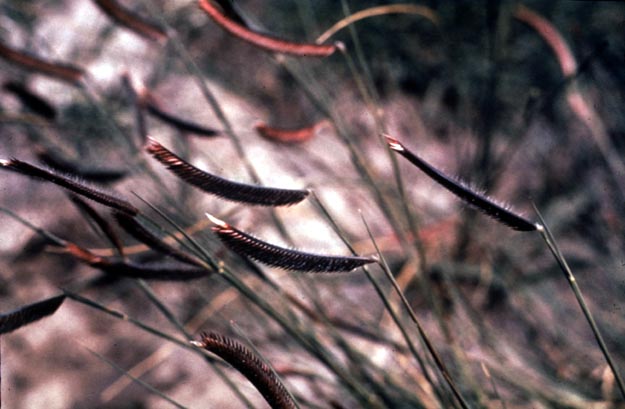
Blue grama is a long-lived perennial flowering grass in the family Poaceae. It is native to North America and occurs from Alberta, Canada, south through the Rocky Mountains and Great Plains to the northern Mexican Plateau. It produces usually two comb-like flower spikes that extend at a sharp angle from the flowering stem.
Written 26 November 2026 from the sources listed below. Each statement was checked against the passage it cites; statements that could not be supported were removed.
Appearance
Blue grama has green to greyish leaves that are less than 3 mm wide and 25 to 250 mm long. Mature plants generally reach 15 to 30 cm in height, and flowering stems measure approximately 18 to 46 cm long.[1][2][3][4]
Its comb-like flower spikes usually number two and extend at a sharp angle from the flowering stem. Each spike contains between 20 and 90 spikelets, measuring 5 to 6 mm long.[5][6][7]
Each spikelet contains one fertile floret and one or two reduced sterile florets. The fertile floret has a lemma with three short awns at its tip.[8][9]
Pollinated fertile florets produce brown oblong-elliptic seeds measuring 2.5 to 3 mm long. The mature spikelet detaches while its two glumes remain attached.[10][11]
Blue grama roots generally extend 30 to 46 cm horizontally and reach depths of 0.9 to 2.0 m.[12]
Habitat
Blue grama is an important component of shortgrass prairie ecosystems. It also occurs in semi-desert grasslands of the southwestern United States and thrives in arid environments such as the Gila region.[13][14][15]
Blue grama occurs in the understory of southwestern evergreen oak woodlands and in ponderosa pine communities. It commonly occurs in pinyon-juniper communities.[16][17][18]
Diet
Blue grama provides forage for deer and small mammals. It is also used as feed for sheep and horses.[19][20]
Behaviour
Established blue grama plants tolerate grazing, cold, and drought. The grass rapidly uses available water and becomes dormant during unfavorable conditions.[21][22]
Prolonged drought reduces the number and extent of blue grama roots. Recovery following disturbance is slow and depends on the type and extent of disturbance.[23][24]
Blue grama is a warm-season C4 grass. It can be diploid or tetraploid and forms dense tufts that help prevent soil erosion.[25][26][27]
Reproduction and life cycle
Blue grama can establish readily from seed but relies more heavily on vegetative reproduction through tillers. Seed production is slow and depends on soil moisture and temperature.[28][29]
Successful seedling establishment requires some soil moisture during adventitious root development. Seedling establishment, survival, and growth are greatest when seedlings are isolated from neighboring adult plants.[30][31]
Conservation
Blue grama is globally secure but vulnerable to extinction in some localized areas. It is classified as an imperiled state priority plant in Idaho and critically imperiled in Missouri.[32][33][34]
Uses
Blue grama is valued as livestock forage and is described as the most valuable grama grass. It is used in perennial gardens, native plant landscaping, and habitat restoration projects.[35][36][37]
Blue grama is used for erosion control along residential areas, civic spaces, and highways. Its flowers are also used in dried flower arrangements.[38][39]
The Zuni people use blue grama bunches as hairbrushes and brooms. The Costanoan or Ohlone people have used its hollow stems as drinking straws.[40][41]
Blue grama is the official state grass of Colorado and New Mexico.[42]
Classification of the Blue Grama
| Kingdom | Plantae |
|---|---|
| Subkingdom | Pteridobiotina |
| Phylum | Tracheophyta |
| Class | Liliopsida |
| Order | Poales |
| Family | Poaceae (Turf) |
| Genus | Bouteloua (Grama) |
| Species | Bouteloua gracilis (Kunth) Lag. ex Griffiths |
Where the Blue Grama is found
Checklists and occurrence records place Bouteloua gracilis in 8 countries across Asia, Europe and North America. GBIF holds 17,387 georeferenced records of it.
Countries where it is native or its origin is not stated
Countries where it has been introduced
Regions and cities with the most records
- Colorado, United States 2,032
- New Mexico, United States 2,030
- Arizona, United States 1,090
- Alberta, Canada 963
- Texas, United States 577
- Utah, United States 516
- Saskatchewan, Canada 478
- Durango, Mexico 445
- Montana, United States 435
- Minnesota, United States 350
- Wyoming, United States 343
- South Dakota, United States 339
- Nebraska, United States 334
- Kansas, United States 308
- Greenwood Village, United States 235
- Coahuila, Mexico 230
- Chihuahua, Mexico 224
- California, United States 214
- Zacatecas, Mexico 208
- Englewood, United States 204
- Boulder, United States 197
- Santa Fe, United States 197
- Wheat Ridge, United States 193
- Westminster, United States 188
- Littleton, United States 187
- Centennial, United States 186
- Louisville, United States 186
- Arvada, United States 185
- Denver, United States 184
- Aurora, United States 180
- Lakewood, United States 178
- Lafayette, United States 169
- Sherrelwood, United States 167
- Colorado Springs, United States 166
- Flagstaff, United States 163
- Columbine, United States 162
6 more countries have a few records outside this range
These countries hold a few records of Bouteloua gracilis but lie outside the range the checklists give for it. Such records are often zoo or garden specimens, museum material or vagrants, so the species is not counted as occurring there.
A number beside a place is its count of GBIF occurrence records. A place without a number comes from a checklist alone. Records show where a species has been observed or collected, which can include escapes and vagrants.
Common names
English
- Blue Grama
- Blue Grama Grass
- Eyelash Grass
- Graceful Grama Grass
Names in 2 other languages
- French
- boutelou gracieux, boutelou grêle
- Spanish
- navajita, navajita azul
Synonyms
18 other scientific names have been used for this species and are now treated as synonyms of Bouteloua gracilis.
- Actinochloa gracilis (Kunth) Willd. ex Roem. & Schult.
- Atheropogon gracilis (Kunth) Spreng.
- Atheropogon oligostachyus Nutt.
- Bouteloua gracilis f. pallida (Beal) B.Boivin
- Bouteloua gracilis var. major (Vasey) Beetle
- Bouteloua gracilis var. stricta (Vasey) Hitchc.
- Bouteloua major Vasey
- Bouteloua oligostachya (Nutt.) Torr. ex A.Gray
- Bouteloua oligostachya var. intermedia Vasey
- Bouteloua oligostachya var. major Vasey
- Bouteloua oligostachya var. pallida Beal
- Bouteloua stricta Vasey
- Chondrosum gracile Kunth
- Chondrosum gracile var. polystachyum Nees
- Chondrosum oligostachyum (Nutt.) Torr.
- Chondrosum strictum (Vasey) Wipff
- Eutriana oligostachya (Nutt.) Kunth
- Eutriana gracilis (Kunth) Trin. ambiguous synonym
Related species
-
 Sideoats GramaBouteloua curtipendula
-
 Black GramaBouteloua eriopoda
-
 Hairy GramaBouteloua hirsuta
-
 Needle GramaBouteloua aristidoides
-
 Sixweeks GramaBouteloua barbata
-
 Slender GramaBouteloua repens
-
 Red GramaBouteloua trifida
- Gypsum GramaBouteloua breviseta
Compare
Questions and answers
What is the scientific name of the Blue Grama?
The scientific name of the Blue Grama is Bouteloua gracilis. Written with its author, the full name is Bouteloua gracilis (Kunth) Lag. ex Griffiths.
Which family does the Blue Grama belong to?
Bouteloua gracilis belongs to the family Poaceae, in the order Poales and the class Liliopsida.
Where is the Blue Grama found?
Checklists and occurrence records place Bouteloua gracilis in 8 countries, including Mexico and Canada.
What is the conservation status of the Blue Grama?
The IUCN Red List category recorded for Bouteloua gracilis is Least Concern (LC).
What other names does the Blue Grama have?
Bouteloua gracilis is also known in English as Blue Grama Grass, Eyelash Grass and Graceful Grama Grass.
Does blue grama spread?
Blue grama can establish readily from seed but relies more heavily on vegetative reproduction through tillers.[28]
What animals eat blue grama grass?
Blue grama provides forage for deer and small mammals. It is also used as feed for sheep and horses.[19][20]
Where is blue grama grass native to?
Blue grama is native to North America. It occurs from Alberta, Canada, south through the Rocky Mountains and Great Plains to the northern Mexican Plateau, as far west as Southern California and east to Missouri and Texas.[43][44][45]
What adaptations does blue grama grass have?
Established blue grama plants tolerate grazing, cold, and drought. They rapidly use available water and become dormant during unfavorable conditions. Their roots can reach depths of 0.9 to 2.0 m, and prolonged drought reduces the number and extent of their roots.[12][21][22][23]
Does bouteloua gracilis spread?
Blue grama can establish from seed and spreads more heavily through vegetative reproduction by tillers.[28]
Sources
Passages the profile rests on
- Blue grama has green to greyish leaves that are less than 3 mm wide. Source passage: “Blue grama has green to greyish leaves less than 3 mm (0.1 in) wide” — English Wikipedia
- The leaves of blue grama are 25 to 250 mm long. Source passage: “1 to 10 in (25 to 250 mm) long.” — English Wikipedia
- Mature blue grama plants generally reach 15 to 30 cm in height. Source passage: “The overall height of the plant is 6 to 12 in (15 to 30 cm) at maturity.” — English Wikipedia
- Blue grama flowering stems measure approximately 18 to 46 cm long. Source passage: “The flowering stems (culms) are 7 to 18 in (18 to 46 cm) long.” — English Wikipedia
- Blue grama produces comb-like flower spikes that usually number two and extend at a sharp angle from the flowering stem. Source passage: “At the top are one to four, usually two, comb-like spikes, which extend out at a sharp angle from the flowering stem.” — English Wikipedia
- Each blue grama spike contains between 20 and 90 spikelets. Source passage: “Each spike has 20 to 90 spikelets.” — English Wikipedia
- Blue grama spikelets measure 5 to 6 mm long. Source passage: “Each spikelet is 5 to 6 mm (0.20 to 0.24 in) long” — English Wikipedia
- Each spikelet contains one fertile floret and one or two reduced sterile florets. Source passage: “Each spikelet is 5 to 6 mm (0.20 to 0.24 in) long, and has one fertile floret and one or two reduced sterile ones.” — English Wikipedia
- The fertile floret has a lemma with three short awns at its tip. Source passage: “The fertile floret has a lemma (bract) 5 to 5.5 mm (0.20 to 0.22 in) long, with three short awns (bristles) at the tip” — English Wikipedia
- Pollinated fertile florets produce brown oblong-elliptic seeds measuring 2.5 to 3 mm long. Source passage: “If pollinated, the fertile floret produces an oblong-elliptic brown seed 2.5 to 3 mm (0.10 to 0.12 in) long.” — English Wikipedia
- The mature spikelet detaches while its two glumes remain attached. Source passage: “When the seed is mature, the whole spikelet detaches, but the two glumes remain.” — English Wikipedia
- Blue grama roots generally extend 30 to 46 cm horizontally and reach depths of 0.9 to 2.0 m. Source passage: “The roots generally grow 12 to 18 in (30 to 46 cm) outwards, and 3 to 6.5 ft (0.9 to 2.0 m) deep.” — English Wikipedia
- Blue grama is an important component of shortgrass prairie ecosystems. Source passage: “Blue grama is an important component of the shortgrass prairie” — fs.usda.gov
- Blue grama occurs in semi-desert grasslands of the southwestern United States. Source passage: “In the semi-desert grasslands of the Southwest, blue grama occurs with hairy grama” — fs.usda.gov
- Blue grama thrives in arid environments such as the Gila region. Source passage: “Blue Grama is highly drought-tolerant and thrives in arid environments, making it well-suited to the dry conditions of the Gila region.” — nps.gov
- Blue grama occurs in the understory of southwestern evergreen oak woodlands. Source passage: “In the evergreen oak woodlands of the southwest, blue grama occurs in the understory” — fs.usda.gov
- Blue grama occurs in ponderosa pine communities. Source passage: “In ponderosa pine (Pinus ponderosa) communities, blue grama occurs with Colorado pinyon” — fs.usda.gov
- Blue grama commonly occurs in pinyon-juniper communities. Source passage: “In pinyon-juniper communities, blue grama commonly occurs with Colorado pinyon” — fs.usda.gov
- Blue grama provides forage for deer and small mammals. Source passage: “It is a crucial forage species for wildlife such as deer and small mammals, as well as for livestock.” — nps.gov
- The Navajo people have used blue grama as feed for sheep and horses. Source passage: “The Navajo use(d) it as sheep and horse feed.” — English Wikipedia
- Established blue grama plants tolerate grazing, cold, and drought. Source passage: “Established plants are grazing-, cold-, and drought-tolerant” — English Wikipedia
- Blue grama rapidly uses available water and becomes dormant during unfavorable conditions. Source passage: “They employ an opportunistic water-use strategy, rapidly using water when available, and becoming dormant during less-favorable conditions.” — English Wikipedia
- Prolonged drought reduces the number and extent of blue grama roots. Source passage: “though prolonged drought leads to a reduction in root number and extent.” — English Wikipedia
- Blue grama recovers slowly following disturbance, with recovery depending on disturbance type and extent. Source passage: “Recovery following disturbance is slow and depends on the type and extent of the disturbance.” — English Wikipedia
- Blue grama is a warm-season C4 grass. Source passage: “a long-lived, warm-season (C4) perennial grass” — English Wikipedia
- Blue grama can be diploid or tetraploid. Source passage: “It can be diploid or tetraploid.” — English Wikipedia
- Blue grama forms dense tufts that help prevent soil erosion. Source passage: “The dense tufts formed by Blue Grama help prevent soil erosion, making it an important species for maintaining soil health in the monument.” — nps.gov
- Blue grama can establish readily from seed but relies more heavily on vegetative reproduction through tillers. Source passage: “Blue grama is readily established from seed, but depends more on vegetative reproduction via tillers.” — English Wikipedia
- Blue grama seed production is slow and depends on soil moisture and temperature. Source passage: “Seed production is slow, and depends on soil moisture and temperature.” — English Wikipedia
- Successful blue grama seedling establishment requires some soil moisture during adventitious root development. Source passage: “Successful establishment requires a modest amount of soil moisture during the extension and development of adventitious roots.” — English Wikipedia
- Blue grama seedling establishment, survival, and growth are greatest when seedlings are isolated from neighboring adult plants. Source passage: “Seedling establishment, survival, and growth are greatest when isolated from neighboring adult plants” — English Wikipedia
- Blue grama is globally secure but vulnerable to extinction in some localized areas. Source passage: “Though it is widespread and globally secure [197], blue grama is vulnerable to extinction in some localized areas.” — fs.usda.gov
- Blue grama is classified as an imperiled state priority plant in Idaho. Source passage: “In Idaho, blue grama is classified a state priority plant with imperiled status.” — fs.usda.gov
- Blue grama is classified as critically imperiled in Missouri. Source passage: “In Missouri, blue grama is ranked "critically imperiled" due to extreme rarity or vulnerability to extirpation from the state” — fs.usda.gov
- Blue grama is valued as livestock forage and is described as the most valuable grama grass. Source passage: “Blue grama is valued as forage, and is the most valuable grama.” — English Wikipedia
- Blue grama is used in perennial gardens and native plant landscaping. Source passage: “used in perennial gardens, naturalistic and native plant landscaping” — English Wikipedia
- Blue grama is used in habitat restoration projects. Source passage: “habitat restoration projects” — English Wikipedia
- Blue grama is used for erosion control along residential areas, civic spaces, and highways. Source passage: “residential, civic, and highway erosion control.” — English Wikipedia
- Blue grama flowers are used in dried flower arrangements. Source passage: “Blue grama flowers are also used in dried flower arrangements.” — English Wikipedia
- The Zuni people use blue grama bunches as hairbrushes and brooms. Source passage: “Among the Zuni people, the grass bunches are tied together and the severed end is used as a hairbrush, the other as a broom.” — English Wikipedia
- The Costanoan or Ohlone people have used the hollow stems of blue grama as drinking straws. Source passage: “The Costanoan, or Ohlone, use(d) the hollow stems as straws.” — English Wikipedia
- Blue grama is the official state grass of Colorado and New Mexico. Source passage: “Blue grama is the state grass of Colorado and New Mexico.” — English Wikipedia
- Blue grama is native to North America. Source passage: “native to North America.” — English Wikipedia
- Blue grama occurs from Alberta, Canada, south through the Rocky Mountains and Great Plains to the northern Mexican Plateau. Source passage: “from Alberta, Canada, east to Manitoba and south across the Rocky Mountains, Great Plains, and U.S. Midwest states, onto the northern Mexican Plateau in Mexico.” — English Wikipedia
- Blue grama occurs as far west as Southern California and extends east to Missouri and Texas. Source passage: “extending east to Missouri and Texas, and as far west as Southern California.” — English Wikipedia
Data
- Catalogue of Life, 2026-10-16 XR cc by
- Global Biodiversity Information Facility CC BY 4.0
- Wikidata CC0
- GeoNames CC BY 4.0
- Wikimedia Commons per image; credit shown with each image
- Within the Catalogue of Life, this name comes from The World Checklist of Vascular Plants (WCVP) cc by
References
- Contr. U.S. Natl. Herb. 14: 375 (1912) where the name was published
This species in other databases
Page built on 27 November 2026. See how the catalog is made and all sources and licences.
Cite this page
ScientificNames.org. (2026). Bouteloua gracilis (Blue Grama). Retrieved November 27, 2026, from https://scientificnames.org/species/bouteloua-gracilis
“Bouteloua gracilis (Blue Grama).” ScientificNames.org, 2026, scientificnames.org/species/bouteloua-gracilis. Accessed 27 Nov. 2026.
ScientificNames.org. “Bouteloua gracilis (Blue Grama).” Accessed November 27, 2026. https://scientificnames.org/species/bouteloua-gracilis.
@misc{scientificnames_bouteloua_gracilis_blue_grama,
  author = {{ScientificNames.org}},
  title = {Bouteloua gracilis (Blue Grama)},
  year = {2026},
  url = {https://scientificnames.org/species/bouteloua-gracilis},
  note = {Accessed 2026-11-27}
}