Comparison

Bouteloua polymorpha vs Blue Grama

Bouteloua polymorpha (Bouteloua polymorpha) and Blue Grama (Bouteloua gracilis) both belong to the genus Bouteloua (grama) and part ways below it. Both are recorded in 1 country.
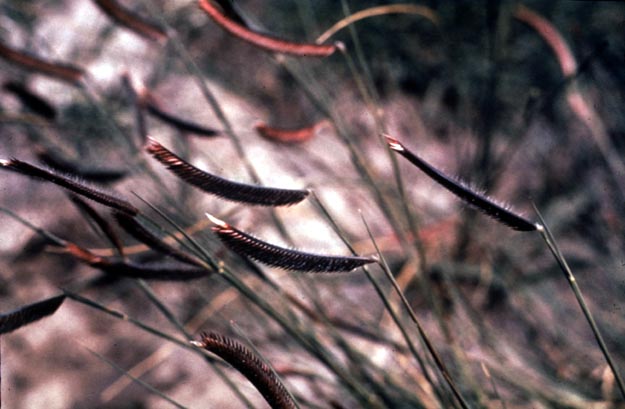
Blue Grama

Blue Grama

Bouteloua gracilis

Unknown author, Public domain, via Wikimedia Commons

Side by side

Bouteloua polymorphaBlue Grama
Scientific nameBouteloua polymorpha (E.Fourn.) ColumbusBouteloua gracilis (Kunth) Lag. ex Griffiths
English nameNot recordedBlue Grama
GroupFlowering plantsFlowering plants
ClassLiliopsidaLiliopsida
OrderPoalesPoales
FamilyPoaceae TurfPoaceae Turf
GenusBouteloua GramaBouteloua Grama
Red List categoryNot recordedLeast Concern
Countries on record1 country8 countries
GBIF occurrence records161 records17,387 records

Rows where the two agree are shown in grey.

Where each is found

Both recorded in 1 country

Only Blue Grama (7)

From Catalogue of Life checklists and GBIF occurrence records. A country missing from a list means no record is held, which is not proof of absence.

Checked facts

Bouteloua polymorphaBlue Grama
AppearanceNo checked fact yet
  • Blue grama has green to greyish leaves that are less than 3 mm wide. English Wikipedia
  • The leaves of blue grama are 25 to 250 mm long. English Wikipedia
  • Blue grama produces comb-like flower spikes that usually number two and extend at a sharp angle from the flowering stem. English Wikipedia
  • Each blue grama spike contains between 20 and 90 spikelets. English Wikipedia
  • Each spikelet contains one fertile floret and one or two reduced sterile florets. English Wikipedia
  • The fertile floret has a lemma with three short awns at its tip. English Wikipedia
  • Pollinated fertile florets produce brown oblong-elliptic seeds measuring 2.5 to 3 mm long. English Wikipedia
  • The mature spikelet detaches while its two glumes remain attached. English Wikipedia
SizeNo checked fact yet
HabitatNo checked fact yet
  • Blue grama is an important component of shortgrass prairie ecosystems. fs.usda.gov
  • Blue grama occurs in the understory of southwestern evergreen oak woodlands. fs.usda.gov
  • Blue grama occurs in ponderosa pine communities. fs.usda.gov
  • Blue grama commonly occurs in pinyon-juniper communities. fs.usda.gov
  • Blue grama occurs in semi-desert grasslands of the southwestern United States. fs.usda.gov
  • Blue grama thrives in arid environments such as the Gila region. nps.gov
DietNo checked fact yet
  • Blue grama provides forage for deer and small mammals. nps.gov
BehaviourNo checked fact yet
  • Established blue grama plants tolerate grazing, cold, and drought. English Wikipedia
  • Blue grama rapidly uses available water and becomes dormant during unfavorable conditions. English Wikipedia
  • Prolonged drought reduces the number and extent of blue grama roots. English Wikipedia
  • Blue grama recovers slowly following disturbance, with recovery depending on disturbance type and extent. English Wikipedia
ReproductionNo checked fact yet
  • Blue grama can establish readily from seed but relies more heavily on vegetative reproduction through tillers. English Wikipedia
  • Blue grama seed production is slow and depends on soil moisture and temperature. English Wikipedia
  • Successful blue grama seedling establishment requires some soil moisture during adventitious root development. English Wikipedia
  • Blue grama seedling establishment, survival, and growth are greatest when seedlings are isolated from neighboring adult plants. English Wikipedia
LifespanNo checked fact yet
DistributionNo checked fact yet
  • Blue grama is native to North America. English Wikipedia
  • Blue grama occurs from Alberta, Canada, south through the Rocky Mountains and Great Plains to the northern Mexican Plateau. English Wikipedia
  • Blue grama occurs as far west as Southern California and extends east to Missouri and Texas. English Wikipedia
ConservationNo checked fact yet
  • Blue grama is globally secure but vulnerable to extinction in some localized areas. fs.usda.gov
  • Blue grama is classified as an imperiled state priority plant in Idaho. fs.usda.gov
  • Blue grama is classified as critically imperiled in Missouri. fs.usda.gov
UsesNo checked fact yet
  • Blue grama is valued as livestock forage and is described as the most valuable grama grass. English Wikipedia
  • Blue grama is used in perennial gardens and native plant landscaping. English Wikipedia
  • Blue grama is used in habitat restoration projects. English Wikipedia
  • Blue grama is used for erosion control along residential areas, civic spaces, and highways. English Wikipedia
  • Blue grama flowers are used in dried flower arrangements. English Wikipedia
  • The Zuni people use blue grama bunches as hairbrushes and brooms. English Wikipedia
  • The Costanoan or Ohlone people have used the hollow stems of blue grama as drinking straws. English Wikipedia
  • The Navajo people have used blue grama as feed for sheep and horses. English Wikipedia
  • Blue grama is the official state grass of Colorado and New Mexico. English Wikipedia
OtherNo checked fact yet

In brief

Blue Grama

Blue grama is a long-lived perennial flowering grass in the family Poaceae. It is native to North America and occurs from Alberta, Canada, south through the Rocky Mountains and Great Plains to the northern Mexican Plateau. It produces usually two comb-like flower spikes that extend at a sharp angle from the flowering stem. Full profile

Compare something else

Page built on 26 November 2026 from the data on the two species pages, where every source is listed.

Cite this page

ScientificNames.org. (2026). Bouteloua polymorpha vs Blue Grama. Retrieved November 26, 2026, from https://scientificnames.org/compare/bouteloua-polymorpha-vs-blue-grama