Comparison
Pumpkin Toadlet vs Pumpkin Toadlet
Pumpkin Toadlet (Brachycephalus pitanga) and Pumpkin Toadlet (Brachycephalus ephippium) both belong to the genus Brachycephalus (saddleback toad) and part ways below it. Both are recorded in 1 country.

Pumpkin Toadlet
Brachycephalus pitanga
Carlos Henrique Luz Nunes de Almeida, CC BY 3.0, via Wikimedia Commons


Side by side
| Pumpkin Toadlet | Pumpkin Toadlet | |
|---|---|---|
| Scientific name | Brachycephalus pitanga Alves, Sawaya, Reis & Haddad, 2009 | Brachycephalus ephippium (Spix, 1824) |
| English name | Pumpkin Toadlet | Pumpkin Toadlet |
| Group | Amphibians | Amphibians |
| Class | Amphibia Amphibians | Amphibia Amphibians |
| Order | Anura Frogs | Anura Frogs |
| Family | Brachycephalidae Shield Toads | Brachycephalidae Shield Toads |
| Genus | Brachycephalus Saddleback Toad | Brachycephalus Saddleback Toad |
| Named in | 2009 | 1824 |
| Red List category | Not recorded | Least Concern |
| Countries on record | 1 country | 2 countries |
| GBIF occurrence records | 432 records | 1,007 records |
Rows where the two agree are shown in grey.
Where each is found
Both recorded in 1 country
Only Pumpkin Toadlet (1)
From Catalogue of Life checklists and GBIF occurrence records. A country missing from a list means no record is held, which is not proof of absence.
Checked facts
| Pumpkin Toadlet | Pumpkin Toadlet | |
|---|---|---|
| Appearance |
|
|
| Size |
|
|
| Habitat |
|
|
| Diet | No checked fact yet |
|
| Behaviour |
|
|
| Reproduction | No checked fact yet |
|
| Distribution |
|
|
| Conservation |
|
|
| Similar species | No checked fact yet |
|
| Other |
|
|
In brief
Pumpkin Toadlet
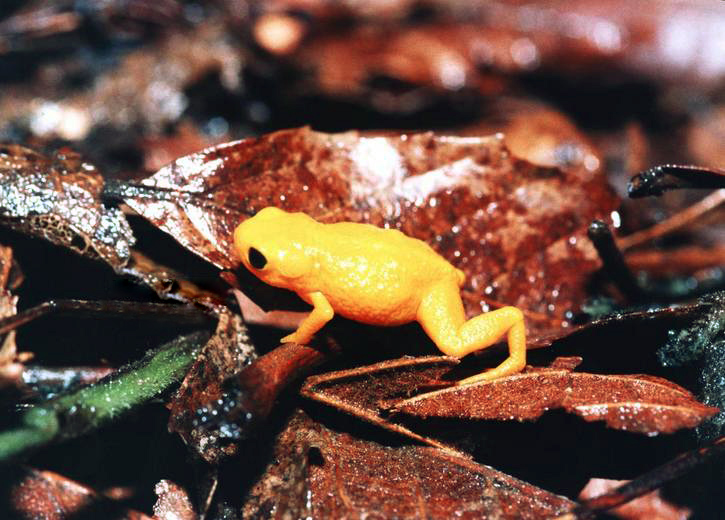
Brachycephalus pitanga, known as the Pumpkin Toadlet, is an amphibian in the family Brachycephalidae, order Anura and class Amphibia. It inhabits leaf litter on the rainforest floor. It has an overall orange coloration with irregular red markings on its upper surfaces, which vary in extent. Full profile
Pumpkin Toadlet
Brachycephalus ephippium inhabits leaf litter in primary and secondary montane forests of southeastern Brazil. Adults have bright yellow-orange coloration, rounded black eyes and skin with tiny wart-like bumps along the back. Full profile
Compare something else
Page built on 28 November 2026 from the data on the two species pages, where every source is listed.
Cite this page
ScientificNames.org. (2026). Pumpkin Toadlet vs Pumpkin Toadlet. Retrieved November 28, 2026, from https://scientificnames.org/compare/brachycephalus-pitanga-vs-pumpkin-toadlet
“Pumpkin Toadlet vs Pumpkin Toadlet.” ScientificNames.org, 2026, scientificnames.org/compare/brachycephalus-pitanga-vs-pumpkin-toadlet. Accessed 28 Nov. 2026.
ScientificNames.org. “Pumpkin Toadlet vs Pumpkin Toadlet.” Accessed November 28, 2026. https://scientificnames.org/compare/brachycephalus-pitanga-vs-pumpkin-toadlet.
@misc{scientificnames_pumpkin_toadlet_vs_pumpkin_toadlet,
  author = {{ScientificNames.org}},
  title = {Pumpkin Toadlet vs Pumpkin Toadlet},
  year = {2026},
  url = {https://scientificnames.org/compare/brachycephalus-pitanga-vs-pumpkin-toadlet},
  note = {Accessed 2026-11-28}
}