Species · Amphibians
Pumpkin Toadlet Brachycephalus pitanga
The scientific name of the Pumpkin Toadlet is Brachycephalus pitanga. It is a species of amphibian in the family Brachycephalidae (shield toads), order Anura. The name dates from 2009.
- Scientific name
- Brachycephalus pitanga Alves, Sawaya, Reis & Haddad, 2009
- Common name
- Pumpkin Toadlet
- Genus
- Brachycephalus
- Family
- Brachycephalidae (Shield Toads)
- Order
- Anura
- Class
- Amphibia
- Recorded in
- 1 country
- Name status
- accepted in the Catalogue of Life

Overview
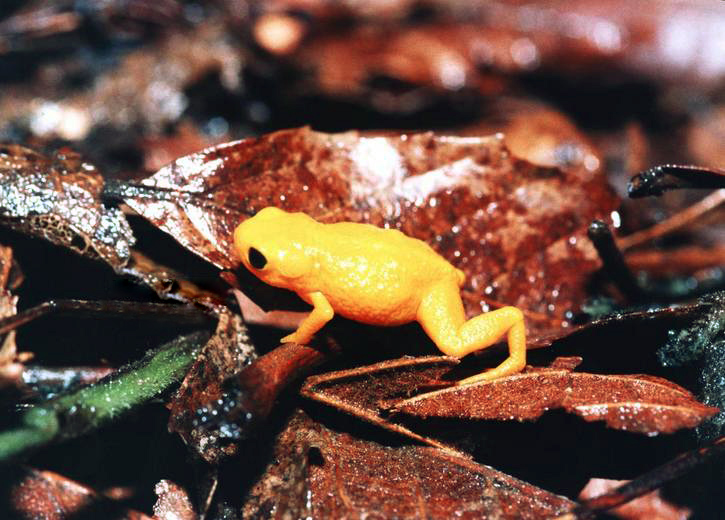
Brachycephalus pitanga, known as the Pumpkin Toadlet, is an amphibian in the family Brachycephalidae, order Anura and class Amphibia. It inhabits leaf litter on the rainforest floor. It has an overall orange coloration with irregular red markings on its upper surfaces, which vary in extent.
Written 26 November 2026 from the sources listed below. Each statement was checked against the passage it cites; statements that could not be supported were removed.
Appearance
The Pumpkin Toadlet has an overall orange coloration with irregular red markings on its upper surfaces. The red coloration varies from almost absent to covering nearly the entire upper body.[1][2]
Adult males measure 10.8–12.1 mm in snout-to-vent length, while adult females measure 12.6–14 mm.[3][4]
Habitat
The Pumpkin Toadlet inhabits leaf litter on the rainforest floor.[5]
It is endemic to Atlantic rainforests in São Paulo state, southeastern Brazil. It is known from four localities in the municipalities of Ubatuba and São Luiz do Paraitinga, at elevations between 900 and 1,140 metres.[6][7][8]
Behaviour
The Pumpkin Toadlet is active during daylight hours. Individuals generally remain concealed and show little activity during dry weather, but can be observed walking on leaf litter during the wet season and periods of high humidity.[9][10][11]
The species cannot hear the frequency of its own advertisement calls because its ears are underdeveloped. It retains some hearing ability at frequencies outside its own advertisement call.[12][13]
Communication appears to involve movements such as vocal sac inflation, mouth gaping and arm waving.[14]
Conservation
The Pumpkin Toadlet is not considered threatened. Two of its four known localities are protected within Serra do Mar State Park.[15][16]
Classification of the Pumpkin Toadlet
| Kingdom | Animalia |
|---|---|
| Phylum | Chordata |
| Subphylum | Vertebrata |
| Infraphylum | Gnathostomata |
| Parvphylum | Osteichthyes |
| Megaclass | Tetrapoda |
| Class | Amphibia (Amphibians) |
| Order | Anura (Frogs) |
| Superfamily | Brachycephaloidea |
| Family | Brachycephalidae (Shield Toads) |
| Genus | Brachycephalus (Saddleback Toad) |
| Species | Brachycephalus pitanga Alves, Sawaya, Reis & Haddad, 2009 |
Where the Pumpkin Toadlet is found
Checklists and occurrence records place Brachycephalus pitanga in 1 country. GBIF holds 432 georeferenced records of it.
Countries
Regions and cities with the most records
A number beside a place is its count of GBIF occurrence records. A place without a number comes from a checklist alone. Records show where a species has been observed or collected, which can include escapes and vagrants.
Common names
English
- Pumpkin Toadlet
- Santa Virgínia Flea Toad
Names in 1 other language
- Portuguese
- Pingo de Ouro, Sapinho-Pitanga
Related species
-
 Pumpkin ToadletBrachycephalus ephippium
-
 Brazilian Flea ToadBrachycephalus pulex
-
 Brachycephalus dacnis
-
 Brazilian Gold FrogBrachycephalus didactylus
- Morro Anhangava Flea ToadBrachycephalus pernix
-
 Pico Caratuva Flea ToadBrachycephalus brunneus
-
 Vargem Alta Flea ToadBrachycephalus alipioi
-
 Pedra Da Tartaruga Flea ToadBrachycephalus auroguttatus
Compare
Questions and answers
What is the scientific name of the Pumpkin Toadlet?
The scientific name of the Pumpkin Toadlet is Brachycephalus pitanga. Written with its author, the full name is Brachycephalus pitanga Alves, Sawaya, Reis & Haddad, 2009.
Which family does the Pumpkin Toadlet belong to?
Brachycephalus pitanga belongs to the family Brachycephalidae, in the order Anura and the class Amphibia.
Where is the Pumpkin Toadlet found?
Checklists and occurrence records place Brachycephalus pitanga in 1 country: Brazil.
What other names does the Pumpkin Toadlet have?
Brachycephalus pitanga is also known in English as Santa Virgínia Flea Toad.
Are pumpkin toadlets endangered?
The Pumpkin Toadlet is not considered threatened.[15]
Sources
Passages the profile rests on
- The species has an overall orange coloration with irregular red markings on its upper surfaces. Source passage: “It is overall orange, but with irregular red markings above.” — English Wikipedia
- The amount of red coloration varies from almost absent to covering nearly the entire upper body. Source passage: “The extent of these marking vary greatly; from individuals where there are almost none (they are almost entirely orange throughout) to individuals where the upperparts are almost entirely red.” — English Wikipedia
- Adult males measure 10.8–12.1 mm in snout-to-vent length. Source passage: “snout–to–vent length of 10.8–12.1 mm (0.43–0.48 in) in adult males” — English Wikipedia
- Adult females measure 12.6–14 mm in snout-to-vent length. Source passage: “12.6–14 mm (0.50–0.55 in) in adult females” — English Wikipedia
- The species inhabits leaf litter on the rainforest floor. Source passage: “The red pumpkin toadlet is diurnal and live in leaf litter on the rainforest floor.” — English Wikipedia
- The species is endemic to Atlantic rainforests in São Paulo state, southeastern Brazil. Source passage: “It is endemic to Atlantic rainforests in São Paulo state of southeastern Brazil” — English Wikipedia
- The species is known from four localities in the municipalities of Ubatuba and São Luiz do Paraitinga. Source passage: “only known from four localities at an altitude of 900–1,140 m (2,950–3,740 ft) in Ubatuba (the type locality) and São Luiz do Paraitinga.” — English Wikipedia
- The species has recorded localities at elevations between 900 and 1,140 metres. Source passage: “at an altitude of 900–1,140 m (2,950–3,740 ft)” — English Wikipedia
- The species is active during daylight hours. Source passage: “The red pumpkin toadlet is diurnal” — English Wikipedia
- Individuals generally remain concealed and show little activity during dry weather. Source passage: “During dry weather they mostly remain hidden and there is little activity” — English Wikipedia
- Individuals can be observed walking on leaf litter during the wet season and periods of high humidity. Source passage: “during the wet season and high humidity they can be seen walking on top of the leaf litter.” — English Wikipedia
- The species cannot hear the frequency of its own advertisement calls because its ears are underdeveloped. Source passage: “are unable to hear the frequency of their own advertising calls, as their ears are underdeveloped.” — English Wikipedia
- The species retains some hearing ability at frequencies outside its own advertisement call. Source passage: “they do have some hearing ability in frequencies outside their call” — English Wikipedia
- Communication appears to involve movements such as vocal sac inflation, mouth gaping and arm waving. Source passage: “their communication appears to rely on certain movements like the vocal sac that inflates when calling, mouth gaping and waving of their arms.” — English Wikipedia
- The species is not considered threatened. Source passage: “the red pumpkin toadlet is not considered threatened.” — English Wikipedia
- Two of the four known localities are protected within Serra do Mar State Park. Source passage: “two of the known localities are protected by the Serra do Mar State Park.” — English Wikipedia
Data
- Catalogue of Life, 2026-10-16 XR cc by
- Global Biodiversity Information Facility CC BY 4.0
- Wikidata CC0
- GeoNames CC BY 4.0
- Wikimedia Commons per image; credit shown with each image
- Within the Catalogue of Life, this name comes from The Integrated Taxonomic Information System cc0
References
- New species of Brachycephalus (Anura: Brachycephalidae) from the Atlantic rain forest in Sao Paulo State, southeastern Brazil. (2009). Journal of Herpetology, 43(2), 212–219. https://doi.org/10.1670/0022-1511-43.2.212 Link where the name was published
This species in other databases
Page built on 27 November 2026. See how the catalog is made and all sources and licences.
Cite this page
ScientificNames.org. (2026). Brachycephalus pitanga (Pumpkin Toadlet). Retrieved November 27, 2026, from https://scientificnames.org/species/brachycephalus-pitanga
“Brachycephalus pitanga (Pumpkin Toadlet).” ScientificNames.org, 2026, scientificnames.org/species/brachycephalus-pitanga. Accessed 27 Nov. 2026.
ScientificNames.org. “Brachycephalus pitanga (Pumpkin Toadlet).” Accessed November 27, 2026. https://scientificnames.org/species/brachycephalus-pitanga.
@misc{scientificnames_brachycephalus_pitanga_pumpkin_toadlet,
  author = {{ScientificNames.org}},
  title = {Brachycephalus pitanga (Pumpkin Toadlet)},
  year = {2026},
  url = {https://scientificnames.org/species/brachycephalus-pitanga},
  note = {Accessed 2026-11-27}
}