Comparison
Hill Kurrajong vs Queensland Bottle Tree
Hill Kurrajong (Brachychiton collinus) and Queensland Bottle Tree (Brachychiton rupestris) both belong to the genus Brachychiton (bottletree) and part ways below it. Both are recorded in 1 country.

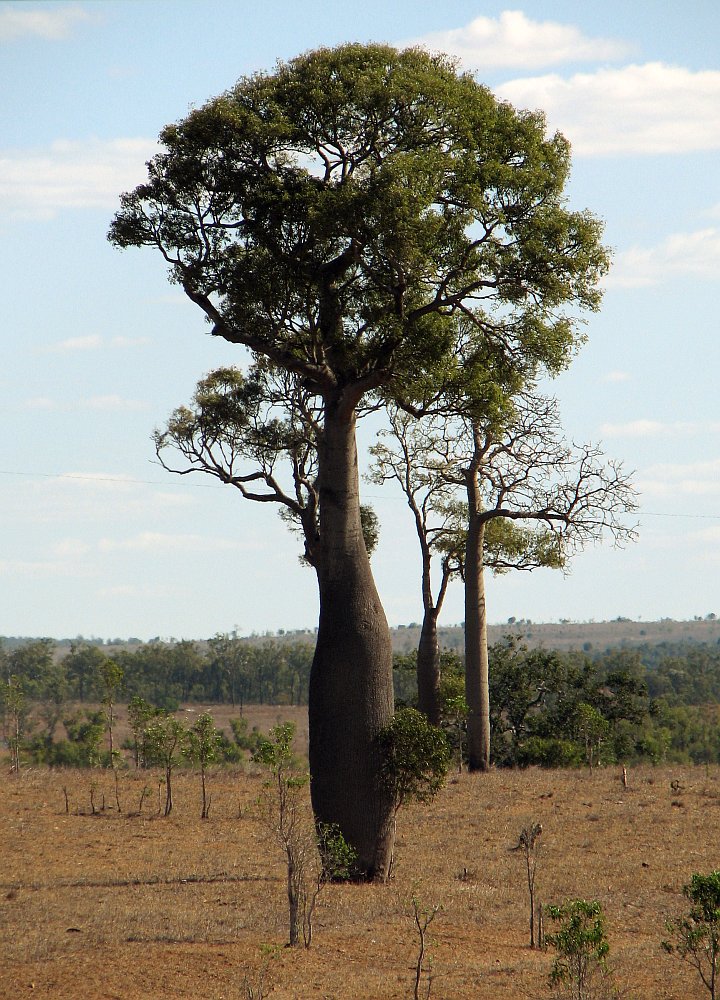


Side by side
| Hill Kurrajong | Queensland Bottle Tree | |
|---|---|---|
| Scientific name | Brachychiton collinus Guymer | Brachychiton rupestris (Lindl.) Schum. |
| English name | Hill Kurrajong | Queensland Bottle Tree |
| Group | Flowering plants | Flowering plants |
| Class | Magnoliopsida | Magnoliopsida |
| Order | Malvales | Malvales |
| Family | Malvaceae Mallow Family | Malvaceae Mallow Family |
| Genus | Brachychiton Bottletree | Brachychiton Bottletree |
| Red List category | Near Threatened | Least Concern |
| Countries on record | 1 country | 3 countries |
| GBIF occurrence records | 139 records | 982 records |
Rows where the two agree are shown in grey.
Where each is found
Both recorded in 1 country
Only Queensland Bottle Tree (2)
From Catalogue of Life checklists and GBIF occurrence records. A country missing from a list means no record is held, which is not proof of absence.
Checked facts
| Hill Kurrajong | Queensland Bottle Tree | |
|---|---|---|
| Appearance |
|
|
| Size | No checked fact yet |
|
| Habitat |
|
|
| Diet | No checked fact yet |
|
| Behaviour |
|
|
| Reproduction | No checked fact yet |
|
| Distribution |
|
|
| Conservation | No checked fact yet |
|
| Uses | No checked fact yet |
|
| Similar species | No checked fact yet |
|
In brief
Hill Kurrajong
Hill Kurrajong is a small deciduous tree. It is commonly found between Cloncurry and Mount Isa in north-west Queensland, Australia. It most often grows on rocky outcrops where few other scrub plants, grasses, or understory plants can survive. Full profile
Queensland Bottle Tree
The Queensland Bottle Tree is a tree that typically reaches 10–20 metres in height. The species is endemic to Queensland, Australia, and its natural range extends across central Queensland between latitudes 22° S and 28° S. The species develops a distinctive bulbous trunk that can reach 3.5 metres in diameter at breast height. Full profile
Compare something else
Page built on 28 November 2026 from the data on the two species pages, where every source is listed.
Cite this page
ScientificNames.org. (2026). Hill Kurrajong vs Queensland Bottle Tree. Retrieved November 28, 2026, from https://scientificnames.org/compare/hill-kurrajong-vs-queensland-bottle-tree
“Hill Kurrajong vs Queensland Bottle Tree.” ScientificNames.org, 2026, scientificnames.org/compare/hill-kurrajong-vs-queensland-bottle-tree. Accessed 28 Nov. 2026.
ScientificNames.org. “Hill Kurrajong vs Queensland Bottle Tree.” Accessed November 28, 2026. https://scientificnames.org/compare/hill-kurrajong-vs-queensland-bottle-tree.
@misc{scientificnames_hill_kurrajong_vs_queensland_bottle_tree,
  author = {{ScientificNames.org}},
  title = {Hill Kurrajong vs Queensland Bottle Tree},
  year = {2026},
  url = {https://scientificnames.org/compare/hill-kurrajong-vs-queensland-bottle-tree},
  note = {Accessed 2026-11-28}
}