Species · Flowering plants
Queensland Bottle Tree Brachychiton rupestris
The scientific name of the Queensland Bottle Tree is Brachychiton rupestris. It is a species of flowering plant in the family Malvaceae (mallow family), order Malvales.
- Scientific name
- Brachychiton rupestris (Lindl.) Schum.
- Common name
- Queensland Bottle Tree
- Genus
- Brachychiton
- Family
- Malvaceae (Mallow Family)
- Order
- Malvales
- Class
- Magnoliopsida
- Red List category
- LC Least Concern
- Recorded in
- 3 countries
- Name status
- accepted in the Catalogue of Life
Overview
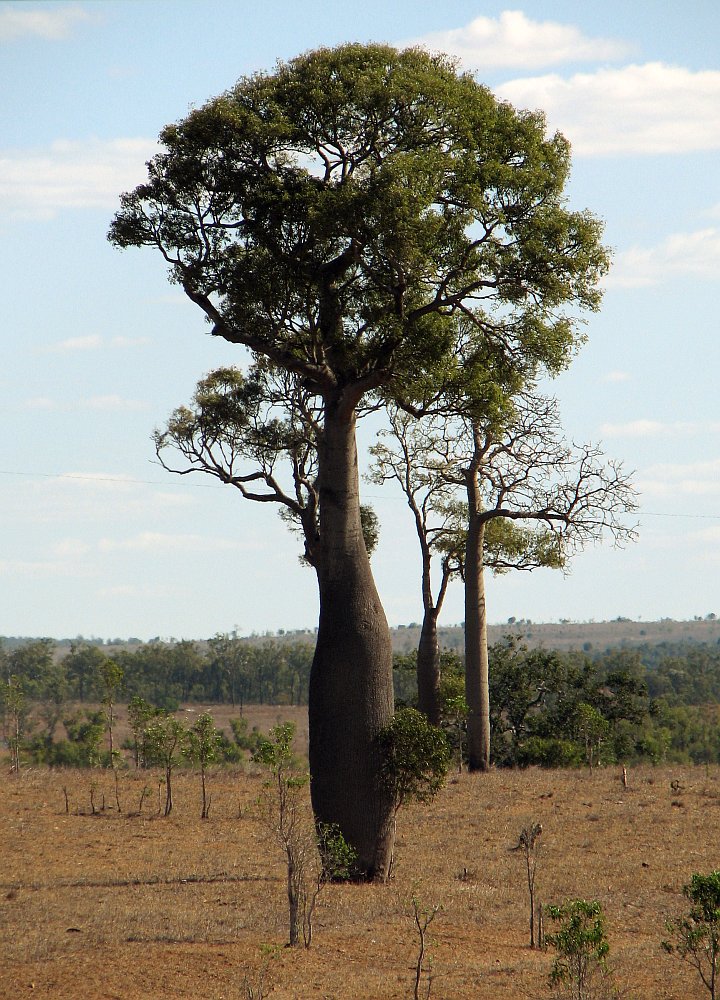
The Queensland Bottle Tree is a tree that typically reaches 10–20 metres in height. The species is endemic to Queensland, Australia, and its natural range extends across central Queensland between latitudes 22° S and 28° S. The species develops a distinctive bulbous trunk that can reach 3.5 metres in diameter at breast height.
Written 26 November 2026 from the sources listed below. Each statement was checked against the passage it cites; statements that could not be supported were removed.
Appearance
The Queensland Bottle Tree develops a distinctive bulbous trunk. Its bark is dark grey, with shallow tessellation and deeper fissures.[1][2]
The leaves are alternately arranged along the stems. Adult leaves have glossy upper surfaces and pale undersides, with blades measuring 4–11 centimetres long and 0.8–2 centimetres wide.[3][4][5]
Juvenile compound leaves have three to nine lanceolate or linear lobes. The flowers are creamy-yellow with red markings and measure 0.5–1 centimetre long and 1.3–1.8 centimetres wide.[6][7][8]
Habitat
The Queensland Bottle Tree grows on hilltops, hill slopes and ridges in low hilly country. Its habitat soils include clay, shale and basalt.[9][10]
The species occurs as an emergent tree in forests dominated by brigalow, hoop pine or ooline. It is consistently present in the Central semi-evergreen vine thicket ecosystem of the Brigalow Belt.[11][12]
The species also occurs in an endangered ecosystem of semi-evergreen vine thickets in the Brigalow Belt and Nandewar bioregions.[13]
Diet
The roots of young Queensland Bottle Trees have been eaten by Aboriginal people.[14]
Behaviour
The Queensland Bottle Tree is deciduous and typically loses its leaves between September and December in its native habitat. Extreme rainfall or drought can affect the timing, duration and extent of leaf shedding.[15][16]
Reproduction and life cycle
The Queensland Bottle Tree is monoecious, with separate male and female flowers on each plant. Male flowers contain 15 stamens, while female flowers have cream or white stigmas.[17][18][19]
Flowering in the species' native range occurs between September and November. Trees grown from seed can take up to 20 years to flower.[20][21]
The species produces groups of three to five woody, boat-shaped follicles. Each follicle generally contains four to eight seeds, occasionally containing up to twelve.[22][23]
The seeds measure 6–7 millimetres long and 3.5–4.5 millimetres wide. The follicles ripen between November and May and split lengthwise to expose their seeds.[24][25][26]
The species can be propagated from seed. Semi-mature stem cuttings can be collected in late summer for propagation.[27][28]
Conservation
The Queensland Bottle Tree is classified as least concern under Queensland's Nature Conservation Act. Its population is declining across its geographical range.[29][30]
The species is conserved in several Queensland national parks, including Auburn River, Benarkin and Bunya Mountains.[31]
Uses
Aboriginal people consumed secretions obtained from wounds in the tree trunk. Fibre from the species was used to make nets.[32][33]
The species is planted in streets, parks, farms and gardens. It has also been cultivated as an indoor plant and a bonsai subject.[34][35]
Similar species
Brachychiton × turgidulus is a naturally occurring hybrid between the Queensland Bottle Tree and Brachychiton populneus subsp. populneus.[36]
Classification of the Queensland Bottle Tree
| Kingdom | Plantae |
|---|---|
| Subkingdom | Pteridobiotina |
| Phylum | Tracheophyta |
| Class | Magnoliopsida |
| Order | Malvales |
| Family | Malvaceae (Mallow Family) |
| Subfamily | Sterculioideae |
| Genus | Brachychiton (Bottletree) |
| Species | Brachychiton rupestris (Lindl.) Schum. |
Where the Queensland Bottle Tree is found
Checklists and occurrence records place Brachychiton rupestris in 3 countries across Asia and Oceania. GBIF holds 982 georeferenced records of it.
Countries where it is native or its origin is not stated
Countries where it has been introduced
Regions and cities with the most records
- Queensland, Australia 843
- New South Wales, Australia 59
- Rockhampton, Australia 19
- Brisbane, Australia 18
- Toowoomba, Australia 18
- Logan City, Australia 16
- Beidou, Taiwan 7
- Nantou, Taiwan 7
- Pitou, Taiwan 7
- Shetou, Taiwan 7
- Taiwan, Taiwan 7
- Tianwei, Taiwan 7
- Tianzhong, Taiwan 7
- Xihu, Taiwan 7
- Yongjing, Taiwan 7
- Yuanlin, Taiwan 7
- Zhongxing New Village, Taiwan 7
- Citong, Taiwan 6
- Erlin, Taiwan 6
- Erlun, Taiwan 6
- Linnei, Taiwan 6
- Victoria, Australia 6
- Xiluo, Taiwan 6
- St Albans, Australia 5
- Cessnock, Australia 3
3 more countries have a few records outside this range
These countries hold a few records of Brachychiton rupestris but lie outside the range the checklists give for it. Such records are often zoo or garden specimens, museum material or vagrants, so the species is not counted as occurring there.
Range as the checklists state it
Taiwan [I]; Australia (Queensland)
A number beside a place is its count of GBIF occurrence records. A place without a number comes from a checklist alone. Records show where a species has been observed or collected, which can include escapes and vagrants.
Common names
English
- Queensland Bottle Tree
- Kurrajong
- Narrow-leaved Bottle Tree
- Queensland Rattletree
- Bottletree
- Narrow-leaf Bottletree
Names in 1 other language
- German
- Queensland-Flaschenbaum
Synonyms
8 other scientific names have been used for this species and are now treated as synonyms of Brachychiton rupestris.
- Brachychiton delabechei F.Muell.
- Brachychiton rupestris (Lindl.) A.Terracc.
- Clompanus rupestris (T.Mitch. ex Lindl.) Kuntze
- Delabechea rupestris T.Mitch. ex Lindl.
- Oleobachia macrophylla Anon.
- Oleobachia palustrie Mast.
- Oleobachia palustris Mast.
- Sterculia rupestris (T.Mitch. ex Lindl.) Benth.
Related species
- Illawarra Flame TreeBrachychiton acerifolius
-
 KurrajongBrachychiton populneus
-
 LacebarkBrachychiton discolor
-
 Dwarf KurrajongBrachychiton bidwillii
-
 Desert KurrajongBrachychiton gregorii
-
 Broad-leaved BottletreeBrachychiton australis
-
 Northern KurrajongBrachychiton diversifolius
-
 Red-flowering KurrajongBrachychiton megaphyllus
Compare
Questions and answers
What is the scientific name of the Queensland Bottle Tree?
The scientific name of the Queensland Bottle Tree is Brachychiton rupestris. Written with its author, the full name is Brachychiton rupestris (Lindl.) Schum..
Which family does the Queensland Bottle Tree belong to?
Brachychiton rupestris belongs to the family Malvaceae, in the order Malvales and the class Magnoliopsida.
Where is the Queensland Bottle Tree found?
Checklists and occurrence records place Brachychiton rupestris in 3 countries, including Australia and New Zealand.
What is the conservation status of the Queensland Bottle Tree?
The IUCN Red List category recorded for Brachychiton rupestris is Least Concern (LC).
What other names does the Queensland Bottle Tree have?
Brachychiton rupestris is also known in English as Kurrajong, Narrow-leaved Bottle Tree, Queensland Rattletree, Bottletree and Narrow-leaf Bottletree.
Sources
Passages the profile rests on
- The species develops a distinctive bulbous trunk. Source passage: “it earned its name from its bulbous trunk” — English Wikipedia
- The species has dark grey bark with shallow tessellation and deeper fissures. Source passage: “It has dark grey bark and is marked by shallow tessellation and deeper fissures.” — English Wikipedia
- The leaves are alternately arranged along the stems. Source passage: “the leaves are alternately arranged along the stems.” — English Wikipedia
- Adult leaves have glossy upper surfaces and pale undersides. Source passage: “The upper surface is glossy, contrasting with a pale undersurface.” — English Wikipedia
- Adult leaf blades measure 4–11 centimetres long and 0.8–2 centimetres wide. Source passage: “The adult leaf blades are 4–11 cm (1.6–4.3 in) long and 0.8–2 cm (0.3–0.8 in) wide” — English Wikipedia
- Juvenile compound leaves have three to nine lanceolate or linear lobes. Source passage: “The compound juvenile leaves have 3–9 spear-shaped (lanceolate) or linear lobes.” — English Wikipedia
- The flowers are creamy-yellow with red markings. Source passage: “Panicles of creamy-yellow flowers with red markings appear” — English Wikipedia
- Each flower measures 0.5–1 centimetre long and 1.3–1.8 centimetres wide. Source passage: “each flower is 0.5–1 cm (0.2–0.4 in) long and 1.3–1.8 cm (0.5–0.7 in) wide.” — English Wikipedia
- The species grows on hilltops, hill slopes and ridges in low hilly country. Source passage: “It grows on the tops and slopes of hills or ridges in low hilly country” — English Wikipedia
- Its habitat soils include clay, shale and basalt. Source passage: “in clay, shale, or basalt soils.” — English Wikipedia
- The species occurs as an emergent tree in forests dominated by brigalow, hoop pine or ooline. Source passage: “It is an emergent tree in forests dominated by brigalow (Acacia harpophylla), hoop pine (Araucaria cunninghamii), or ooline (Cadellia pentastylis).” — English Wikipedia
- The species is consistently present in the Central semi-evergreen vine thicket ecosystem of the Brigalow Belt. Source passage: “It is always present in the Central semi-evergreen vine thicket—also known as Bottletree Scrub—of the Brigalow Belt.” — English Wikipedia
- The species occurs in an endangered ecosystem of semi-evergreen vine thickets in the Brigalow Belt and Nandewar bioregions. Source passage: “semi-evergreen vine thickets of the Brigalow Belt (North and South) and Nandewar bioregions” — English Wikipedia
- The roots of young plants have been eaten by Aboriginal people. Source passage: “eating the roots of young plants” — English Wikipedia
- The species is deciduous and typically loses its leaves between September and December in its native habitat. Source passage: “Trees in their native habitat are typically leafless between September and December” — English Wikipedia
- Extreme rainfall or drought can affect the timing, duration and extent of leaf shedding. Source passage: “the timing, duration and extent of leaf drop may be affected by extremes of rainfall or drought.” — English Wikipedia
- The species is monoecious, with separate male and female flowers on each plant. Source passage: “B. rupestris is monoecious—each plant has distinct male and female flowers.” — English Wikipedia
- Male flowers contain 15 stamens. Source passage: “Male flowers have 15 stamens” — English Wikipedia
- The female flowers have cream or white stigmas. Source passage: “female flowers have cream or white stigmas” — English Wikipedia
- Flowering in the species' native range occurs between September and November. Source passage: “Panicles of creamy-yellow flowers with red markings appear from September to November in the species' native range.” — English Wikipedia
- The species can take up to 20 years to flower when grown from seed. Source passage: “Bottle trees grown from seed may take up to 20 years to flower.” — English Wikipedia
- The species produces groups of three to five woody, boat-shaped follicles. Source passage: “Groups of 3 to 5 woody boat-shaped follicles” — English Wikipedia
- Each follicle generally contains four to eight seeds, occasionally containing up to twelve. Source passage: “each containing 4 to 8 (or occasionally up to 12) seeds” — English Wikipedia
- The seeds measure 6–7 millimetres long and 3.5–4.5 millimetres wide. Source passage: “6–7 mm (0.24–0.28 in) long by 3.5–4.5 mm (0.14–0.18 in) wide” — English Wikipedia
- The follicles ripen between November and May. Source passage: “develop from November to May.” — English Wikipedia
- The follicles split lengthwise to expose their seeds. Source passage: “split along their length to reveal seeds.” — English Wikipedia
- The species can be propagated from seed. Source passage: “Plants are readily propagated from seed.” — English Wikipedia
- Semi-mature stem cuttings can be collected in late summer for propagation. Source passage: “Stem cuttings of semi-mature growth can be taken in late summer” — English Wikipedia
- The species is classified as least concern under Queensland's Nature Conservation Act. Source passage: “Although the species status under Queensland's Nature Conservation Act is least concern” — English Wikipedia
- The species is declining across its geographical range. Source passage: “and is declining across its range.” — English Wikipedia
- The species is conserved in several Queensland national parks, including Auburn River, Benarkin and Bunya Mountains. Source passage: “including Auburn River, Benarkin, Bunya Mountains, Coalstoun Lakes, Dipperu, Good Night Scrub, Humboldt, Isla Gorge and Tregole.” — English Wikipedia
- Aboriginal people consumed secretions obtained from wounds in the tree trunk. Source passage: “consuming secretions from the trunk that were induced by wounds.” — English Wikipedia
- Fibre from the species was used to make nets. Source passage: “Fibre obtained from the species was used to make nets.” — English Wikipedia
- The species is planted in streets, parks, farms and gardens. Source passage: “Bottle trees are commonly found planted in streets and parks, on farms, and as features in gardens.” — English Wikipedia
- The species has been cultivated as an indoor plant and a bonsai subject. Source passage: “The species has been cultivated as an indoor plant and a bonsai subject.” — English Wikipedia
- Brachychiton × turgidulus is a naturally occurring hybrid between this species and Brachychiton populneus subsp. populneus. Source passage: “Brachychiton × turgidulus is a naturally occurring hybrid cross of B. rupestris with the kurrajong B. populneus subsp. populneus.” — English Wikipedia
- The species is endemic to Queensland, Australia. Source passage: “endemic to the Australian state of Queensland.” — English Wikipedia
- Its natural range extends across central Queensland between latitudes 22° S and 28° S. Source passage: “found in central Queensland from latitude 22° S to 28° S” — English Wikipedia
Data
- Catalogue of Life, 2026-10-16 XR cc by
- Global Biodiversity Information Facility CC BY 4.0
- Wikidata CC0
- GeoNames CC BY 4.0
- Wikimedia Commons per image; credit shown with each image
- Within the Catalogue of Life, this name comes from Synonymic Checklists of the Vascular Plants of the World cc by
References
- Schum. (1893). Nat. Pflanzenfam. [Engler & Prantl] III, 6: 96 (1893). where the name was published
This species in other databases
Page built on 27 November 2026. See how the catalog is made and all sources and licences.
Cite this page
ScientificNames.org. (2026). Brachychiton rupestris (Queensland Bottle Tree). Retrieved November 27, 2026, from https://scientificnames.org/species/brachychiton-rupestris
“Brachychiton rupestris (Queensland Bottle Tree).” ScientificNames.org, 2026, scientificnames.org/species/brachychiton-rupestris. Accessed 27 Nov. 2026.
ScientificNames.org. “Brachychiton rupestris (Queensland Bottle Tree).” Accessed November 27, 2026. https://scientificnames.org/species/brachychiton-rupestris.
@misc{scientificnames_brachychiton_rupestris_queensland_bottle_tree,
  author = {{ScientificNames.org}},
  title = {Brachychiton rupestris (Queensland Bottle Tree)},
  year = {2026},
  url = {https://scientificnames.org/species/brachychiton-rupestris},
  note = {Accessed 2026-11-27}
}