Comparison

Long-billed Murrelet vs Common Murre

Long-billed Murrelet (Brachyramphus perdix) and Common Murre (Uria aalge) both belong to the family Alcidae (auk) and part ways below it. Both are recorded in 6 countries.
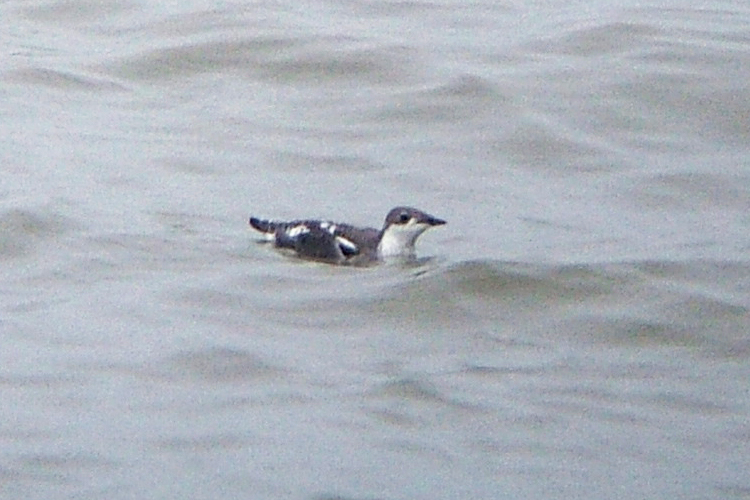
Long-billed Murrelet

Long-billed Murrelet

Brachyramphus perdix

MPF, CC BY 2.5, via Wikimedia Commons

Common Murre

Common Murre

Uria aalge

Charles J. Sharp, CC BY-SA 4.0, via Wikimedia Commons

Side by side

Long-billed MurreletCommon Murre
Scientific nameBrachyramphus perdix (Pallas, 1811)Uria aalge (Pontoppidan, 1763)
English nameLong-billed MurreletCommon Murre
GroupBirdsBirds
ClassAves BirdAves Bird
OrderCharadriiformes AuksCharadriiformes Auks
FamilyAlcidae AukAlcidae Auk
GenusBrachyramphus Marbled MurreletsUria Murres
Named in18111763
Red List categoryNear ThreatenedLeast Concern
Environmentmarine, terrestrialmarine, terrestrial
Countries on record7 countries33 countries
GBIF occurrence records770 records1,459,567 records

Rows where the two agree are shown in grey.

Where each is found

Both recorded in 6 countries

Only Long-billed Murrelet (1)

Only Common Murre (27)

From Catalogue of Life checklists and GBIF occurrence records. A country missing from a list means no record is held, which is not proof of absence.

Checked facts

Long-billed MurreletCommon Murre
Appearance
  • The Long-billed Murrelet has a chunky body and a slender black bill. English Wikipedia
  • The species has pointed wings and seasonal variations in its plumage. English Wikipedia
  • In non-breeding plumage, the bird is typically white underneath, with a black crown, nape, wings and back. English Wikipedia
  • During the breeding season, its plumage is predominantly brown, with pale feather edges creating a scaly appearance. English Wikipedia
  • The central underparts of breeding birds are white. English Wikipedia
  • The species has a white eye ring. English Wikipedia
  • Breeding individuals have a pale throat that is absent in the Marbled Murrelet. English Wikipedia
  • Its breeding plumage has weaker scaling than that of the Marbled Murrelet. English Wikipedia
  • In winter plumage, the species lacks the white collar found on the Marbled Murrelet. English Wikipedia
  • Breeding adults have black heads, necks, backs, and wings, with white underparts. English Wikipedia
  • Adults have a thin, dark, pointed bill and a small, rounded black tail. English Wikipedia
  • The legs and bill are generally dark grey. English Wikipedia
  • Some North Atlantic individuals have a white eye ring extending backward as a white line. English Wikipedia
  • The bridled form is a polymorphism rather than a distinct subspecies. English Wikipedia
  • First-winter plumage resembles adult winter plumage. English Wikipedia
  • Chicks have blackish feathers on their upperparts and white feathers underneath. English Wikipedia
  • Juveniles resemble adults but are smaller and have darker heads. animaldiversity.org
Size
  • The Long-billed Murrelet is approximately 20% heavier than the Marbled Murrelet. English Wikipedia
Habitat
  • Breeding habitat includes islands, rocky shores, cliffs, and sea stacks. English Wikipedia
  • The species spends most of its time at sea and comes ashore to breed. English Wikipedia
  • Breeding occurs on coastal cliffs and primarily rocky offshore islands. animaldiversity.org
  • The species primarily inhabits pelagic marine environments. animaldiversity.org
  • Its habitat includes coasts, shorelines, and the open ocean. audubon.org
Diet
  • The species mainly consumes small schooling forage fish measuring 200 mm or less. English Wikipedia
  • Common prey includes polar cod, capelin, sand lances, sprats, sandeels, Atlantic cod, and Atlantic herring. English Wikipedia
  • Capelin and sand lances are preferred foods. English Wikipedia
  • The species also eats molluscs, marine worms, squid, and crustaceans. English Wikipedia
  • Adults consume an average of 20–32 g of food daily. English Wikipedia
  • The species primarily consumes fish, including capelin, northern anchovy, and Pacific herring, as well as invertebrates and crustaceans. fws.gov
  • The species consumes approximately 30% of its body weight in food daily. fws.gov
Behaviour
Reproduction
  • The female lays a single egg on a thick branch or in a hollow covered with lichen or moss. English Wikipedia
  • The Long-billed Murrelet incubates its egg for approximately one month. English Wikipedia
  • The chick is fed for approximately 40 days before fledging. English Wikipedia
  • After fledging, the chick flies to the sea without an accompanying adult. English Wikipedia
LifespanNo checked fact yet
Distribution
  • The species breeds in Japan, across the Sea of Okhotsk region, and on the Kamchatka Peninsula in Russia. datazone.birdlife.org
  • Most individuals winter in seas around northern Japan. English Wikipedia
  • The species has a circumpolar distribution in low-Arctic and boreal waters of the North Atlantic and North Pacific. English Wikipedia
  • Pacific breeding populations extend from western Alaska to central California. animaldiversity.org
  • Atlantic breeding populations extend from Labrador to Nova Scotia. animaldiversity.org
Conservation
  • The Long-billed Murrelet is considered globally threatened. English Wikipedia
  • The species has declined across its range over recent decades. English Wikipedia
  • Logging-related loss of old-growth forest is identified as the greatest threat to the species. English Wikipedia
  • The species can also be lost through entanglement in fishing gear. English Wikipedia
  • Oil development on the Okhotsk and Bering Sea shelves is identified as a potential threat. English Wikipedia
  • A major die-off in the northeast Pacific during 2015–2016 was associated with the 2014–2016 marine heatwave. English Wikipedia
  • Approximately 62,000 dead or dying birds were documented along the Pacific coast from California to Alaska during the die-off. English Wikipedia
  • The die-off was attributed primarily to starvation following a reduction in the abundance and quality of forage fish. English Wikipedia
  • Threats include introduced predators, oil spills, gill nets, and pollution. fws.gov
UsesNo checked fact yet
  • The species' excrement is rich in potash, which contributes to the growth of marine species. animaldiversity.org
Similar species
  • The Long-billed Murrelet closely resembles the Marbled Murrelet. English Wikipedia
  • The Long-billed Murrelet was classified as a subspecies of the Marbled Murrelet until 1998. English Wikipedia
No checked fact yet

In brief

Long-billed Murrelet

The Long-billed Murrelet breeds in Japan, across the Sea of Okhotsk region and on the Kamchatka Peninsula in Russia, and most individuals winter in seas around northern Japan. It closely resembles the Marbled Murrelet but has a pale throat in breeding plumage, which is absent in the Marbled Murrelet. Full profile

Common Murre

The Common Murre is a bird that pursues prey underwater using its wings for propulsion. It has a circumpolar distribution in low-Arctic and boreal waters of the North Atlantic and North Pacific. Breeding adults have black upperparts and white underparts, with a thin, dark, pointed bill. Full profile

Compare something else

Page built on 28 November 2026 from the data on the two species pages, where every source is listed.

Cite this page

ScientificNames.org. (2026). Long-billed Murrelet vs Common Murre. Retrieved November 28, 2026, from https://scientificnames.org/compare/long-billed-murrelet-vs-common-murre