Species · Birds
Long-billed Murrelet Brachyramphus perdix
The scientific name of the Long-billed Murrelet is Brachyramphus perdix. It is a species of bird in the family Alcidae (auk), order Charadriiformes. The name dates from 1811.
- Scientific name
- Brachyramphus perdix (Pallas, 1811)
- Common name
- Long-billed Murrelet
- Genus
- Brachyramphus
- Family
- Alcidae (Auk)
- Order
- Charadriiformes
- Class
- Aves
- Red List category
- NT Near Threatened
- Environment
- marine, terrestrial
- Recorded in
- 7 countries
- Name status
- accepted in the Catalogue of Life
Overview
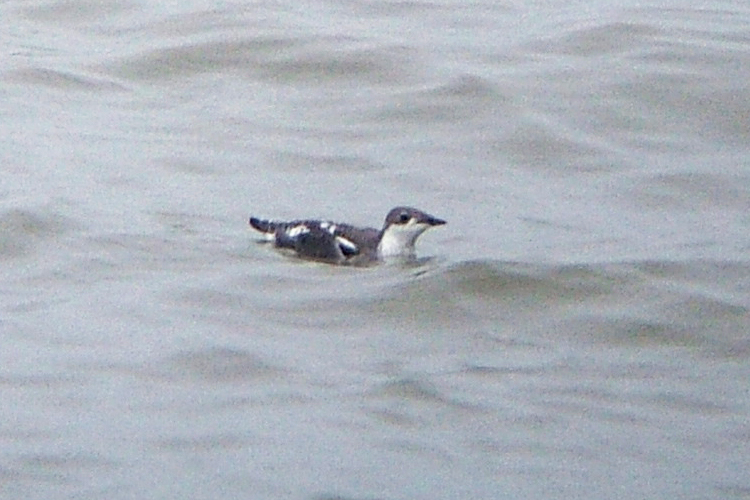
The Long-billed Murrelet breeds in Japan, across the Sea of Okhotsk region and on the Kamchatka Peninsula in Russia, and most individuals winter in seas around northern Japan. It closely resembles the Marbled Murrelet but has a pale throat in breeding plumage, which is absent in the Marbled Murrelet.
Written 26 November 2026 from the sources listed below. Each statement was checked against the passage it cites; statements that could not be supported were removed.
Appearance
The Long-billed Murrelet has a chunky body, a slender black bill and pointed wings. Its plumage varies seasonally, and it has a white eye ring.[1][2][3]
In non-breeding plumage, the bird is typically white underneath, with a black crown, nape, wings and back. During the breeding season, its plumage is predominantly brown, with pale feather edges creating a scaly appearance and white central underparts.[4][5][6]
Breeding individuals have a pale throat and weaker plumage scaling than the Marbled Murrelet. In winter plumage, the Long-billed Murrelet lacks the white collar found on the Marbled Murrelet.[7][8][9]
The Long-billed Murrelet is approximately 20% heavier than the Marbled Murrelet.[10]
Habitat
The Long-billed Murrelet nests inland in old-growth forests, on branches of old-growth conifer trees. It can nest far from the sea.[11][12][13]
The species feeds in pelagic offshore waters, often near upwellings, and in protected inshore bays. It is recorded in lakes, ponds, rivers and the open ocean.[14][15][16]
Diet
The Long-billed Murrelet feeds principally on small fish.[17]
Behaviour
The Long-billed Murrelet tends to migrate farther than the Marbled Murrelet. The species is unusually prone to vagrancy.[18][19]
The species does not normally breed in colonies and can nest far from the sea.[20][13]
Reproduction and life cycle
The female lays a single egg on a thick branch or in a hollow covered with lichen or moss. The Long-billed Murrelet incubates its egg for approximately one month.[21][22]
The chick is fed for approximately 40 days before fledging. After fledging, it flies to the sea without an accompanying adult.[23][24]
Conservation
The Long-billed Murrelet is considered globally threatened and has declined across its range over recent decades. Logging-related loss of old-growth forest is identified as the greatest threat to the species.[25][26][27]
The species can also be lost through entanglement in fishing gear. Oil development on the Okhotsk and Bering Sea shelves is identified as a potential threat.[28][29]
Similar species
The Long-billed Murrelet closely resembles the Marbled Murrelet. It was classified as a subspecies of the Marbled Murrelet until 1998.[30][31]
Classification of the Long-billed Murrelet
| Kingdom | Animalia |
|---|---|
| Phylum | Chordata |
| Subphylum | Vertebrata |
| Infraphylum | Gnathostomata |
| Parvphylum | Osteichthyes |
| Megaclass | Tetrapoda |
| Class | Aves (Bird) |
| Order | Charadriiformes (Auks) |
| Family | Alcidae (Auk) |
| Genus | Brachyramphus (Marbled Murrelets) |
| Species | Brachyramphus perdix (Pallas, 1811) |
Where the Long-billed Murrelet is found
Checklists and occurrence records place Brachyramphus perdix in 7 countries across North America. GBIF holds 770 georeferenced records of it.
Countries
Regions and cities with the most records
- Exeter, United Kingdom 106
- Exmouth, United Kingdom 106
- Newton Abbot, United Kingdom 106
- Torquay, United Kingdom 106
- Paignton, United Kingdom 81
- England, United Kingdom 79
- Cornwall, Canada 68
- Kosong, South Korea 63
- New York, United States 48
- Ontario, Canada 46
- Middletown, United States 30
- Narragansett, United States 30
- Newport, United States 30
- North Kingstown, United States 30
- South Kingstown, United States 30
- Pennsylvania, United States 27
- Ithaca, United States 26
- Alaska, United States 22
- Kamchatka, Russia 22
- Rhode Island, United States 22
- Fremont, United States 19
- Hokkaido, Japan 19
- Ohio, United States 19
- Tiffin, United States 19
- California, United States 18
- Florida, United States 18
- Arcata, United States 17
- Washington, United States 17
- Clarksville, United States 15
- Fern Creek, United States 15
- Highview, United States 15
- Jeffersontown, United States 15
- Jeffersonville, United States 15
- Louisville, United States 15
- New Albany, United States 15
- Newburg, United States 15
Range as the checklists state it
Europe & Northern Asia (excluding China)
North America
A number beside a place is its count of GBIF occurrence records. A place without a number comes from a checklist alone. Records show where a species has been observed or collected, which can include escapes and vagrants.
Common names
English
- Long-billed Murrelet
Names in 33 other languages
- Arabic
- موريليت طويل المنقار
- Breton
- Godog beg hir
- Catalan
- gavotí jaspiat asiàtic
- Chinese
- 長嘴海雀, 长嘴斑海雀
- Croatian
- dugokljuna njorka
- Czech
- alkoun dlouhozobý
- Danish
- Langnæbbet Dværgalk
- Dutch
- Aziatische Marmeralk
- Esperanto
- Longbeka urio, longbeka urieto
- Estonian
- ohhoota kirjuörd
- Finnish
- aasianmarmorimurri
- French
- Guillemot à long bec
- German
- Kamtschatka-Marmelalk, Kamtschatkamarmelalk, Langschnabelalk
- Greek
- Μακρύραμφος Δασόκεπφος
- Hebrew
- אלקית ארוכת-מקור
- Hungarian
- hosszúcsőrű törpealka
- Italian
- Urietta beccolungo
- Japanese
- ハシナガウミスズメ, マダラウミスズメ
- Korean
- 알락쇠오리
- Latvian
- garknābja kairīte
- Lithuanian
- Ilgasnapė alkutė
- Norwegian
- langnebbdvergteist
- Polish
- morzyk kamczacki
- Portuguese
- Airinho-de-bico-comprido, mérgulo-de-bico-longo, torda-pedrês
- Romanian
- Alcă cu cioc lung
- Russian
- Азиатский длинноклювый пыжик, Пёстрый пыжик, длинноклювый пыжик
- Serbian
- Dugokljuna njorčica
- Slovak
- alka bielooká
- Spanish
- Mérgulo jaspeado asiático, Mérgulo piquilargo
- Swedish
- långnäbbad marmoralka
- Turkish
- uzun gagalı dalıcı martı, Çilli Alk
- Ukrainian
- Довгодзьобий пижик, Пижик довгодзьобий, пижик охотський
- Welsh
- carfil hirbig
Synonyms
5 other scientific names have been used for this species and are now treated as synonyms of Brachyramphus perdix.
- Brachyramphus marmoratum perdix Pallas, PS, 1811
- Brachyramphus perdrix Pallas, PS, 1811
- Brachyrampus marmoratus perdix Pallas, PS, 1811
- Brachyrampus perdix (Pallas, 1811)
- Cepphus perdix Pallas, 1811
Related species
-
 Marbled MurreletBrachyramphus marmoratus
-
 Kittlitz's MurreletBrachyramphus brevirostris
-
 Atlantic PuffinFratercula arctica
-
 RazorbillAlca torda
-
 Common MurreUria aalge
-
 Black GuillemotCepphus grylle
-
 Tufted PuffinFratercula cirrhata
-
 Little AukAlle alle
Compare
Questions and answers
What is the scientific name of the Long-billed Murrelet?
The scientific name of the Long-billed Murrelet is Brachyramphus perdix. Written with its author, the full name is Brachyramphus perdix (Pallas, 1811).
Which family does the Long-billed Murrelet belong to?
Brachyramphus perdix belongs to the family Alcidae, in the order Charadriiformes and the class Aves.
Where is the Long-billed Murrelet found?
Checklists and occurrence records place Brachyramphus perdix in 7 countries, including United States, Russia, United Kingdom, Japan, South Korea and Canada.
What is the conservation status of the Long-billed Murrelet?
The IUCN Red List category recorded for Brachyramphus perdix is Near Threatened (NT).
What birds have long bills?
The Long-billed Murrelet has a slender black bill.[1]
Sources
Passages the profile rests on
- The Long-billed Murrelet has a chunky body and a slender black bill. Source passage: “a small (25 cm long), chunky auk with a slender black bill.” — English Wikipedia
- The species has pointed wings and seasonal variations in its plumage. Source passage: “It has pointed wings and plumage that varies by season.” — English Wikipedia
- The species has a white eye ring. Source passage: “and has a white eye ring.” — English Wikipedia
- In non-breeding plumage, the bird is typically white underneath, with a black crown, nape, wings and back. Source passage: “The non-breeding appearance is typically white underneath with a black crown, nape, wings and back.” — English Wikipedia
- During the breeding season, its plumage is predominantly brown, with pale feather edges creating a scaly appearance. Source passage: “The breeding plumage is mainly brown, with pale feather edges giving a scaly appearance” — English Wikipedia
- The central underparts of breeding birds are white. Source passage: “the central underparts, normally below the surface on a swimming bird, are white.” — English Wikipedia
- Breeding individuals have a pale throat that is absent in the Marbled Murrelet. Source passage: “In breeding plumage it shows a pale throat which is absent in marbled murrelet” — English Wikipedia
- Its breeding plumage has weaker scaling than that of the Marbled Murrelet. Source passage: “and weaker scaling because of fewer rusty and buff markings.” — English Wikipedia
- In winter plumage, the species lacks the white collar found on the Marbled Murrelet. Source passage: “In winter, the long-billed murrelet lacks the white collar of the marbled.” — English Wikipedia
- The Long-billed Murrelet is approximately 20% heavier than the Marbled Murrelet. Source passage: “and 20% heavier than the marbled murrelet” — English Wikipedia
- The species nests inland in old-growth forests. Source passage: “often nesting far inland in old growth forests.” — English Wikipedia
- The Long-billed Murrelet nests on branches of old-growth conifer trees. Source passage: “instead nesting in on branches of old-growth conifers.” — English Wikipedia
- The species can nest far from the sea. Source passage: “or even necessarily close to the sea” — English Wikipedia
- The species feeds in pelagic offshore waters, often near upwellings. Source passage: “in pelagic offshore areas (often associating with upwellings)” — English Wikipedia
- The species also feeds in protected inshore bays. Source passage: “and inshore in protected bays.” — English Wikipedia
- The species is recorded in lakes, ponds, rivers and the open ocean. Source passage: “Lakes, Ponds, and Rivers, Open Ocean.” — audubon.org
- The Long-billed Murrelet feeds principally on small fish. Source passage: “The long-billed murrelet feeds at sea principally on small fish” — English Wikipedia
- The species tends to migrate farther than the Marbled Murrelet. Source passage: “It tends to migrate more than its closest relative the marbled murrelet.” — English Wikipedia
- The species is unusually prone to vagrancy. Source passage: “The species is unusually prone to vagrancy” — English Wikipedia
- The Long-billed Murrelet does not normally breed in colonies. Source passage: “it does not breed in colonies” — English Wikipedia
- The female lays a single egg on a thick branch or in a hollow covered with lichen or moss. Source passage: “It lays one egg on a thick lichen- or moss-covered branch or hollow.” — English Wikipedia
- The Long-billed Murrelet incubates its egg for approximately one month. Source passage: “The egg is incubated for a month” — English Wikipedia
- The chick is fed for approximately 40 days before fledging. Source passage: “then the chick is fed for around 40 days until it fledges” — English Wikipedia
- After fledging, the chick flies to the sea without an accompanying adult. Source passage: “and flies unaccompanied to the sea.” — English Wikipedia
- The Long-billed Murrelet is considered globally threatened. Source passage: “The long-billed murrelet is considered globally threatened” — English Wikipedia
- The species has declined across its range over recent decades. Source passage: “having declined across its range over the last few decades.” — English Wikipedia
- Logging-related loss of old-growth forest is identified as the greatest threat to the species. Source passage: “The biggest threat to the murrelet is the loss of the old growth forest to logging.” — English Wikipedia
- The species can also be lost through entanglement in fishing gear. Source passage: “Other losses can occur through entanglement in fishing gear.” — English Wikipedia
- Oil development on the Okhotsk and Bering Sea shelves is identified as a potential threat. Source passage: “The bird could be threatened by the oil development of the Okhotsk and Bering Sea shelves.” — English Wikipedia
- The Long-billed Murrelet closely resembles the Marbled Murrelet. Source passage: “It closely resembles the marbled murrelet” — English Wikipedia
- The Long-billed Murrelet was classified as a subspecies of the Marbled Murrelet until 1998. Source passage: “of which it was considered a subspecies until 1998” — English Wikipedia
Data
- Catalogue of Life, 2026-10-16 XR cc by
- Global Biodiversity Information Facility CC BY 4.0
- Wikidata CC0
- GeoNames CC BY 4.0
- Wikimedia Commons per image; credit shown with each image
- Within the Catalogue of Life, this name comes from The Integrated Taxonomic Information System cc0
References
- Gill, Frank, & and Minturn Wright. (2006). Birds of the World: Recommended English Names.
- Dickinson, E. C., and J. V. Remsen Jr., eds. (2013). The Howard and Moore Complete Checklist of the Birds of the World, 4th Edition, Vol. 1 Non-Passerines.
- Howell, Steve N. G., Ian Lewington, and Will Russell. (2014). Rare Birds of North America.
This species in other databases
- Catalogue of Life 68RK2
- Wikidata Q1268226
- iNaturalist 4530
- WoRMS urn:lsid:marinespecies.org:taxname:254309
- Avibase lobmur
Page built on 26 November 2026. See how the catalog is made and all sources and licences.
Cite this page
ScientificNames.org. (2026). Brachyramphus perdix (Long-billed Murrelet). Retrieved November 26, 2026, from https://scientificnames.org/species/brachyramphus-perdix
“Brachyramphus perdix (Long-billed Murrelet).” ScientificNames.org, 2026, scientificnames.org/species/brachyramphus-perdix. Accessed 26 Nov. 2026.
ScientificNames.org. “Brachyramphus perdix (Long-billed Murrelet).” Accessed November 26, 2026. https://scientificnames.org/species/brachyramphus-perdix.
@misc{scientificnames_brachyramphus_perdix_long_billed_murrelet,
  author = {{ScientificNames.org}},
  title = {Brachyramphus perdix (Long-billed Murrelet)},
  year = {2026},
  url = {https://scientificnames.org/species/brachyramphus-perdix},
  note = {Accessed 2026-11-26}
}