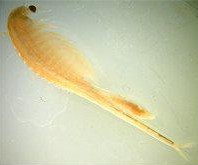
| Appearance | - The species lacks a carapace covering its head and back. English Wikipedia
- The shrimp has two stalked compound eyes. English Wikipedia
- Its phyllopods are leaflike or paddlelike structures on its legs. English Wikipedia
- Adult males have relatively smooth antennae consisting of two jointed segments of approximately equal length. English Wikipedia
- The second antennal segment of adult males bends inward approximately 90 degrees at its tip. English Wikipedia
- The larger of the two humps at the male antennal tip is positioned toward the front of the animal. English Wikipedia
- Females possess pear-shaped brood pouches that do not extend far down the body. English Wikipedia
| - The species has a delicate, elongated body, large stalked compound eyes, no carapace and eleven pairs of swimming legs. English Wikipedia
- A female specimen of the species is identified in the document. naturalreserves.ucdavis.edu
|
|---|
| Size | | |
|---|
| Habitat | - The species inhabits shallow ephemeral pools near the middle of California's Central Valley. English Wikipedia
- The species occurs in shallow vernal pools, vernal swales and artificial ephemeral wetlands. English Wikipedia
- The species has also been recorded in roadside puddles, scrapes, ditches and railroad toe-drain pools. English Wikipedia
- The species appears to prefer shallow pools containing cool water and low to moderate dissolved salt concentrations. English Wikipedia
- The species can tolerate warm water, with live adults recorded in water measuring 32 °C. English Wikipedia
- The species has been recorded in some relatively alkaline pools. English Wikipedia
- Pools occupied by the species averaged 10.1 centimetres in depth in a comparative study. English Wikipedia
| - The species inhabits relatively large, moderately turbid vernal pools containing cool water. English Wikipedia
- Its vernal pool habitats fill during the rainy season and gradually dry from their shallow outer edges toward their deeper centres. English Wikipedia
|
|---|
| Diet | - The species filters phytoplankton, detrital bacterial colonies, rotifers, protozoa and small larvae from the water. English Wikipedia
| - The species feeds on algae, bacteria, protozoa, rotifers and detritus. English Wikipedia
|
|---|
| Behaviour | - The species swims on its back through the water. English Wikipedia
- The shrimp propels itself through the water by beating its phyllopods. English Wikipedia
- The phyllopods function as gills by extracting oxygen from the water stream generated by their movement. English Wikipedia
- The phyllopods contain cells involved in salt exchange. English Wikipedia
| - Individuals swim upside down using coordinated, wave-like movements of their legs. English Wikipedia
- The species has been observed and collected in vernal pools between early November and early April. English Wikipedia
- Individuals disappear before their vernal pool habitat completely dries out. English Wikipedia
- Fairy shrimp undergo aestivation using heat- and drought-resistant cysts. naturalreserves.ucdavis.edu
|
|---|
| Reproduction | - Males use their antennae to clasp females during mating. English Wikipedia
- Females thrash about when clasped by males during mating. English Wikipedia
- Populations survive seasonal pond drying by laying eggs enclosed in nearly impervious shells. English Wikipedia
- Embryos inside the eggs enter a dormant developmental state called diapause. English Wikipedia
- The dormant eggs, known as cysts, can remain in the soil and produce new adult populations when pools refill. English Wikipedia
- The species can mature approximately eight days after hatching, although 26 days is the reported average. English Wikipedia
- Multiple hatching events have been observed during a single rainy season. English Wikipedia
| - Females carry their eggs in a ventral brood sac. English Wikipedia
- Females either release their eggs onto the pool bottom or retain them in the brood sac until they die and sink. English Wikipedia
- The eggs remain in the dry pool bed after the habitat dries and hatch following rainfall and other environmental stimuli. English Wikipedia
- The resting eggs of the species are called cysts. English Wikipedia
- The cysts can withstand heat, cold and prolonged periods of desiccation. English Wikipedia
- Only some cysts may hatch when the pools refill. English Wikipedia
- The soil cyst bank can contain eggs produced across several breeding years. English Wikipedia
- Hatching can start within the first week after a pool begins filling. English Wikipedia
- The average time to maturity is 49 days. English Wikipedia
- Maturity can occur in as few as 19 days in warmer pools. English Wikipedia
|
|---|
| Distribution | No checked fact yet | - The species is endemic to California, United States, according to the document's distribution summary. English Wikipedia
- Recorded populations include Montgomery Field Vernal Pools in San Diego County, California. English Wikipedia
- The species has been recorded in the Vina Plains in Tehama County, California. English Wikipedia
- The species has been recorded south of Chico in Butte County, California. English Wikipedia
- The Jepson Prairie Preserve and its surrounding area in Solano County, California, are recorded locations for the species. English Wikipedia
- The Sacramento National Wildlife Refuge Complex in Glenn County, California, is a recorded location. English Wikipedia
- Mapes Ranch west of Modesto, California, is a recorded location for the species. English Wikipedia
- The species has been recorded at San Luis National Wildlife Refuge in Merced County, California. English Wikipedia
- The Haystack Mountain and Yosemite Lake area in Merced County, California, is a recorded location. English Wikipedia
- Two locations on Los Padres National Forest in Ventura County, California, are recorded for the species. English Wikipedia
- A separate record reports the species in Minnesota. English Wikipedia
- The species' historical distribution has not been established. English Wikipedia
- The species may formerly have occupied suitable vernal pool habitats across much of California's Central Valley and southern coastal regions. English Wikipedia
|
|---|
| Conservation | - A petition to list the species as endangered and designate critical habitat was submitted to the U.S. Fish and Wildlife Service on August 31, 2001. English Wikipedia
- The U.S. Fish and Wildlife Service determined that listing the species was not warranted at the time of its review. English Wikipedia
- As of 2024, the species was considered eligible for listing as rare, threatened or endangered under the California Environmental Quality Act. English Wikipedia
- Habitat fragmentation and loss are identified as significant threats to the species. English Wikipedia
- Urban development, agricultural conversion and associated hydrological changes have placed California's remaining vernal pools under severe pressure. English Wikipedia
| - The conservancy fairy shrimp is classified as endangered under the Endangered Species Act of 1973. English Wikipedia
- The species' vernal pool habitat is threatened by urban development, water supply and flood control projects, and agricultural land conversion. English Wikipedia
- Between 60 and 85 percent of the habitat that formerly supported vernal pools was estimated to have been destroyed by 1973. English Wikipedia
- The estimated annual loss rate of vernal pool habitat in California was two to three percent. English Wikipedia
- The species is listed as endangered in the US Fish and Wildlife Service species profile. ecos.fws.gov
|
|---|
| Similar species | - Adult males most closely resemble male Conservancy fairy shrimp. English Wikipedia
- Females resemble female vernal pool fairy shrimp, particularly in their pear-shaped brood pouches. English Wikipedia
| No checked fact yet |
|---|
| Other | No checked fact yet | - The species belongs to the crustaceans category in the US Fish and Wildlife Service taxonomic record. fws.gov
|
|---|