Comparison

Brazos Water Snake vs Common Watersnake

Brazos Water Snake (Nerodia harteri) and Common Watersnake (Nerodia sipedon) both belong to the genus Nerodia (water snakes) and part ways below it. Both are recorded in 1 country.

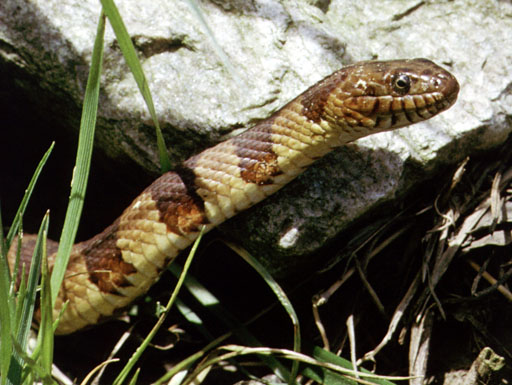
Brazos Water Snake

Brazos Water Snake

Nerodia harteri

Bgenter, CC0, via Wikimedia Commons

Common Watersnake

Common Watersnake

Nerodia sipedon

Patrick Coin (Patrick Coin), CC BY-SA 2.5, via Wikimedia Commons

Side by side

Brazos Water SnakeCommon Watersnake
Scientific nameNerodia harteri (Trapido, 1941)Nerodia sipedon (Linnaeus, 1758)
English nameBrazos Water SnakeCommon Watersnake
GroupReptilesReptiles
ClassReptilia ReptileReptilia Reptile
OrderSquamata SnakesSquamata Snakes
FamilyColubridae ColubridColubridae Colubrid
GenusNerodia Water SnakesNerodia Water Snakes
Named in19411758
Red List categoryNear ThreatenedLeast Concern
EnvironmentNot recordedfreshwater, marine
Countries on record1 country4 countries
GBIF occurrence records883 records84,794 records

Rows where the two agree are shown in grey.

Where each is found

Both recorded in 1 country

Only Common Watersnake (3)

From Catalogue of Life checklists and GBIF occurrence records. A country missing from a list means no record is held, which is not proof of absence.

Checked facts

Brazos Water SnakeCommon Watersnake
Appearance
  • The species has a brown, gray, reddish, or brownish-black body with dark crossbands on the neck and dark blotches along the rest of the body. English Wikipedia
  • The species' coloration generally darkens with age, and its body pattern may become difficult to distinguish. English Wikipedia
  • The belly can be white, yellow, or gray and usually has reddish or black crescent-shaped markings. English Wikipedia
  • Adult individuals can become almost entirely black. English Wikipedia
  • The species has keeled scales and a divided anal plate. animaldiversity.org
  • Juveniles have reddish-brown saddles against a tan, brown, or gray background. animaldiversity.org
  • The species has 21–25 scales at midbody. animaldiversity.org
  • Juvenile individuals have dark crossbands against a light-brown, tan, or gray background. in.gov
Size
  • The species reaches a total length, including its tail, of 41–81 cm. English Wikipedia
No checked fact yet
Habitat
  • The species prefers rocky areas along the Brazos River. English Wikipedia
  • Juveniles use medium to large flat rocks on unshaded shores as hiding places. pubs.usgs.gov
  • Rocky shallows are important feeding grounds for juveniles. pubs.usgs.gov
  • Adult individuals occupy a broader range of habitats in pools and lakes than rocky riffles in flowing rivers. pubs.usgs.gov
  • The species exhibits an ontogenetic shift in habitat use. pubs.usgs.gov
  • The species inhabits streams, lakes, ponds, and wetlands. English Wikipedia
  • Juveniles typically occupy smaller streams adjacent to the larger waterways inhabited by adults. English Wikipedia
  • The species uses rivers, streams, sloughs, lakes, ponds, bogs, marshes, and impoundments. animaldiversity.org
  • Northern water snakes prefer open areas with basking opportunities and relatively still water. animaldiversity.org
  • Individuals may shelter beneath flat rocks, logs, and boards when not basking or searching for food. animaldiversity.org
  • The species prefers warm, permanent, shallow water with access to basking locations. in.gov
DietNo checked fact yet
  • The species feeds on small fish, tadpoles, frogs, worms, leeches, crayfish, large insects, mollusks, annelids, salamanders, other snakes, turtles, small birds, and mammals. English Wikipedia
  • The species is both carnivorous and a scavenger. animaldiversity.org
  • Northern water snakes swallow their prey alive rather than constricting it. animaldiversity.org
  • The species also consumes frogs, toads, salamanders, and carrion in Indiana. in.gov
BehaviourNo checked fact yet
  • The species is active both during daylight and nighttime. English Wikipedia
  • The species commonly basks on rocks, stumps, and brush. English Wikipedia
  • The species uses smell and sight to locate prey. English Wikipedia
  • The species commonly dives into the water when disturbed while basking. English Wikipedia
  • When cornered or captured, the species generally defends itself. English Wikipedia
  • Northern water snakes are more active during daylight hours despite being observed both day and night. animaldiversity.org
  • When escaping predators, northern water snakes may dive and anchor themselves to vegetation or logs underwater. animaldiversity.org
  • When threatened, northern water snakes flatten their bodies and jaws and strike and bite. animaldiversity.org
  • The species may release foul-smelling musk and defecate when threatened. animaldiversity.org
  • The species may flatten its head and strike when cornered or restrained. in.gov
ReproductionNo checked fact yet
Distribution
  • The species is endemic to Texas in the United States. English Wikipedia
  • The species occurs only in Central Texas within the Brazos River system. English Wikipedia
  • The species has one of the smallest geographic ranges among North American snake species. pubs.usgs.gov
No checked fact yet
Conservation
  • The species is considered near threatened in Texas because of its restricted geographic range. English Wikipedia
  • Some sections of the Brazos and Colorado rivers lack the species, apparently because suitable juvenile habitat is absent or scarce. pubs.usgs.gov
  • Past dam projects have eliminated populations through habitat destruction caused by inundation and siltation. pubs.usgs.gov
  • Population fragmentation may prevent recolonization following local extinctions. pubs.usgs.gov
  • Introduced common watersnakes in California are considered invasive and may compete with the threatened giant garter snake. English Wikipedia
  • The species may threaten vulnerable fish and amphibians through excessive predation. English Wikipedia
  • The Lake Erie watersnake subspecies was removed from the United States Federal List of Endangered and Threatened Wildlife on August 16, 2011. English Wikipedia
  • The Lake Erie watersnake population increased to 11,980 individuals by 2009. English Wikipedia
UsesNo checked fact yet
  • The species may benefit sport fishing by consuming diseased and dying fish and reducing fish overpopulation. animaldiversity.org
  • The species may cause problems for fish hatcheries and fish farms. animaldiversity.org
Similar speciesNo checked fact yet
  • The common watersnake is frequently mistaken for the venomous cottonmouth. English Wikipedia
  • The common watersnake has round pupils and lacks heat-sensing pits, distinguishing it from the cottonmouth. English Wikipedia
OtherNo checked fact yet
  • The species is nonvenomous and harmless to humans. English Wikipedia
  • The saliva contains a mild hemotoxic anticoagulant that can increase bleeding from bites. English Wikipedia

In brief

Brazos Water Snake

Nerodia harteri occurs only in Central Texas within the Brazos River system. It has two rows of spots along either side of its back and a pink or orange underside with dark spots along both sides. Full profile

Common Watersnake

Nerodia sipedon has a brown, gray, reddish, or brownish-black body with dark crossbands on the neck and dark blotches along the rest of the body. Full profile

Compare something else

Page built on 29 November 2026 from the data on the two species pages, where every source is listed.

Cite this page

ScientificNames.org. (2026). Brazos Water Snake vs Common Watersnake. Retrieved November 29, 2026, from https://scientificnames.org/compare/brazos-water-snake-vs-common-watersnake