Species · Reptiles
Brazos Water Snake Nerodia harteri
The scientific name of the Brazos Water Snake is Nerodia harteri. It is a species of reptile in the family Colubridae (colubrid), order Squamata. The name dates from 1941.
- Scientific name
- Nerodia harteri (Trapido, 1941)
- Common name
- Brazos Water Snake
- Genus
- Nerodia
- Family
- Colubridae (Colubrid)
- Order
- Squamata
- Class
- Reptilia
- Red List category
- NT Near Threatened
- Recorded in
- 1 country
- Name status
- accepted in the Catalogue of Life

Overview
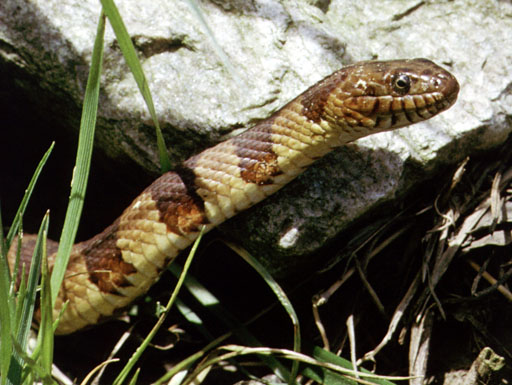
Nerodia harteri occurs only in Central Texas within the Brazos River system. It has two rows of spots along either side of its back and a pink or orange underside with dark spots along both sides.
Written 26 November 2026 from the sources listed below. Each statement was checked against the passage it cites; statements that could not be supported were removed.
Appearance
The Brazos Water Snake ranges in color from brown to olive green. It has two rows of spots extending along either side of its back.[1][2]
Its underside is pink or orange, with dark spots along both sides. Its total length, including its tail, ranges from 41–81 cm.[3][4]
Habitat
The species prefers rocky areas along the Brazos River. Juveniles use medium to large flat rocks on unshaded shores as hiding places.[5][6]
Rocky shallows are important feeding grounds for juveniles. Adult individuals occupy a broader range of habitats in pools and lakes than rocky riffles in flowing rivers.[7][8]
The species exhibits an ontogenetic shift in habitat use.[9]
Conservation
The species is considered near threatened in Texas because of its restricted geographic range. It has one of the smallest geographic ranges among North American snake species.[10][11]
Some sections of the Brazos and Colorado rivers lack the species, apparently because suitable juvenile habitat is absent or scarce. Past dam projects have eliminated populations through habitat destruction caused by inundation and siltation.[12][13]
Population fragmentation may prevent recolonization following local extinctions.[14]
Classification of the Brazos Water Snake
| Kingdom | Animalia |
|---|---|
| Phylum | Chordata |
| Subphylum | Vertebrata |
| Infraphylum | Gnathostomata |
| Parvphylum | Osteichthyes |
| Megaclass | Tetrapoda |
| Class | Reptilia (Reptile) |
| Order | Squamata (Snakes) |
| Suborder | Serpentes (Snakes) |
| Infraorder | Alethinophidia |
| Family | Colubridae (Colubrid) |
| Subfamily | Natricinae |
| Genus | Nerodia (Water Snakes) |
| Species | Nerodia harteri (Trapido, 1941) |
Where the Brazos Water Snake is found
Checklists and occurrence records place Nerodia harteri in 1 country across North America. GBIF holds 883 georeferenced records of it.
Countries
Regions and cities with the most records
Range as the checklists state it
USA (C Texas)
A number beside a place is its count of GBIF occurrence records. A place without a number comes from a checklist alone. Records show where a species has been observed or collected, which can include escapes and vagrants.
Common names
English
- Brazos Water Snake
- Brazos River Water Snake
- Harter's Water Snake
- Harters Water Snake
Names in 3 other languages
- German
- Harters Schwimmnatter
- Portuguese
- Cobra-d'água-de-Brazos
- Russian
- Американский уж Хартера
Synonyms
2 other scientific names have been used for this species and are now treated as synonyms of Nerodia harteri.
- Natrix harteri Trapido, 1941
- Nerodia harteri harteri (Trapido, 1941)
Related species
-
 Common WatersnakeNerodia sipedon
-
 Banded Water SnakeNerodia fasciata
-
 Diamond-backed WatersnakeNerodia rhombifer
-
 Plain-bellied Water SnakeNerodia erythrogaster
-
 Green Water SnakeNerodia cyclopion
-
 Salt Marsh SnakeNerodia clarkii
-
 Brown Water SnakeNerodia taxispilota
-
 Florida Green Water SnakeNerodia floridana
Compare
Questions and answers
What is the scientific name of the Brazos Water Snake?
The scientific name of the Brazos Water Snake is Nerodia harteri. Written with its author, the full name is Nerodia harteri (Trapido, 1941).
Which family does the Brazos Water Snake belong to?
Nerodia harteri belongs to the family Colubridae, in the order Squamata and the class Reptilia.
Where is the Brazos Water Snake found?
Checklists and occurrence records place Nerodia harteri in 1 country: United States.
What is the conservation status of the Brazos Water Snake?
The IUCN Red List category recorded for Nerodia harteri is Near Threatened (NT).
What other names does the Brazos Water Snake have?
Nerodia harteri is also known in English as Brazos River Water Snake, Harter's Water Snake and Harters Water Snake.
Sources
Passages the profile rests on
- The species ranges in color from brown to olive green. Source passage: “ranges in color from brown to olive green.” — English Wikipedia
- The species has two rows of spots extending along either side of its back. Source passage: “It has two rows of spots that go down either side of its back” — English Wikipedia
- The underside is pink or orange and has dark spots along both sides. Source passage: “has a pink or orange underside with dark spots down either side.” — English Wikipedia
- The species reaches a total length, including its tail, of 41–81 cm. Source passage: “grows to a total length (including tail) of 16 to 32 inches (41–81 cm)” — English Wikipedia
- The species prefers rocky areas along the Brazos River. Source passage: “The preferred habitat of N. harteri is rocky areas along the Brazos River.” — English Wikipedia
- Juveniles use medium to large flat rocks on unshaded shores as hiding places. Source passage: “Medium to large, flat rocks on an unshaded shore for hiding places” — pubs.usgs.gov
- Rocky shallows are important feeding grounds for juveniles. Source passage: “rocky shallows for feeding grounds appear to be important for juveniles.” — pubs.usgs.gov
- Adult individuals occupy a broader range of habitats in pools and lakes than rocky riffles in flowing rivers. Source passage: “adult N. harteri are not restricted to rocky riffles in flowing rivers but can inhabitat a much wider range of habitats in pools and lakes.” — pubs.usgs.gov
- The species exhibits an ontogenetic shift in habitat use. Source passage: “There is an ontogenetic habitat shift in N. harteri” — pubs.usgs.gov
- The species has one of the smallest geographic ranges among North American snake species. Source passage: “Harter's water snake has one of the smallest ranges of any North American snake species.” — pubs.usgs.gov
- The species is considered near threatened in Texas because of its restricted geographic range. Source passage: “Due to its limited range, N. harteri is considered to be a near-threatened species in Texas.” — English Wikipedia
- Some sections of the Brazos and Colorado rivers lack the species, apparently because suitable juvenile habitat is absent or scarce. Source passage: “Several sections of both the Brazos and Colorado rivers are uninhabited by N. harteri, apparently because juvenile habitat is lacking or scarce.” — pubs.usgs.gov
- Past dam projects have eliminated populations through habitat destruction caused by inundation and siltation. Source passage: “Past dam projects have eliminated populations of Nerodia harteri through habitat destruction by inundation and siltation.” — pubs.usgs.gov
- Population fragmentation may prevent recolonization following local extinctions. Source passage: “Fragmentation of populations may also prevent recolonization after local extinctions.” — pubs.usgs.gov
Data
- Catalogue of Life, 2026-10-16 XR cc by
- Global Biodiversity Information Facility CC BY 4.0
- Wikidata CC0
- GeoNames CC BY 4.0
- Wikimedia Commons per image; credit shown with each image
- Within the Catalogue of Life, this name comes from The Reptile Database cc by
References
- Trapido, H. (1941). A new species of Natrix from Texas. American Midland Naturalist 25: 673-680. Link
- Conant, & Roger. (1942). Notes on the young of three recently described snakes, with comments upon their relationships [Coluber constrictor priapus; Salvadora lineata; Natrix harteri]. Bulletin of the Chicago Academy of Sciences 6 (10): 193-200.
- Mecham, John S. (1983). Nerodia harteri. Catalogue of American Amphibians and Reptiles (330): 1-2.
- Lawson, R. (1987). Molecular studies of Thamnophiine snakes: 1. The phylogeny of the genus Nerodia. Journal of Herpetology 21 (2): 140-157.
- Scott, N. J., Maxwell, T. C., Thorton, O. W., Fitzgerald, L. A., & Flury, J. W. (1989). Distribution, habitat, and future of Harter’s water snake, Nerodia harteri, in Texas. Journal of Herpetology 23 (4): 373-389.
- Conant, R., & Collins, J. T. (1991). A Field Guide to Reptiles and Amphibians of Eastern/Central North America, 3rd ed. Houghton Mifflin (Boston/New York), Xx + 450 P.
- Densmore III,L.D.; Rose,F.L. & Kain,S.J. (1992). Mitochondrial DNA evolution and speciation in water snakes (genus Nerodia) with special reference to Nerodia harteri. Herpetologica 48 (1): 60-68.
- Thornton, Okla W., Jr.;Smith, Jerry R. (1993). New county records of amphibians and reptiles from West-Central Texas. Herpetological Review 24 (1): 35-36.
- Greene, B.D., J.R. Dixon, J.M. Mueller, M.J. Whiting & O.W. Thornton, Jr. (1994). Feeding Ecology of the Concho Water Snake, Nerodia harteri paucimaculata. Journal of Herpetology 28 (2): 165-172.
- Dixon, James R. (2000). Amphibians and reptiles of Texas, second edition. Texas A&M University Press, 421 Pp.
- Werler, John E. & James R. Dixon. (2000). Texas Snakes. University of Texas Press, 544 Pages.
- Tennant, A., & Bartlett, R. D. (2000). Snakes of North America - Eastern and Central Regions. Gulf Publishing, Houston, TX, 588 Pp.
- Tennant, A. (2003). Snakes of North America - Eastern and Central Regions, revised edition. Lone Star Books, 605 Pp.
- Ernst, C. H., & Ernst, E. M. (2003). Snakes of the United States and Canada. Smithsonian Inst. Press, Washington, 668 Pp.
- Gibbons, J. W. & Mike Dorcas. (2004). North American Water Snakes. University of Oklahoma Press, 496 Pp.
- Hibbitts, Troy D. & Lee A. Fitzgerald. (2005). Morphological and ecological convergence in two natricine snakes. Biological Journal of the Linnean Society85: 363–371.
- Beolens, B., & Michael Watkins, a. M. G. (2011). The Eponym Dictionary of Reptiles. Johns Hopkins University Press, Baltimore, USA.
- Crother, B. I. (ed.). (2012). Standard Common and Current Scientific Names for North American Amphibians, Turtles, Reptiles, and Crocodilians, Seventh Edition. Herpetological Circular 39: 1-92.
- Wallach, Van; Kenneth L. Williams, Jeff Boundy. (2014). Snakes of the World: A Catalogue of Living and Extinct Species. [type catalogue]. Taylor and Francis, CRC Press, 1237 Pp.
- Roelke, Corey E. and Nathan Rains. (2014). Results of repeated surveys for the Brazos water snake (Nerodia harteri) in a section of the Brazos River in North Texas. Herpetological Review 45 (4): 577-579.
- Siegel, Dustin S.; Stanley E. Trauth, Justin L. Rheubert, Brian Rabe, Brenton Ruopp, Aurélien Miralles, Christopher M. Murray, and Robert D. Aldridge. (2014). Novel Cloacal Glands in Snakes: The Phylogenetic Distribution of Ventral Urodaeal Glands in Thamnophiini. Herpetologica 70 (3): 279-289.
- O’Shea, M. (2018). The Book of Snakes. Ivy Press / Quarto Publishing, London,.
- Weidler, & M, J. (2019). Protected areas of Texas in relation to Texas reptiles. Herpetological Review 50 (3): 462-473.
- Yates, Jessica R.; Andrew M. Durso, Stephen F. Harding, David Rodriguez, Matthew Kwiatkowski & Stephen J. Mullin. (2024). Site-Level Occupancy and Microhabitat Selection of Sympatric Nerodia (Serpentes: Colubridae) within an Imperiled River System. Herpetologica Sep 2024 Vol. 80, No. 3: 248-261.
This species in other databases
Page built on 27 November 2026. See how the catalog is made and all sources and licences.
Cite this page
ScientificNames.org. (2026). Nerodia harteri (Brazos Water Snake). Retrieved November 27, 2026, from https://scientificnames.org/species/nerodia-harteri
“Nerodia harteri (Brazos Water Snake).” ScientificNames.org, 2026, scientificnames.org/species/nerodia-harteri. Accessed 27 Nov. 2026.
ScientificNames.org. “Nerodia harteri (Brazos Water Snake).” Accessed November 27, 2026. https://scientificnames.org/species/nerodia-harteri.
@misc{scientificnames_nerodia_harteri_brazos_water_snake,
  author = {{ScientificNames.org}},
  title = {Nerodia harteri (Brazos Water Snake)},
  year = {2026},
  url = {https://scientificnames.org/species/nerodia-harteri},
  note = {Accessed 2026-11-27}
}