Comparison
Broad-bordered Grass Yellow vs Small Grass-yellow
Broad-bordered Grass Yellow (Eurema brigitta) and Small Grass-yellow (Eurema smilax) both belong to the genus Eurema (grass yellows) and part ways below it. Both are recorded in 2 countries.


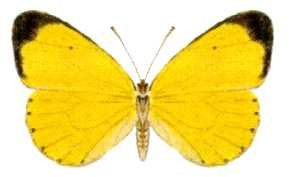
Small Grass-yellow
Eurema smilax
Commonwealth Scientific and Industrial Research Organisation (CSIRO), Public domain, via Wikimedia Commons

Side by side
| Broad-bordered Grass Yellow | Small Grass-yellow | |
|---|---|---|
| Scientific name | Eurema brigitta (Stoll, [1780] ) | Eurema smilax (Donovan, 1805) |
| English name | Broad-bordered Grass Yellow | Small Grass-yellow |
| Group | Insects | Insects |
| Class | Insecta Insect | Insecta Insect |
| Order | Lepidoptera | Lepidoptera |
| Family | Pieridae Whites | Pieridae Whites |
| Genus | Eurema Grass Yellows | Eurema Grass Yellows |
| Named in | 1780 | 1805 |
| Red List category | Least Concern | Not recorded |
| Countries on record | 52 countries | 2 countries |
| GBIF occurrence records | 8,905 records | 3,282 records |
Rows where the two agree are shown in grey.
Where each is found
Both recorded in 2 countries
Only Broad-bordered Grass Yellow (50)
- Angola
- Benin
- Botswana
- Burkina Faso
- Cameroon
- China
- Comoros
- Democratic Republic of the Congo
- Eswatini
- Ethiopia
- Fiji
- Gabon
- Gambia
- Ghana
- Guinea
- India
- Indonesia
- Ivory Coast
- Japan
- Kenya
- Liberia
- Madagascar
- Malawi
- Malaysia
- Mali
- Mauritius
- Mozambique
- Namibia
- Nepal
- Nigeria
- Pakistan
- Papua New Guinea
- Philippines
- Republic of the Congo
- Reunion
- Rwanda
- Senegal
- South Africa
- South Sudan
- Sri Lanka
- Sudan
- Taiwan
- Tanzania
- Thailand
- Timor Leste
- Uganda
- Wallis and Futuna
- Yemen
- Zambia
- Zimbabwe
From Catalogue of Life checklists and GBIF occurrence records. A country missing from a list means no record is held, which is not proof of absence.
Checked facts
| Broad-bordered Grass Yellow | Small Grass-yellow | |
|---|---|---|
| Appearance |
|
|
| Size |
|
|
| Habitat | No checked fact yet |
|
| Diet |
|
|
| Behaviour |
|
|
| Reproduction | No checked fact yet |
|
| Distribution |
|
|
| Similar species | No checked fact yet |
|
| Other |
| No checked fact yet |
In brief
Broad-bordered Grass Yellow
The species is recorded from tropical Africa. It has a wingspan of 30–35 mm. Full profile
Small Grass-yellow
Eurema smilax occurs throughout mainland Australia, with occasional records from Kangaroo Island, Lord Howe Island and Tasmania. Adult butterflies are yellow and have black tips on the upper surfaces of their forewings. Full profile
Compare something else
Page built on 27 November 2026 from the data on the two species pages, where every source is listed.
Cite this page
ScientificNames.org. (2026). Broad-bordered Grass Yellow vs Small Grass-yellow. Retrieved November 27, 2026, from https://scientificnames.org/compare/broad-bordered-grass-yellow-vs-small-grass-yellow
“Broad-bordered Grass Yellow vs Small Grass-yellow.” ScientificNames.org, 2026, scientificnames.org/compare/broad-bordered-grass-yellow-vs-small-grass-yellow. Accessed 27 Nov. 2026.
ScientificNames.org. “Broad-bordered Grass Yellow vs Small Grass-yellow.” Accessed November 27, 2026. https://scientificnames.org/compare/broad-bordered-grass-yellow-vs-small-grass-yellow.
@misc{scientificnames_broad_bordered_grass_yellow_vs_small_grass_yellow,
  author = {{ScientificNames.org}},
  title = {Broad-bordered Grass Yellow vs Small Grass-yellow},
  year = {2026},
  url = {https://scientificnames.org/compare/broad-bordered-grass-yellow-vs-small-grass-yellow},
  note = {Accessed 2026-11-27}
}