Species · Insects
Small Grass-yellow Eurema smilax
The scientific name of the Small Grass-yellow is Eurema smilax. It is a species of insect in the family Pieridae (whites), order Lepidoptera. The name dates from 1805.
- Scientific name
- Eurema smilax (Donovan, 1805)
- Common name
- Small Grass-yellow
- Genus
- Eurema
- Family
- Pieridae (Whites)
- Order
- Lepidoptera
- Class
- Insecta
- Recorded in
- 2 countries
- Name status
- accepted in the Catalogue of Life
Overview
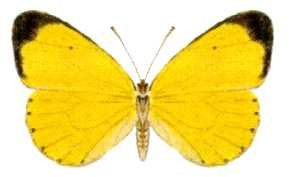
Eurema smilax occurs throughout mainland Australia, with occasional records from Kangaroo Island, Lord Howe Island and Tasmania. Adult butterflies are yellow and have black tips on the upper surfaces of their forewings.
Written 27 November 2026 from the sources listed below. Each statement was checked against the passage it cites; statements that could not be supported were removed.
Appearance
Adult butterflies have a wingspan of approximately 30–34 mm. Female adults are slightly larger than males, while males are generally brighter yellow.[1][2][3]
In southern Australia, summer-form adults are usually pale yellow, with few or no brown markings on the undersides of their wings. Winter-form adults are brighter yellow and have pronounced brown markings on the undersides of their wings.[4][5]
Young caterpillars are initially pale yellow before becoming greenish. Third- and fourth-instar caterpillars develop a darker dorsal line and a yellow lateral line.[6][7]
All larval stages possess specialised hairs that secrete poison, which appears as clear droplets at the hair tips. Mature larvae measure 18–22 mm in length.[8][9]
The pupae are approximately 15 mm long.[10]
Habitat
Females appear to prefer laying eggs on small plants growing in full sunlight.[11]
Diet
The larvae mainly feed on plants belonging to the genera Senna and Neptunia.[12]
Recorded Senna host plants include Senna acclinis, Senna coronilloides, Senna gaudichaudii, Senna artemisioides, Senna odorata and Senna petiolaris.[13][14]
Other recorded Senna host plants include Senna surattensis, Senna alata and Senna auriculata.[15]
Neptunia gracilis and Neptunia monosperma are recorded larval host plants. Paraserianthes lophantha is also a recorded host plant.[16][17]
Behaviour
The species exhibits both migratory and vagrant movement patterns. In South Australia, adults migrate south from northern breeding grounds during spring.[18][19]
Hot northerly winds assist the species during its southward spring migrations in South Australia. Migrating adults fly steadily and directly below head height.[20][21]
Females undertaking migration are gravid and fertile.[22]
Reproduction and life cycle
Females lay their eggs individually on host plants. The eggs are spindle-shaped and approximately 1.2 mm high.[23][24]
The eggs are initially white and subsequently become yellowish. During spring, they hatch approximately 7–11 days after being laid.[25][26]
The pupae are green and attach to the host plant using a cremaster and a central silken girdle. The head of the pupa may point either upwards or downwards.[27][28]
The pupal stage lasts approximately 8–13 days.[29]
Similar species
Terias parvula Herrich-Schäffer, 1869 is listed as a synonym of the Small Grass-yellow.[30]
Classification of the Small Grass-yellow
| Kingdom | Animalia |
|---|---|
| Phylum | Arthropoda |
| Subphylum | Hexapoda |
| Class | Insecta (Insect) |
| Order | Lepidoptera |
| Superfamily | Papilionoidea |
| Family | Pieridae (Whites) |
| Genus | Eurema (Grass Yellows) |
| Species | Eurema smilax (Donovan, 1805) |
Where the Small Grass-yellow is found
Checklists and occurrence records place Eurema smilax in 2 countries. GBIF holds 3,282 georeferenced records of it.
Countries
Regions and cities with the most records
- Queensland, Australia 1,403
- New South Wales, Australia 634
- South Australia, Australia 413
- Victoria, Australia 251
- Brisbane, Australia 164
- Western Australia, Australia 159
- Australian Capital Territory, Australia 121
- Northern Territory, Australia 120
- Adelaide, Australia 91
- Adelaide Hills, Australia 91
- Canberra, Australia 83
- Tuggeranong, Australia 78
- Capalaba, Australia 74
- Logan City, Australia 63
- Hornsby, Australia 61
- Sydney, Australia 56
- Narangba, Australia 51
- Parramatta, Australia 47
- Sunshine Coast, Australia 47
- Toowoomba, Australia 47
- Mackay, Australia 26
- Mount Barker, Australia 18
- Balwyn North, Australia 17
- Burwood, Australia 17
- Caloundra, Australia 16
- Rockhampton, Australia 16
- Gawler, Australia 15
- Gold Coast, Australia 15
- Melbourne, Australia 15
- Gladstone, Australia 13
- Bundaberg, Australia 12
- Kalgoorlie, Australia 12
- Liverpool, Australia 12
- Townsville, Australia 12
- St Albans, Australia 11
- Alice Springs, Australia 10
1 more country has a few records outside this range
These countries hold a few records of Eurema smilax but lie outside the range the checklists give for it. Such records are often zoo or garden specimens, museum material or vagrants, so the species is not counted as occurring there.
A number beside a place is its count of GBIF occurrence records. A place without a number comes from a checklist alone. Records show where a species has been observed or collected, which can include escapes and vagrants.
Common names
English
- Small Grass-yellow
- Small Grass Yellow
Synonyms
One other scientific name has been used for this species and is now treated as a synonym of Eurema smilax.
- Terias parvula Herrich-Schäffer, 1869
Related species
-
 Common Grass YellowEurema hecabe
-
 Broad-bordered Grass YellowEurema brigitta
-
 Three Spot Grass YellowEurema blanda
- Barred SulphurEurema daira
-
 Mexican YellowEurema mexicana
-
 Spotless Grass YellowEurema laeta
- Changeable Grass YellowEurema simulatrix
-
 Malagasy Grass YellowEurema floricola
Compare
Questions and answers
What is the scientific name of the Small Grass-yellow?
The scientific name of the Small Grass-yellow is Eurema smilax. Written with its author, the full name is Eurema smilax (Donovan, 1805).
Which family does the Small Grass-yellow belong to?
Eurema smilax belongs to the family Pieridae, in the order Lepidoptera and the class Insecta.
Where is the Small Grass-yellow found?
Checklists and occurrence records place Eurema smilax in 2 countries: Australia and New Caledonia.
What other names does the Small Grass-yellow have?
Eurema smilax is also known in English as Small Grass Yellow.
Sources
Passages the profile rests on
- Male adults are generally brighter yellow than female adults. Source passage: “The males are generally a brighter yellow than the females.” — English Wikipedia
- Adult butterflies have a wingspan of approximately 30–34 mm. Source passage: “Eurema smilax adults have a wingspan of 30–34 mm” — English Wikipedia
- Female adults are slightly larger than male adults. Source passage: “with females being slightly larger than males.” — English Wikipedia
- Summer-form adults in southern Australia are usually pale yellow and have few or no brown markings on the undersides of their wings. Source passage: “In southern Australia, the summer flying forms are usually pale yellow, with few or no brown markings on the wing undersides.” — English Wikipedia
- Winter-form adults in southern Australia are brighter yellow and have pronounced brown markings on the undersides of their wings. Source passage: “The winter forms are a brighter yellow, with pronounced brown markings on the wing undersides.” — English Wikipedia
- Young caterpillars are initially pale yellow before becoming greenish. Source passage: “The caterpillar is initially pale yellow, soon becoming greenish.” — English Wikipedia
- Third- and fourth-instar caterpillars develop a darker dorsal line and a yellow lateral line. Source passage: “Third and fourth instars develop a darker dorsal line and a yellow lateral line.” — English Wikipedia
- Mature larvae measure 18–22 mm in length. Source passage: “Mature larvae are 18–22 mm long.” — English Wikipedia
- All larval stages possess specialised hairs that secrete poison, which appears as clear droplets at the hair tips. Source passage: “All larval stages have specialised hairs which secrete poison, visible at the ends of the hairs as clear droplets.” — English Wikipedia
- The pupae are approximately 15 mm long. Source passage: “Pupae are green, about 15 mm long” — English Wikipedia
- Females appear to prefer laying eggs on small plants growing in full sunlight. Source passage: “The females seem to prefer laying eggs on small plants growing in full sun.” — English Wikipedia
- The larvae mainly feed on plants belonging to the genera Senna and Neptunia. Source passage: “The larvae mostly feed on plants of the Senna and Neptunia genera.” — English Wikipedia
- Recorded larval host plants include Senna acclinis, Senna coronilloides and Senna gaudichaudii. Source passage: “Senna acclinis Senna coronilloides Senna gaudichaudii” — English Wikipedia
- Recorded larval host plants include Senna artemisioides, Senna odorata and Senna petiolaris. Source passage: “Senna artemisioides Senna odorata Senna petiolaris” — English Wikipedia
- Recorded larval host plants include Senna surattensis, Senna alata and Senna auriculata. Source passage: “Senna surattensis Senna alata Senna auriculata” — English Wikipedia
- Neptunia gracilis and Neptunia monosperma are recorded larval host plants. Source passage: “Neptunia gracilis Neptunia monosperma” — English Wikipedia
- Paraserianthes lophantha is a recorded larval host plant. Source passage: “Paraserianthes lophantha” — English Wikipedia
- The species exhibits both migratory and vagrant movement patterns. Source passage: “E. smilax exhibits both migrant and vagrant habits.” — English Wikipedia
- In South Australia, adults migrate south from northern breeding grounds during spring. Source passage: “In South Australia, they will fly south from northern breeding grounds in spring” — English Wikipedia
- Hot northerly winds assist the species during its southward spring migrations in South Australia. Source passage: “aided by hot northerly winds.” — English Wikipedia
- Migrating adults fly steadily and directly below head height. Source passage: “During these migrations they fly in a steady, direct manner below head height” — English Wikipedia
- Females undertaking migration are gravid and fertile. Source passage: “with the females being gravid and fertile.” — English Wikipedia
- Females lay their eggs individually on host plants. Source passage: “laid singly on a host plant.” — English Wikipedia
- The eggs are spindle-shaped and approximately 1.2 mm high. Source passage: “They are spindle-shaped, with a height of about 1.2 mm” — English Wikipedia
- The eggs are initially white and subsequently become yellowish. Source passage: “The eggs are initially white, later turning yellowish.” — English Wikipedia
- Eggs hatch approximately 7–11 days after being laid during spring. Source passage: “They hatch in about 7–11 days during spring.” — English Wikipedia
- The pupae are green and attach to the host plant using a cremaster and a central silken girdle. Source passage: “Pupae are green, about 15 mm long, and attached to the host plant via a cremaster and central silken girdle.” — English Wikipedia
- The head of the pupa may point either upwards or downwards. Source passage: “The head may be pointing either upwards or downwards.” — English Wikipedia
- The pupal stage lasts approximately 8–13 days. Source passage: “The pupal period lasts about 8–13 days.” — English Wikipedia
- Terias parvula Herrich-Schäffer, 1869 is listed as a synonym of this species. Source passage: “Terias parvula Herrich-Schäffer, 1869 synonym” — bie.ala.org.au
- Adult butterflies are yellow and have black tips on the upper surfaces of their forewings. Source passage: “They are yellow, with black tips on the upper surface of the forewings.” — English Wikipedia
Data
- Catalogue of Life, 2026-10-16 XR cc by
- Global Biodiversity Information Facility CC BY 4.0
- Wikidata CC0
- GeoNames CC BY 4.0
- Wikimedia Commons per image; credit shown with each image
- Within the Catalogue of Life, this name comes from Global Butterfly Information System cc by
This species in other databases
Page built on 27 November 2026. See how the catalog is made and all sources and licences.
Cite this page
ScientificNames.org. (2026). Eurema smilax (Small Grass-yellow). Retrieved November 27, 2026, from https://scientificnames.org/species/eurema-smilax
“Eurema smilax (Small Grass-yellow).” ScientificNames.org, 2026, scientificnames.org/species/eurema-smilax. Accessed 27 Nov. 2026.
ScientificNames.org. “Eurema smilax (Small Grass-yellow).” Accessed November 27, 2026. https://scientificnames.org/species/eurema-smilax.
@misc{scientificnames_eurema_smilax_small_grass_yellow,
  author = {{ScientificNames.org}},
  title = {Eurema smilax (Small Grass-yellow)},
  year = {2026},
  url = {https://scientificnames.org/species/eurema-smilax},
  note = {Accessed 2026-11-27}
}