Comparison

Brown Palm Civet vs Binturong

Brown Palm Civet (Paradoxurus jerdoni) and Binturong (Arctictis binturong) both belong to the subfamily Paradoxurinae (binturong) and part ways below it. Both are recorded in 1 country.

Brown Palm Civet

Brown Palm Civet

Paradoxurus jerdoni

Kalyanvarma, CC BY-SA 3.0, via Wikimedia Commons

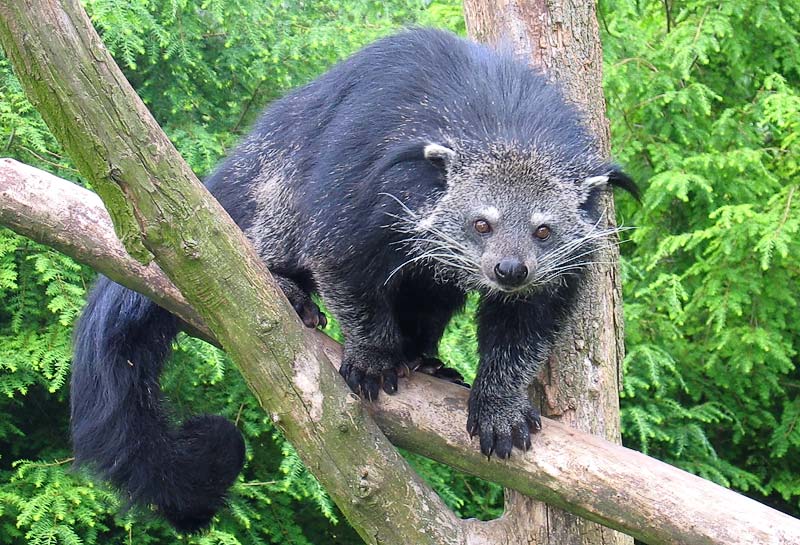
Binturong

Binturong

Arctictis binturong

Tassilo Rau, CC BY-SA 3.0, via Wikimedia Commons

Side by side

Brown Palm CivetBinturong
Scientific nameParadoxurus jerdoni Blanford, 1885Arctictis binturong (Raffles, 1822)
English nameBrown Palm CivetBinturong
GroupMammalsMammals
ClassMammalia MammalMammalia Mammal
OrderCarnivora CarnivoresCarnivora Carnivores
FamilyViverridae OyansViverridae Oyans
GenusParadoxurus Palm CivetArctictis Binturong
Named in18851822
Red List categoryLeast ConcernVulnerable
Countries on record1 country8 countries
GBIF occurrence records166 records408 records

Rows where the two agree are shown in grey.

Where each is found

Both recorded in 1 country

Only Binturong (7)

From Catalogue of Life checklists and GBIF occurrence records. A country missing from a list means no record is held, which is not proof of absence.

Checked facts

Brown Palm CivetBinturong
Appearance
  • The binturong has a thick coat of coarse black hair. English Wikipedia
  • Its coat can include white or buff speckling that produces straw-coloured or grey appearances. English Wikipedia
  • The binturong has a bushy, prehensile tail that tapers and curls inward at its tip. English Wikipedia
  • Its snout is short and pointed, with an upward curve at the nose. English Wikipedia
  • Its ears are short and rounded, with white edges and noticeable black hair tufts. English Wikipedia
  • Its limbs have five clawed digits, with the third and fourth digits joined together. English Wikipedia
Size
Habitat
  • The species inhabits rainforest tracts at elevations between 500 and 1,300 m. English Wikipedia
  • The species occupies fragmented rainforest landscapes containing tea and coffee plantations. English Wikipedia
  • The species prefers habitats with relatively undisturbed forest canopy and sufficient food. animaldiversity.org
  • Its abundance is positively associated with greater food-tree density and higher elevation. animaldiversity.org
  • Its abundance is relatively greater in forest fragments measuring 51 to 100 hectares that border shade coffee plantations. animaldiversity.org
  • Binturongs primarily inhabit lowland primary and secondary forests. English Wikipedia
  • In Laos, binturongs have been observed in extensive evergreen forests. English Wikipedia
  • In Palawan, binturongs inhabit primary and secondary lowland forests, including grassland–forest mosaics up to 400 m elevation. English Wikipedia
  • Binturongs inhabit the canopies of tall, dense tropical forests. animaldiversity.org
Diet
  • Fruit constitutes approximately 97% of the species' diet. English Wikipedia
  • The species predominantly consumes small fruits measuring less than 1 cm in diameter. English Wikipedia
  • Its fruit diet includes multi-seeded pulpy berries and drupes with moderate to high water content. English Wikipedia
  • Recorded fruit species in its diet include Palaquium ellipticum, Elaeocarpus serratus, Holigarna nigra and Knema attenuata. English Wikipedia
  • The species also consumes flowers of Cullenia exarillata and Syzygium species. English Wikipedia
  • When fruit availability is low, the species supplements its diet with invertebrates including insects, millipedes, centipedes, snails and crabs. animaldiversity.org
  • The species rarely supplements its diet with small vertebrates, including rodents, birds and reptiles. animaldiversity.org
  • Recorded introduced food sources include bananas, cardamom, coffee and guavas. animaldiversity.org
  • The binturong is omnivorous and consumes plants, insects and smaller animals. English Wikipedia
  • Its diet includes small mammals, rodents, birds, fish, earthworms, insects and fruits. English Wikipedia
  • Figs constitute a major component of the binturong's diet. English Wikipedia
  • Binturongs also consume carrion, eggs, tree shoots and leaves. animaldiversity.org
  • The binturong consumes fruits from the strangler fig tree (Ficus altissima). animaldiversity.org
Behaviour
Reproduction
Distribution
  • The species is endemic to the Western Ghats of India. English Wikipedia
  • Its recorded distribution extends from Castle Rock in Goa to Kalakkad Mundanthurai Tiger Reserve in the southern Western Ghats. English Wikipedia
  • Binturongs occur in India, Nepal, Bangladesh, Bhutan, Myanmar, Thailand, Malaysia, Laos, Cambodia, Vietnam, China, Indonesia and the Philippines. English Wikipedia
  • Binturongs typically occur at elevations between 0 and 3,000 m. English Wikipedia
Conservation
  • The species is classified as being of low conservation concern because of its large range and presence in several protected areas. English Wikipedia
  • Habitat fragmentation associated with human development affects the species. animaldiversity.org
Uses
  • The species' seed dispersal may contribute to restoring degraded forest patches in the Western Ghats. animaldiversity.org
  • The species' seed dispersal contributes to maintaining or increasing forest diversity. animaldiversity.org
Similar species
  • The brown palm civet is distinguished from the common palm civet by the reverse direction of hair growth at its neck. animaldiversity.org
No checked fact yet
OtherNo checked fact yet
  • Binturongs are considered keystone species because they disperse strangler fig seeds. English Wikipedia

In brief

Brown Palm Civet

Paradoxurus jerdoni is endemic to the Western Ghats of India, where it inhabits rainforest tracts at elevations between 500 and 1,300 m. It has uniformly brown fur, a long sleek tail and reverse-direction hair growth on its nape. Full profile

Binturong

Binturongs occur in India, Nepal, Bangladesh, Bhutan, Myanmar, Thailand, Malaysia, Laos, Cambodia, Vietnam, China, Indonesia and the Philippines. The Binturong has a bushy, prehensile tail and is the largest species in the Viverridae family. Full profile

Compare something else

Page built on 29 November 2026 from the data on the two species pages, where every source is listed.

Cite this page

ScientificNames.org. (2026). Brown Palm Civet vs Binturong. Retrieved November 29, 2026, from https://scientificnames.org/compare/brown-palm-civet-vs-binturong