Species · Mammals
Binturong Arctictis binturong
The scientific name of the Binturong is Arctictis binturong. It is a species of mammal in the family Viverridae (oyans), order Carnivora. The name dates from 1822.
- Scientific name
- Arctictis binturong (Raffles, 1822)
- Common name
- Binturong
- Genus
- Arctictis
- Family
- Viverridae (Oyans)
- Order
- Carnivora
- Class
- Mammalia
- Red List category
- VU Vulnerable
- Recorded in
- 8 countries
- Name status
- accepted in the Catalogue of Life
Overview
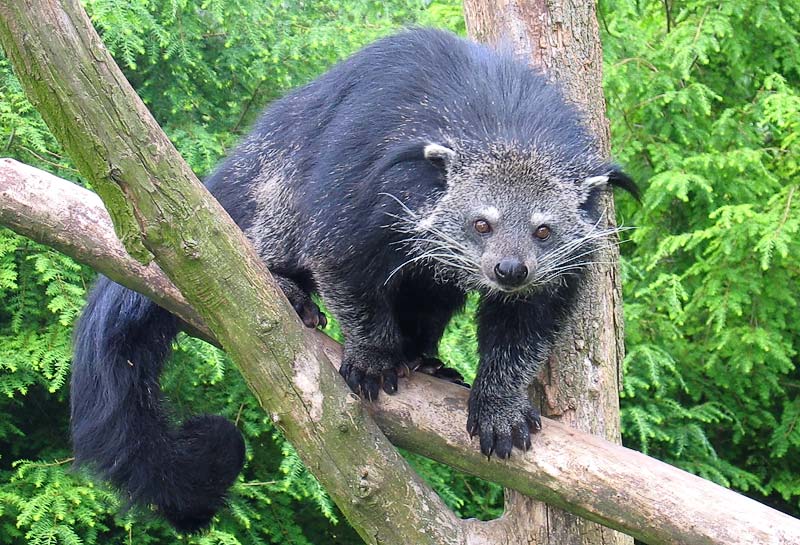
Binturongs occur in India, Nepal, Bangladesh, Bhutan, Myanmar, Thailand, Malaysia, Laos, Cambodia, Vietnam, China, Indonesia and the Philippines. The Binturong has a bushy, prehensile tail and is the largest species in the Viverridae family.
Written 24 November 2026 from the sources listed below. Each statement was checked against the passage it cites; statements that could not be supported were removed.
Appearance
The Binturong has a thick coat of coarse black hair, which can include white or buff speckling that produces straw-coloured or grey appearances. Its snout is short and pointed, with an upward curve at the nose.[1][2][3]
Its ears are short and rounded, with white edges and noticeable black hair tufts. Its limbs have five clawed digits, with the third and fourth digits joined together.[4][5]
Its body length ranges from 71 to 84 cm, and its tail measures between 66 and 69 cm long. It weighs approximately 9–20 kg, and females are approximately 20% larger than males.[6][7][8][9]
Habitat
Binturongs primarily inhabit lowland primary and secondary forests. They inhabit the canopies of tall, dense tropical forests.[10][11]
In Laos, binturongs have been observed in extensive evergreen forests. In Palawan, they inhabit primary and secondary lowland forests, including grassland–forest mosaics up to 400 m elevation.[12][13]
Binturongs typically occur at elevations between 0 and 3,000 m.[14]
Diet
The Binturong is omnivorous and consumes plants, insects and smaller animals. Its diet includes small mammals, rodents, birds, fish, earthworms, insects and fruits.[15][16]
Figs constitute a major component of its diet. It also consumes fruits from the strangler fig tree (Ficus altissima), as well as carrion, eggs, tree shoots and leaves.[17][18][19]
Behaviour
Binturongs are generally nocturnal but may also be crepuscular or occasionally diurnal. They are generally solitary unless females are in estrus.[20][21]
Binturongs are not strictly territorial and tend to avoid one another.[22]
Reproduction and life cycle
Binturongs reproduce throughout the year. The gestation period ranges from 84 to 99 days, and females can delay implantation of fertilized eggs until environmental conditions are suitable.[23][24][25]
Females reach sexual maturity at approximately 30 months of age, while males reach sexual maturity at approximately 28 months.[26][27]
Conservation
The Binturong is classified as Vulnerable on the IUCN Red List and is listed in Appendix III of CITES.[28][29]
Major threats to binturongs include deforestation, wildlife trade and hunting. Binturong populations have declined by more than 30% over the past 30 years.[30][31]
Uses
Binturongs are kept in zoos for educational purposes and public display. They provide rodent control by preying on rodents in the wild.[32][33]
Binturongs have been used for their fur and meat.[34]
Binturongs are considered keystone species because they disperse strangler fig seeds.[35]
Classification of the Binturong
| Kingdom | Animalia |
|---|---|
| Phylum | Chordata |
| Subphylum | Vertebrata |
| Infraphylum | Gnathostomata |
| Parvphylum | Osteichthyes |
| Megaclass | Tetrapoda |
| Class | Mammalia (Mammal) |
| Subclass | Theria |
| Infraclass | Eutheria |
| Order | Carnivora (Carnivores) |
| Suborder | Feliformia (Cat-like Carnivores) |
| Family | Viverridae (Oyans) |
| Subfamily | Paradoxurinae (Binturong) |
| Genus | Arctictis (Binturong) |
| Species | Arctictis binturong (Raffles, 1822) |
Where the Binturong is found
Checklists and occurrence records place Arctictis binturong in 8 countries across Asia. GBIF holds 408 georeferenced records of it.
Countries
Regions and cities with the most records
- Sabah, Malaysia 59
- Sarawak, Malaysia 15
- Puerto Princesa, Philippines 13
- Riau, Indonesia 10
- Pahang, Malaysia 9
- Lampung, Indonesia 8
- Kedah, Malaysia 7
- Nakhon Nayok, Thailand 7
- Jambi, Indonesia 6
- Khammouane Province, Laos 6
- Negeri Sembilan, Malaysia 6
- Perak, Malaysia 6
- Bolikhamsai, Laos 5
- Kelantan, Malaysia 5
- Narathiwat, Thailand 5
- Bentong Town, Malaysia 4
- Nakhon Ratchasima, Thailand 4
- Tawau, Malaysia 4
- Aceh, Indonesia 3
- Kota Kinabalu, Malaysia 3
- Phetchaburi, Thailand 3
- Putatan, Malaysia 3
2 more countries have a few records outside this range
These countries hold a few records of Arctictis binturong but lie outside the range the checklists give for it. Such records are often zoo or garden specimens, museum material or vagrants, so the species is not counted as occurring there.
Range as the checklists state it
Southern Asia
A number beside a place is its count of GBIF occurrence records. A place without a number comes from a checklist alone. Records show where a species has been observed or collected, which can include escapes and vagrants.
Common names
English
- Binturong
- Asian Bearcat
- Bearcat
Names in 20 other languages
- Arabic
- بنتورونغ, قط دبي
- Chinese
- 熊狸, 熊貍
- Dutch
- Beermarter
- Esperanto
- Binturongo
- Finnish
- Binturonki, binturongi
- German
- Marderbär
- Hebrew
- בינטורונג
- Indonesian
- Binturung
- Italian
- Gatto orsino
- Japanese
- ビントロング
- Korean
- 빈투롱
- Malay
- Musang Binturong
- Norwegian Bokmål
- Bjørnekatt, Mårbjørn
- Polish
- binturong orientalny
- Russian
- Бинтуронг
- Spanish
- Manturón
- Tamil
- கரடிப்பூனை
- Thai
- หมีขอ
- Ukrainian
- Бінтуронг
- asm
- বিণ্টুৰং
Synonyms
One other scientific name has been used for this species and is now treated as a synonym of Arctictis binturong.
- Viverra binturong Raffles, 1822
Subspecies and varieties
- Arctictis binturong albifrons (Yunnan Binturong) subspecies
- Arctictis binturong binturong (Javan Binturong) subspecies
Related species
-
 Asian Palm CivetParadoxurus hermaphroditus
-
 African CivetCivettictis civetta
-
 Common GenetGenetta genetta
-
 Masked Palm CivetPaguma larvata
-
 Large Indian CivetViverra zibetha
-
 Malabar Large-spotted CivetViverra civettina
-
 Malayan CivetViverra tangalunga
-
 Otter CivetCynogale bennettii
Compare
Questions and answers
What is the scientific name of the Binturong?
The scientific name of the Binturong is Arctictis binturong. Written with its author, the full name is Arctictis binturong (Raffles, 1822).
Which family does the Binturong belong to?
Arctictis binturong belongs to the family Viverridae, in the order Carnivora and the class Mammalia.
Where is the Binturong found?
Checklists and occurrence records place Arctictis binturong in 8 countries, including Indonesia, Malaysia, Thailand, Philippines, Laos and India.
What is the conservation status of the Binturong?
The IUCN Red List category recorded for Arctictis binturong is Vulnerable (VU).
What other names does the Binturong have?
Arctictis binturong is also known in English as Asian Bearcat and Bearcat.
What do binturongs eat?
Binturongs are omnivorous and consume small mammals, rodents, birds, fish, earthworms, insects and fruits. Their diet also includes figs, carrion, eggs, tree shoots and leaves.[15][16][17][18][19]
What environment do binturongs live in?
Binturongs primarily inhabit lowland primary and secondary forests and the canopies of tall, dense tropical forests. They typically occur at elevations between 0 and 3,000 m.[10][11][14]
Sources
Passages the profile rests on
- The binturong has a thick coat of coarse black hair. Source passage: “The binturong has a thick coat of coarse black hair” — English Wikipedia
- Its coat can include white or buff speckling that produces straw-coloured or grey appearances. Source passage: “The body hairs are typically dark in base colour, but with varying levels of white or buff specklage, sometimes resulting in a straw-coloured or grey binturong.” — English Wikipedia
- Its snout is short and pointed, with an upward curve at the nose. Source passage: “The snout is short and pointed, with a slight upward curve at the nose” — English Wikipedia
- Its ears are short and rounded, with white edges and noticeable black hair tufts. Source passage: “the ears are short and rounded, edged with white hair, and have noticeable black hair tufts.” — English Wikipedia
- Its limbs have five clawed digits, with the third and fourth digits joined together. Source passage: “each sporting five clawed digits. Its third and fourth digits are syndactylous.” — English Wikipedia
- The binturong's body length ranges from 71 to 84 cm. Source passage: “The body ranges from 71 to 84 cm (28 to 33 in)” — English Wikipedia
- Its tail measures between 66 and 69 cm long. Source passage: “the tail ranging from 66 to 69 cm (26 to 27 in) long.” — English Wikipedia
- The binturong weighs approximately 9–20 kg. Source passage: “The binturong weighs around 9–20kg.” — English Wikipedia
- Females are approximately 20% larger than males. Source passage: “Females are 20% larger than males” — animaldiversity.org
- Binturongs primarily inhabit lowland primary and secondary forests. Source passage: “with primary and secondary lowland forests being more common.” — English Wikipedia
- Binturongs inhabit the canopies of tall, dense tropical forests. Source passage: “live in the canopies of tall, dense, tropical forests.” — animaldiversity.org
- In Laos, binturongs have been observed in extensive evergreen forests. Source passage: “In Laos, it has been observed in extensive evergreen forest.” — English Wikipedia
- In Palawan, binturongs inhabit primary and secondary lowland forests, including grassland–forest mosaics up to 400 m elevation. Source passage: “In Palawan, it inhabits primary and secondary lowland forest, including grassland–forest mosaic up to 400 m (1,300 ft).” — English Wikipedia
- Binturongs typically occur at elevations between 0 and 3,000 m. Source passage: “It typically occurs at elevations of 0–3,000 m (0–9,843 ft)” — English Wikipedia
- The binturong is omnivorous and consumes plants, insects and smaller animals. Source passage: “The binturong is an omnivore, feeding on plants, insects, and smaller animals.” — English Wikipedia
- Its diet includes small mammals, rodents, birds, fish, earthworms, insects and fruits. Source passage: “feeding on small mammals, rodents, birds, fish, earthworms, insects, and fruits.” — English Wikipedia
- Figs constitute a major component of the binturong's diet. Source passage: “Figs are a major component of its diet.” — English Wikipedia
- Binturongs also consume carrion, eggs, tree shoots and leaves. Source passage: “binturongs will also eat carrion, eggs, tree shoots, and leaves.” — animaldiversity.org
- The binturong consumes fruits from the strangler fig tree (Ficus altissima). Source passage: “They eat fruits such as those of the strangler fig tree ( Ficus altissima ).” — animaldiversity.org
- Binturongs are generally nocturnal but may also be crepuscular or occasionally diurnal. Source passage: “Binturongs are largely thought to be nocturnal, but they have also been described as crepuscular, and occasionally diurnal.” — animaldiversity.org
- Binturongs are generally solitary unless females are in estrus. Source passage: “Binturongs are generally solitary unless females are in estrus” — animaldiversity.org
- Binturongs are not strictly territorial and tend to avoid one another. Source passage: “Binturongs are mostly solitary and tend to evade each other, but aren't strictly territorial.” — animaldiversity.org
- Binturongs reproduce throughout the year. Source passage: “They reproduce year-round” — English Wikipedia
- The gestation period ranges from 84 to 99 days. Source passage: “gestation ranging 84 to 99 days in length” — English Wikipedia
- Females can delay implantation of fertilized eggs until environmental conditions are suitable. Source passage: “Females are able to enact delayed implantation” — English Wikipedia
- Females reach sexual maturity at approximately 30 months of age. Source passage: “Females reach sexual maturity at about 30 months” — animaldiversity.org
- Males reach sexual maturity at approximately 28 months of age. Source passage: “males reach sexual maturity at about 28 months” — animaldiversity.org
- The binturong is classified as Vulnerable on the IUCN Red List. Source passage: “It has been assessed as Vulnerable on the IUCN Red List.” — English Wikipedia
- The binturong is listed in Appendix III of CITES. Source passage: “The binturong is listed under CITES Appendix III” — English Wikipedia
- Major threats to binturongs include deforestation, wildlife trade and hunting. Source passage: “The main threats to binturongs include deforestation, wildlife trade, and hunting” — animaldiversity.org
- Binturong populations have declined by more than 30% over the past 30 years. Source passage: “Populations of binturongs have declined more than 30% over the last 30 years” — animaldiversity.org
- Binturongs are kept in zoos for educational purposes and public display. Source passage: “Many zoos have or desire binturongs for education and static display.” — animaldiversity.org
- Binturongs provide rodent control by preying on rodents in the wild. Source passage: “In the wild, binturongs prey on rodents and provide humans with rodent control.” — animaldiversity.org
- Binturongs have been used for their fur and meat. Source passage: “Binturongs can also be used by humans for their fur and meat” — animaldiversity.org
- Binturongs are considered keystone species because they disperse strangler fig seeds. Source passage: “The binturong is considered to be a keystone species as they are very important dispersers of Ficus seeds, specifically strangler fig” — English Wikipedia
Data
- Catalogue of Life, 2026-10-16 XR cc by
- Global Biodiversity Information Facility CC BY 4.0
- Wikidata CC0
- GeoNames CC BY 4.0
- Wikimedia Commons per image; credit shown with each image
- Within the Catalogue of Life, this name comes from The Integrated Taxonomic Information System cc0
References
- Trans. Linn. Soc. Lond. vol.13 p.253 where the name was published
- Wilson, Don E., and DeeAnn M. Reeder, eds. (1993). Mammal Species of the World: A Taxonomic and Geographic Reference, 2nd Ed., 3rd Printing.
- Wilson, Don E., and F. Russell Cole. (2000). Common Names of Mammals of the World.
- Wilson, Don E., and DeeAnn M. Reeder, eds. (2005). Mammal Species of the World: A Taxonomic and Geographic Reference, 3rd Ed., Vols. 1 & 2.
- Jennings, A. P., and G. Veron / Don E. Wilson and Russell A. Mittermeier, eds. (2009). Family Viverridae (Civets, Genets and Oyans). Handbook of the Mammals of the World. Vol. 1: Carnivores.
- Veron, Géraldine, Agathe Debruille, Pauline Kayser, Desamarie Antonette P. Fernandez, et al. (2019). Genetic diversity and structure of the binturong Arctictis binturong (Carnivora: Viverridae) - status of the elusive Palawan binturong and implications for conservation. Zoological Journal of the Linnean Society, Vol. 188, No. 1.
This species in other databases
Page built on 24 November 2026. See how the catalog is made and all sources and licences.
Cite this page
ScientificNames.org. (2026). Arctictis binturong (Binturong). Retrieved November 24, 2026, from https://scientificnames.org/species/arctictis-binturong
“Arctictis binturong (Binturong).” ScientificNames.org, 2026, scientificnames.org/species/arctictis-binturong. Accessed 24 Nov. 2026.
ScientificNames.org. “Arctictis binturong (Binturong).” Accessed November 24, 2026. https://scientificnames.org/species/arctictis-binturong.
@misc{scientificnames_arctictis_binturong_binturong,
  author = {{ScientificNames.org}},
  title = {Arctictis binturong (Binturong)},
  year = {2026},
  url = {https://scientificnames.org/species/arctictis-binturong},
  note = {Accessed 2026-11-24}
}