Comparison

Burmese Nuthatch vs Brown-headed Nuthatch

Burmese Nuthatch (Sitta neglecta) and Brown-headed Nuthatch (Sitta pusilla) both belong to the genus Sitta (nuthatch) and part ways below it.

Burmese Nuthatch

Burmese Nuthatch

Sitta neglecta

Christoph Moning (iNaturalist user christoph_moning), CC BY 4.0, via Wikimedia Commons

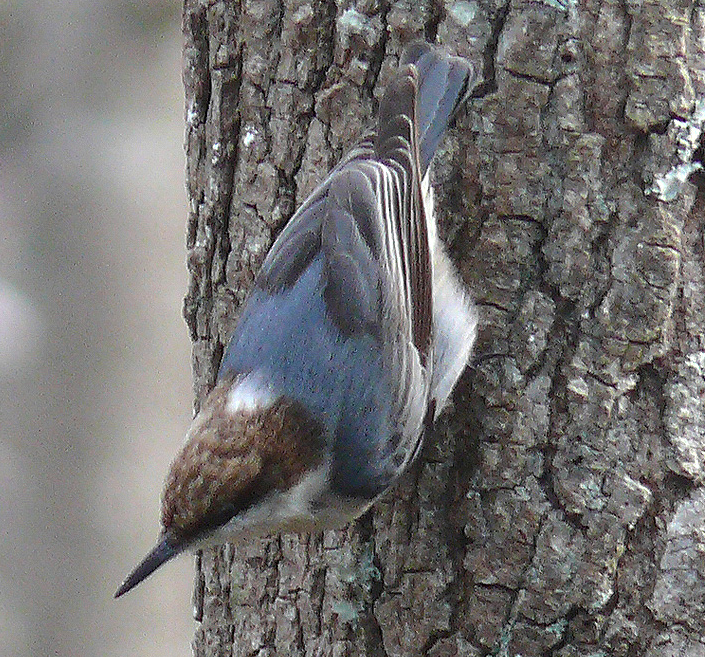
Brown-headed Nuthatch

Brown-headed Nuthatch

Sitta pusilla

derivative work: Snowmanradio (talk) Brown-headed_Nuthatch-27527.jpg: Ken Thomas, Public domain, via Wikimedia Commons

Side by side

Burmese NuthatchBrown-headed Nuthatch
Scientific nameSitta neglecta Walden, 1870Sitta pusilla Latham, 1790
English nameBurmese NuthatchBrown-headed Nuthatch
GroupBirdsBirds
ClassAves BirdAves Bird
OrderPasseriformes PasserinePasseriformes Passerine
FamilySittidae NuthatchSittidae Nuthatch
GenusSitta NuthatchSitta Nuthatch
Named in18701790
Red List categoryLeast ConcernLeast Concern
Countries on record5 countries1 country
GBIF occurrence records2,198 records1,065,259 records

Rows where the two agree are shown in grey.

Where each is found

Only Burmese Nuthatch (5)

Only Brown-headed Nuthatch (1)

From Catalogue of Life checklists and GBIF occurrence records. A country missing from a list means no record is held, which is not proof of absence.

Checked facts

Burmese NuthatchBrown-headed Nuthatch
AppearanceNo checked fact yet
  • The species has a brown cap, a narrow black eyeline, buff-white cheeks, a chin and belly, and bluish-gray wings. English Wikipedia
  • Males and females have similar body sizes and coloration. animaldiversity.org
  • Juveniles resemble adults in both coloration and size. animaldiversity.org
SizeNo checked fact yet
Habitat
  • The species inhabits subtropical or tropical dry forests. English Wikipedia
  • The species inhabits subtropical or tropical moist lowland forests. English Wikipedia
  • The species inhabits subtropical or tropical moist montane forests. English Wikipedia
  • The Burmese Nuthatch inhabits dry broadleaf forests in lowland and foothill areas. ebird.org
  • The Burmese Nuthatch inhabits pine forests in lowland and foothill areas. ebird.org
  • The species typically inhabits open, mature pine stands with sparse understory vegetation. animaldiversity.org
  • Areas subject to frequent prescribed burns provide suitable habitat by maintaining open understories and creating nesting snags. animaldiversity.org
  • The species is generally found at elevations below 700 metres. animaldiversity.org
  • The species is associated with forests, woodlands, shrublands, savannas, and thickets. audubon.org
  • Pine forests provide the species with both food and shelter. nps.gov
DietNo checked fact yet
  • The species eats both seeds and insects. nps.gov
  • Pine seeds become a more important food source during winter when insect activity decreases. nps.gov
  • The species consumes more insects during warmer months when insects are abundant. nps.gov
  • The species is particularly attracted to sunflower seeds and suet cakes at feeding stations. English Wikipedia
BehaviourNo checked fact yet
  • The species uses pieces of bark, small twigs, and pine needles as tools when searching for insects. English Wikipedia
  • Individuals use loose bark as wedges to remove additional pieces of bark and expose insects. animaldiversity.org
  • Individuals wedge seeds into bark depressions and crack them by hammering with their beaks. animaldiversity.org
  • The species travels in single-species flocks of four to five birds during the breeding season. animaldiversity.org
  • During the non-breeding season, individuals travel in mixed-species flocks containing eight to twenty birds. animaldiversity.org
  • The species is bold, inquisitive, and readily approachable by humans. English Wikipedia
  • The species is the only member of the family Sittidae documented using tools. animaldiversity.org
ReproductionNo checked fact yet
  • Brown-headed Nuthatches are cooperative breeders, with groups of two to five adults participating in raising young. animaldiversity.org
  • Cooperative breeding groups include one to three helper birds in addition to the breeding pair. animaldiversity.org
  • Nest construction generally begins in February. animaldiversity.org
  • Nests are commonly located in snags, birdhouses, or abandoned woodpecker cavities. animaldiversity.org
  • Nest entrances are usually less than 2.5 cm in diameter. animaldiversity.org
  • The nest cavity is at least 30 cm deep and less than three metres above the ground. animaldiversity.org
  • Females generally lay four to eight eggs per brood between March and July. animaldiversity.org
  • Nestlings remain in the nest for approximately 17 to 19 days after hatching. animaldiversity.org
  • Young birds fledge approximately 18 to 19 days after hatching. animaldiversity.org
  • Most adults produce only one clutch of eggs annually. nps.gov
  • Females lay an average of four to six eggs per nest. nps.gov
Distribution
  • The Burmese Nuthatch occurs in Myanmar, Thailand, Laos, Cambodia, and Vietnam. English Wikipedia
  • The Brown-headed Nuthatch is endemic to pine forests throughout the southeastern United States. English Wikipedia
  • The species occurs as far north as Virginia, as far west as Texas, and as far south as southern Florida. animaldiversity.org
  • A small, declining population occurs on the Grand Bahama Islands. animaldiversity.org
  • The species occurs along the coastal states of the southeastern United States from North Carolina to Texas. nps.gov
ConservationNo checked fact yet
  • The species is classified as a Species of Conservation Concern by the Missouri Department of Conservation. mdc.mo.gov
Similar species
  • The Burmese Nuthatch was previously classified together with the Chestnut-bellied Nuthatch before being split as a separate species. English Wikipedia
  • The Burmese Nuthatch is very similar in appearance to the Chestnut-bellied Nuthatch. ebird.org
  • The Burmese Nuthatch has minimal geographic overlap with the Chestnut-bellied Nuthatch. ebird.org
  • The Brown-headed Nuthatch is approximately the same size as the Pygmy Nuthatch, and both are identified as the world's smallest nuthatches. English Wikipedia
  • The Brown-headed Nuthatch overlaps geographically with Red-breasted and White-breasted Nuthatches, which are larger and differently marked. English Wikipedia
OtherNo checked fact yet
  • The Bahama Nuthatch was formerly classified as a subspecies of the Brown-headed Nuthatch but is now recognized as a separate species. English Wikipedia

In brief

Burmese Nuthatch

Sitta neglecta occurs in Myanmar, Thailand, Laos, Cambodia, and Vietnam. It was previously classified together with the Chestnut-bellied Nuthatch before being split as a separate species. Full profile

Brown-headed Nuthatch

Sitta pusilla is endemic to pine forests throughout the southeastern United States, with a small, declining population on the Grand Bahama Islands. It is distinguished by its brown cap, narrow black eyeline, buff-white cheeks, and bluish-gray wings. Full profile

Compare something else

Page built on 29 November 2026 from the data on the two species pages, where every source is listed.

Cite this page

ScientificNames.org. (2026). Burmese Nuthatch vs Brown-headed Nuthatch. Retrieved November 29, 2026, from https://scientificnames.org/compare/burmese-nuthatch-vs-brown-headed-nuthatch