Species · Birds
Brown-headed Nuthatch Sitta pusilla
The scientific name of the Brown-headed Nuthatch is Sitta pusilla. It is a species of bird in the family Sittidae (nuthatch), order Passeriformes. The name dates from 1790.
- Scientific name
- Sitta pusilla Latham, 1790
- Common name
- Brown-headed Nuthatch
- Genus
- Sitta
- Family
- Sittidae (Nuthatch)
- Order
- Passeriformes
- Class
- Aves
- Red List category
- LC Least Concern
- Recorded in
- 1 country
- Name status
- accepted in the Catalogue of Life
Overview
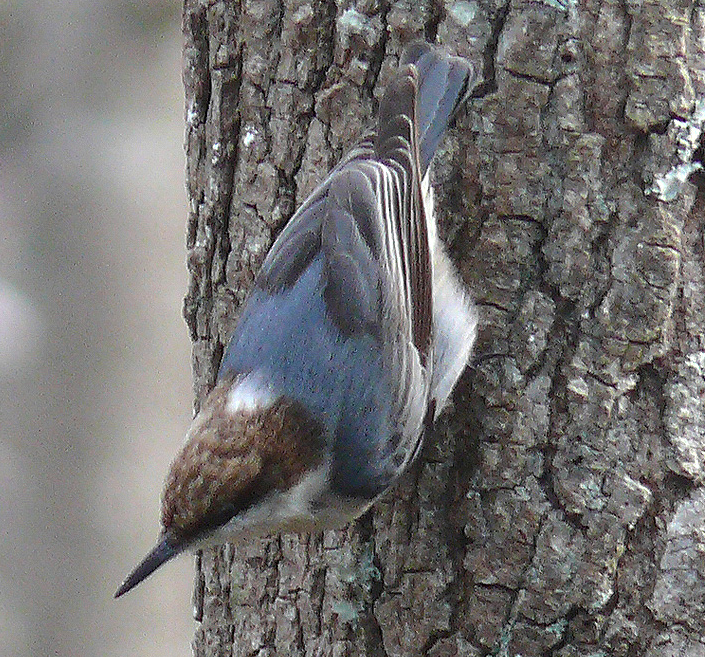
Sitta pusilla is endemic to pine forests throughout the southeastern United States, with a small, declining population on the Grand Bahama Islands. It is distinguished by its brown cap, narrow black eyeline, buff-white cheeks, and bluish-gray wings.
Written 26 November 2026 from the sources listed below. Each statement was checked against the passage it cites; statements that could not be supported were removed.
Appearance
Males and females have similar body sizes and coloration. Juveniles resemble adults in both coloration and size.[1][2]
The species measures approximately 9–11 cm in total length, with a wingspan of approximately 16 to 18 cm. Its body mass ranges from approximately 10 to 12 g, and adults have an average body mass of 10.8 g.[3][4][5][6]
Habitat
The Brown-headed Nuthatch typically inhabits open, mature pine stands with sparse understory vegetation. Pine forests provide both food and shelter.[7][8]
Areas subject to frequent prescribed burns provide suitable habitat by maintaining open understories and creating nesting snags. The species is generally found at elevations below 700 metres.[9][10]
The species is associated with forests, woodlands, shrublands, savannas, and thickets.[11]
The species occurs as far north as Virginia, as far west as Texas, and as far south as southern Florida. It occurs along the coastal states of the southeastern United States from North Carolina to Texas.[12][13]
Diet
The Brown-headed Nuthatch eats both seeds and insects. It consumes more insects during warmer months when insects are abundant, while pine seeds become a more important food source during winter when insect activity decreases.[14][15][16]
The species is particularly attracted to sunflower seeds and suet cakes at feeding stations.[17]
Behaviour
The Brown-headed Nuthatch uses pieces of bark, small twigs, and pine needles as tools when searching for insects. Individuals use loose bark as wedges to remove additional pieces of bark and expose insects.[18][19]
Individuals wedge seeds into bark depressions and crack them by hammering with their beaks. The species is the only member of the family Sittidae documented using tools.[20][21]
During the breeding season, the species travels in single-species flocks of four to five birds. During the non-breeding season, individuals travel in mixed-species flocks containing eight to twenty birds.[22][23]
The species is bold, inquisitive, and readily approachable by humans.[24]
Reproduction and life cycle
Brown-headed Nuthatches are cooperative breeders, with groups of two to five adults participating in raising young. These groups include one to three helper birds in addition to the breeding pair.[25][26]
Nest construction generally begins in February. Nests are commonly located in snags, birdhouses, or abandoned woodpecker cavities.[27][28]
Nest entrances are usually less than 2.5 cm in diameter. The nest cavity is at least 30 cm deep and less than three metres above the ground.[29][30]
Females generally lay four to eight eggs per brood between March and July, with an average of four to six eggs per nest. Most adults produce only one clutch of eggs annually.[31][32][33]
Nestlings remain in the nest for approximately 17 to 19 days after hatching. Young birds fledge approximately 18 to 19 days after hatching.[34][35]
Conservation
The Brown-headed Nuthatch is classified as a Species of Conservation Concern by the Missouri Department of Conservation. A small, declining population occurs on the Grand Bahama Islands.[36][37]
Similar species
The Brown-headed Nuthatch is approximately the same size as the Pygmy Nuthatch, and both are identified as the world's smallest nuthatches. It overlaps geographically with Red-breasted and White-breasted Nuthatches, which are larger and differently marked.[38][39]
The Bahama Nuthatch was formerly classified as a subspecies of the Brown-headed Nuthatch but is now recognized as a separate species.[40]
Classification of the Brown-headed Nuthatch
| Kingdom | Animalia |
|---|---|
| Phylum | Chordata |
| Subphylum | Vertebrata |
| Infraphylum | Gnathostomata |
| Parvphylum | Osteichthyes |
| Megaclass | Tetrapoda |
| Class | Aves (Bird) |
| Order | Passeriformes (Passerine) |
| Family | Sittidae (Nuthatch) |
| Genus | Sitta (Nuthatch) |
| Species | Sitta pusilla Latham, 1790 |
Where the Brown-headed Nuthatch is found
Checklists and occurrence records place Sitta pusilla in 1 country across North America. GBIF holds 1,065,259 georeferenced records of it.
Countries
Regions and cities with the most records
- North Carolina, United States 310,949
- Georgia, United States 297,399
- South Carolina, United States 129,226
- Chamblee, United States 92,635
- Brookhaven, United States 88,342
- Sandy Springs, United States 87,302
- Dunwoody, United States 85,227
- North Druid Hills, United States 79,750
- Tucker, United States 77,769
- Norcross, United States 77,656
- North Decatur, United States 75,622
- Decatur, United States 74,110
- Peachtree Corners, United States 72,696
- Morrisville, United States 70,263
- Belvedere Park, United States 69,194
- Florida, United States 67,269
- Atlanta, United States 65,310
- Virginia, United States 64,407
- Cary, United States 62,461
- Candler-McAfee, United States 61,250
- Alabama, United States 61,225
- Apex, United States 58,968
- Durham, United States 56,248
- Raleigh, United States 54,576
- Chapel Hill, United States 52,814
- Smyrna, United States 52,402
- Carrboro, United States 51,828
- Johns Creek, United States 50,943
- Redan, United States 50,831
- Roswell, United States 49,315
- Stonecrest, United States 47,438
- Marietta, United States 45,729
- Duluth, United States 43,553
- Garner, United States 42,039
- Alpharetta, United States 39,785
- Holly Springs, United States 39,669
Range as the checklists state it
North America
A number beside a place is its count of GBIF occurrence records. A place without a number comes from a checklist alone. Records show where a species has been observed or collected, which can include escapes and vagrants.
Common names
English
- Brown-headed Nuthatch
Names in 28 other languages
- Bulgarian
- Кафявоглава зидарка
- Catalan
- pica-soques capbrú
- Chinese
- 褐头䴓, 褐頭鳾
- Croatian
- smeđokapi brgljez
- Czech
- brhlík hnědohlavý
- Danish
- Brunhættet Spætmejse
- Dutch
- Bruinkopboomklever, Denneboomklever
- Esperanto
- brunkapa sito
- Estonian
- pisi-puukoristaja
- Finnish
- ruskopäänakkeli
- French
- Sittelle à tête brune
- German
- Braunkopfkleiber
- Hungarian
- barnafejű csuszka
- Italian
- Picchio muratore capobruno, Picchio muratore testabruna
- Japanese
- チャガシラヒメゴジュウカラ
- Latvian
- brūngalvas dzilnītis
- Lithuanian
- rudagalvis bukutis
- Norwegian
- brunhettespettmeis
- Polish
- kowalik malutki
- Portuguese
- trepadeira-de-cabeça-castanha
- Russian
- Буроголовый поползень, Коричневоголовый поползень, Поползень буроголовый
- Serbian
- Smeđoglavi američki brgljez
- Slovak
- brhlík hnedohlavý
- Spanish
- Trepador cabecipardo
- Swedish
- brunhuvad nötväcka
- Turkish
- Boz Başlı Sıvacı
- Ukrainian
- повзик малий
- Welsh
- delor cnau penfrown
Synonyms
3 other scientific names have been used for this species and are now treated as synonyms of Sitta pusilla.
- Sitta minor Bechstein, JM, 1793
- Sitta pusilla caniceps Bangs, 1898
- Sitta pusilla pusilla Latham, 1790
Related species
-
 Eurasian NuthatchSitta europaea
-
 White-breasted NuthatchSitta carolinensis
-
 Red-breasted NuthatchSitta canadensis
-
 Pygmy NuthatchSitta pygmaea
- Bahama NuthatchSitta insularis
-
 Beautiful NuthatchSitta formosa
-
 Algerian NuthatchSitta ledanti
-
 Corsican NuthatchSitta whiteheadi
Compare
Questions and answers
What is the scientific name of the Brown-headed Nuthatch?
The scientific name of the Brown-headed Nuthatch is Sitta pusilla. Written with its author, the full name is Sitta pusilla Latham, 1790.
Which family does the Brown-headed Nuthatch belong to?
Sitta pusilla belongs to the family Sittidae, in the order Passeriformes and the class Aves.
Where is the Brown-headed Nuthatch found?
Checklists and occurrence records place Sitta pusilla in 1 country: United States.
What is the conservation status of the Brown-headed Nuthatch?
The IUCN Red List category recorded for Sitta pusilla is Least Concern (LC).
Where are brown-headed nuthatches found?
They occur in pine forests throughout the southeastern United States, as far north as Virginia, as far west as Texas, and as far south as southern Florida. A small, declining population also occurs on the Grand Bahama Islands.[41][12][37]
What is the diet of a nuthatch?
The Brown-headed Nuthatch eats both seeds and insects. Pine seeds become more important during winter, while insects make up a larger part of its diet during warmer months.[14][15][16]
What do brown-headed nuthatches eat?
They eat insects and seeds, including pine seeds. They are particularly attracted to sunflower seeds and suet cakes at feeding stations.[14][15][17]
Where does the Brown-headed Nuthatch live?
It typically inhabits open, mature pine stands with sparse understory vegetation. Its range extends across the coastal states of the southeastern United States from North Carolina to Texas.[13][7]
Are Nuthatches friendly to humans?
The Brown-headed Nuthatch is bold, inquisitive, and readily approachable by humans.[24]
Sources
Passages the profile rests on
- Males and females have similar body sizes and coloration. Source passage: “Brown-headed nuthatches are monomorphic, meaning males and females have a similar size and color.” — animaldiversity.org
- Juveniles resemble adults in both coloration and size. Source passage: “Juveniles also resemble adults in coloring and size.” — animaldiversity.org
- The species measures approximately 9–11 cm in total length. Source passage: “In the brown-headed nuthatch, the total length is 9–11 cm (3.5–4.3 in)” — English Wikipedia
- Its wingspan ranges from approximately 16 to 18 cm. Source passage: “wingspan is 16–18 cm (6.3–7.1 in)” — English Wikipedia
- Its body mass ranges from approximately 10 to 12 g. Source passage: “body mass is 10–12 g (0.35–0.42 oz).” — English Wikipedia
- Adult individuals have an average body mass of 10.8 g. Source passage: “with an average adult mass of 10.8 g.” — animaldiversity.org
- The species typically inhabits open, mature pine stands with sparse understory vegetation. Source passage: “Brown-headed nuthatches are typically found in open mature pine stands with thin understories.” — animaldiversity.org
- Pine forests provide the species with both food and shelter. Source passage: “These birds frequently inhabit pine forests because they rely on pine trees for everything from food to shelter.” — nps.gov
- Areas subject to frequent prescribed burns provide suitable habitat by maintaining open understories and creating nesting snags. Source passage: “Areas with frequent prescribed burns are ideal for these birds as it keeps the understory open and creates snags for nesting.” — animaldiversity.org
- The species is generally found at elevations below 700 metres. Source passage: “Typically, these birds are found below 700 m in elevation.” — animaldiversity.org
- The species is associated with forests, woodlands, shrublands, savannas, and thickets. Source passage: “Habitat. Forests and Woodlands, Shrublands, Savannas, and Thickets.” — audubon.org
- The species occurs as far north as Virginia, as far west as Texas, and as far south as southern Florida. Source passage: “They are found as far north as Virginia, as far west as Texas and as far south as southern Florida.” — animaldiversity.org
- The species occurs along the coastal states of the southeastern United States from North Carolina to Texas. Source passage: “Brown-headed nuthatches are found throughout the coastal states of the southeastern United States from North Carolina to Texas.” — nps.gov
- The species eats both seeds and insects. Source passage: “Brown-headed nuthatches eat a combination of seeds and insects.” — nps.gov
- Pine seeds become a more important food source during winter when insect activity decreases. Source passage: “In the winter, when insect life is more subdued, they rely more on seeds such as pine seeds.” — nps.gov
- The species consumes more insects during warmer months when insects are abundant. Source passage: “In warmer months, when insect life is abundant, they tend to eat more insects.” — nps.gov
- The species is particularly attracted to sunflower seeds and suet cakes at feeding stations. Source passage: “It is a frequent visitor to feeding stations and is highly fond of sunflower seeds and suet cakes.” — English Wikipedia
- The species uses pieces of bark, small twigs, and pine needles as tools when searching for insects. Source passage: “The bird is regularly observed using a small chips of bark, small twigs, and pine needles held in its beak as tools to dig for insects.” — English Wikipedia
- Individuals use loose bark as wedges to remove additional pieces of bark and expose insects. Source passage: “They pry off a loose piece of bark and use it as a wedge to pry off more difficult pieces of bark.” — animaldiversity.org
- Individuals wedge seeds into bark depressions and crack them by hammering with their beaks. Source passage: “They are also known to wedge a seed into a bark depression and hammer it with their beaks until the seed cracks.” — animaldiversity.org
- The species is the only member of the family Sittidae documented using tools. Source passage: “Brown-headed nuthatches are the only species in family Sittidae that have been observed using tools.” — animaldiversity.org
- The species travels in single-species flocks of four to five birds during the breeding season. Source passage: “Brown-headed nuthatches are a social species, traveling in small single-species flocks of 4 to 5 birds during the breeding season.” — animaldiversity.org
- During the non-breeding season, individuals travel in mixed-species flocks containing eight to twenty birds. Source passage: “During the non-breeding season, they travel in multi-species flocks of 8 to 20 birds.” — animaldiversity.org
- The species is bold, inquisitive, and readily approachable by humans. Source passage: “Bold and inquisitive, this bird is readily approachable by humans.” — English Wikipedia
- Brown-headed Nuthatches are cooperative breeders, with groups of two to five adults participating in raising young. Source passage: “Brown-headed nuthatches are cooperative breeding birds, meaning they rear their young in groups of 2 to 5 adult birds per nest.” — animaldiversity.org
- Cooperative breeding groups include one to three helper birds in addition to the breeding pair. Source passage: “In addition to the breeding male and female, there are 1 to 3 helper birds that help with nest building, feeding and nest defense.” — animaldiversity.org
- Nest construction generally begins in February. Source passage: “Brown-headed nuthatches start building nests in February.” — animaldiversity.org
- Nests are commonly located in snags, birdhouses, or abandoned woodpecker cavities. Source passage: “Generally they are located in snags (dead trees), birdhouses or abandoned woodpecker holes.” — animaldiversity.org
- Nest entrances are usually less than 2.5 cm in diameter. Source passage: “The nest opening is usually less than 2.5 cm in diameter.” — animaldiversity.org
- The nest cavity is at least 30 cm deep and less than three metres above the ground. Source passage: “The nest itself is at least 30 cm deep and less than 3 meters from the ground” — animaldiversity.org
- Females generally lay four to eight eggs per brood between March and July. Source passage: “The eggs vary in shape and color and can be laid from March to July. Generally 4 to 8 eggs are laid per brood.” — animaldiversity.org
- Most adults produce only one clutch of eggs annually. Source passage: “Most adults will only hatch one clutch of eggs per year.” — nps.gov
- Females lay an average of four to six eggs per nest. Source passage: “Females will lay an average of four to six eggs in the nest.” — nps.gov
- Nestlings remain in the nest for approximately 17 to 19 days after hatching. Source passage: “Once the young hatch, they remain in the nest and are cared for by the adults for another 17 to 19 days.” — animaldiversity.org
- Young birds fledge approximately 18 to 19 days after hatching. Source passage: “Nestlings fledge around 18 to 19 days after hatching” — animaldiversity.org
- The species is classified as a Species of Conservation Concern by the Missouri Department of Conservation. Source passage: “Status. Name. Species of Conservation Concern” — mdc.mo.gov
- A small, declining population occurs on the Grand Bahama Islands. Source passage: “There is also a small, declining population found on the Grand Bahama Islands.” — animaldiversity.org
- The Brown-headed Nuthatch is approximately the same size as the Pygmy Nuthatch, and both are identified as the world's smallest nuthatches. Source passage: “the brown-headed nuthatch is about the same size as the pygmy nuthatch and the two species are the world's smallest nuthatches.” — English Wikipedia
- The Brown-headed Nuthatch overlaps geographically with Red-breasted and White-breasted Nuthatches, which are larger and differently marked. Source passage: “since it overlaps only with the very differently marked and larger red-breasted and white-breasted nuthatches.” — English Wikipedia
- The Bahama Nuthatch was formerly classified as a subspecies of the Brown-headed Nuthatch but is now recognized as a separate species. Source passage: “The Bahama nuthatch was formerly considered a subspecies (S. p. insularis), but has since been reclassified as its own separate species.” — English Wikipedia
- The Brown-headed Nuthatch is endemic to pine forests throughout the southeastern United States. Source passage: “The brown-headed nuthatch (Sitta pusilla) is a small songbird endemic to pine forests throughout the Southeastern United States.” — English Wikipedia
Data
- Catalogue of Life, 2026-10-16 XR cc by
- Global Biodiversity Information Facility CC BY 4.0
- Wikidata CC0
- GeoNames CC BY 4.0
- Wikimedia Commons per image; credit shown with each image
- Within the Catalogue of Life, this name comes from The Integrated Taxonomic Information System cc0
References
- Latham, & Joannis. (1790). Index Ornithologicus, Sive Systema Ornithologiae; Complectens Avium Divisionem in Classes, Ordines, Genera, Species, Ipsarumque Varietates: Adjectis Synonymis, Locis, Descriptionibus, & c, Vol. 1. where the name was published
- Banks, R. C., R. W. McDiarmid, and A. L. Gardner. (1987). Checklist of Vertebrates of the United States, the U.S. Territories, and Canada. Resource Publication, No. 166.
- Gill, Frank, & and Minturn Wright. (2006). Birds of the World: Recommended English Names.
This species in other databases
Page built on 26 November 2026. See how the catalog is made and all sources and licences.
Cite this page
ScientificNames.org. (2026). Sitta pusilla (Brown-headed Nuthatch). Retrieved November 26, 2026, from https://scientificnames.org/species/sitta-pusilla
“Sitta pusilla (Brown-headed Nuthatch).” ScientificNames.org, 2026, scientificnames.org/species/sitta-pusilla. Accessed 26 Nov. 2026.
ScientificNames.org. “Sitta pusilla (Brown-headed Nuthatch).” Accessed November 26, 2026. https://scientificnames.org/species/sitta-pusilla.
@misc{scientificnames_sitta_pusilla_brown_headed_nuthatch,
  author = {{ScientificNames.org}},
  title = {Sitta pusilla (Brown-headed Nuthatch)},
  year = {2026},
  url = {https://scientificnames.org/species/sitta-pusilla},
  note = {Accessed 2026-11-26}
}