Comparison

Cactus Canastero vs Steinbach's Canastero

Cactus Canastero (Pseudasthenes cactorum) and Steinbach's Canastero (Pseudasthenes steinbachi) both belong to the genus Pseudasthenes (false canasteros) and part ways below it.

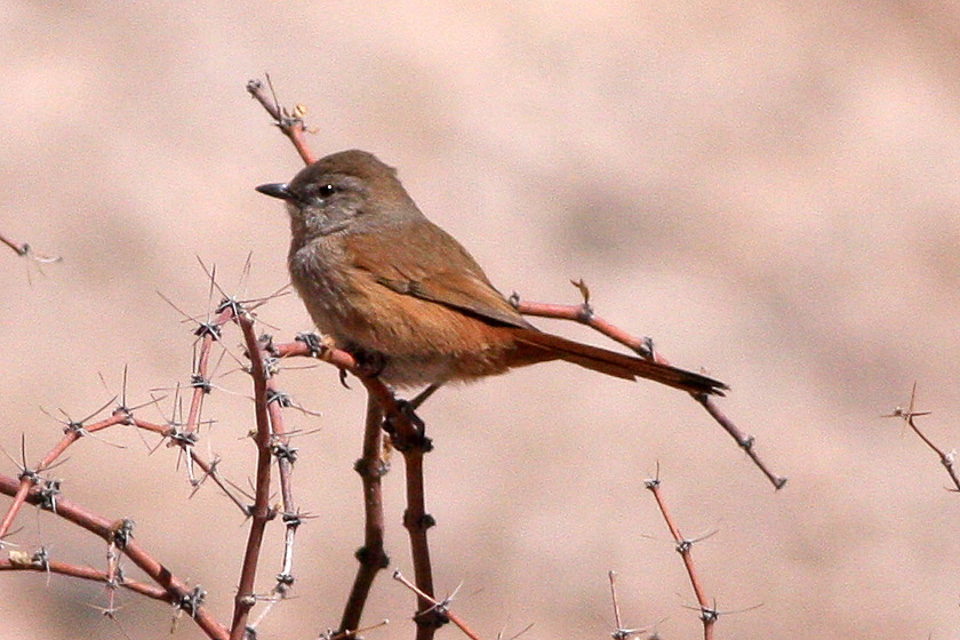
Cactus Canastero

Cactus Canastero

Pseudasthenes cactorum

Nick Athanas, CC BY-SA 4.0, via Wikimedia Commons

Steinbach's Canastero

Steinbach's Canastero

Pseudasthenes steinbachi

Ron Knight, CC BY 2.0, via Wikimedia Commons

Side by side

Cactus CanasteroSteinbach's Canastero
Scientific namePseudasthenes cactorum (Koepcke, 1959)Pseudasthenes steinbachi (E. J. O. Hartert, 1909)
English nameCactus CanasteroSteinbach's Canastero
GroupBirdsBirds
ClassAves BirdAves Bird
OrderPasseriformes PasserinePasseriformes Passerine
FamilyFurnariidae OvenbirdFurnariidae Ovenbird
GenusPseudasthenes False CanasterosPseudasthenes False Canasteros
Named in19591909
Red List categoryLeast ConcernLeast Concern
Countries on record1 country1 country
GBIF occurrence records867 records1,084 records

Rows where the two agree are shown in grey.

Where each is found

Only Cactus Canastero (1)

Only Steinbach's Canastero (1)

From Catalogue of Life checklists and GBIF occurrence records. A country missing from a list means no record is held, which is not proof of absence.

Checked facts

Cactus CanasteroSteinbach's Canastero
Appearance
  • Adult cactus canasteros have a pale buff supercilium, dull brown crown and upperparts, and mostly dull rufous wing coverts. English Wikipedia
  • The cactus canastero has pale orange-tawny coloration on its chin and central throat, with pale buff breast and remaining underparts. English Wikipedia
  • The cactus canastero has a brown iris, a black-to-gray maxilla, a blue-gray mandible with a blackish tip, and gray-brown to black legs and feet. English Wikipedia
  • Male and female cactus canasteros have the same plumage. English Wikipedia
  • Adults have a pale supercilium and an otherwise grayish-brown face. English Wikipedia
  • The crown and back are dull gray-brown, while the rump is chestnut. English Wikipedia
  • Its uppertail coverts are rufous-chestnut. English Wikipedia
  • The wings are predominantly rufous, with dark fuscous outer halves of the flight feathers. English Wikipedia
  • The two outermost pairs of tail feathers are entirely rufous or chestnut. English Wikipedia
  • Its chin and throat are whitish with faint dusky specks. English Wikipedia
  • The breast and belly are grayish, while the flanks and undertail coverts are tawny-rufous or pale cinnamon. English Wikipedia
  • Its iris is brown to dark brown, its bill is black to dark brown, and its legs and feet are brown to black. English Wikipedia
  • Both sexes have the same plumage. English Wikipedia
Size
Habitat
  • The cactus canastero inhabits arid montane scrublands containing scattered bushes and columnar cacti. English Wikipedia
  • The cactus canastero occurs at elevations between 50 and 2,500 m. English Wikipedia
  • The species inhabits arid montane scrublands and favors ravines. English Wikipedia
  • Its elevational range is approximately 500–3,000 m. English Wikipedia
  • The species inhabits well-developed, semi-arid temperate hillside scrub at elevations of 650–3,000 m. datazone.birdlife.org
  • Its desert-scrub habitat includes plants belonging to the genus Larrea. datazone.birdlife.org
  • The species is associated with the Monte desert region of Argentina. ebird.org
  • It is frequently found in low, dense vegetation. ebird.org
DietNo checked fact yet
  • The species is believed to collect arthropods from the ground and low vegetation. English Wikipedia
Behaviour
  • The cactus canastero is usually observed alone or in pairs. English Wikipedia
  • The cactus canastero remains resident throughout its geographical range year-round. English Wikipedia
  • The cactus canastero produces a weak, dry song trill lasting up to six seconds. English Wikipedia
  • The cactus canastero's call is a low-pitched, fast, dry trill that is frequently repeated. English Wikipedia
  • The species is mostly resident, although some individuals from higher elevations move to lower elevations after breeding. English Wikipedia
  • It is usually observed alone or in pairs. English Wikipedia
Reproduction
Distribution
  • The cactus canastero is endemic to Peru. English Wikipedia
  • The cactus canastero occurs on the western slope of the Andes in Peru, in La Libertad and from Lima southward to Arequipa. English Wikipedia
  • The species is endemic to Argentina. English Wikipedia
  • Its range in western Argentina extends from southern Salta Province to Neuquén and Río Negro provinces. English Wikipedia
Conservation
  • The cactus canastero is classified as Least Concern by the IUCN. English Wikipedia
  • The cactus canastero has a large geographical range, but its population size is unknown and believed to be declining. English Wikipedia
  • No immediate threats to the cactus canastero have been identified. English Wikipedia
  • The cactus canastero is considered uncommon and poorly known. English Wikipedia
Similar speciesNo checked fact yet
  • Its relatively plain gray head distinguishes it from other canasteros. ebird.org
Other
  • The cactus canastero was most recently assessed for the IUCN Red List in 2024. iucnredlist.org
  • The species was originally described under the scientific name Siptornis steinbachi. English Wikipedia
  • It was transferred from Asthenes to the newly established genus Pseudasthenes in 2010. English Wikipedia
  • Steinbach's Canastero is a monotypic species. English Wikipedia
  • The species was most recently assessed for the IUCN Red List in 2024. iucnredlist.org

In brief

Cactus Canastero

Pseudasthenes cactorum is endemic to Peru, occurring on the western slope of the Andes in La Libertad and from Lima southward to Arequipa. It has a pale buff supercilium, dull brown upperparts, mostly dull rufous wing coverts and pale orange-tawny coloration on the chin and central throat. Full profile

Steinbach's Canastero

Pseudasthenes steinbachi is endemic to Argentina, where its range extends from southern Salta Province to Neuquén and Río Negro provinces. It is distinguished from other canasteros by its relatively plain gray head. Full profile

Compare something else

Page built on 27 November 2026 from the data on the two species pages, where every source is listed.

Cite this page

ScientificNames.org. (2026). Cactus Canastero vs Steinbach's Canastero. Retrieved November 27, 2026, from https://scientificnames.org/compare/cactus-canastero-vs-steinbachs-canastero