Comparison

Cagle's Map Turtle vs Ouachita Map Turtle

Cagle's Map Turtle (Graptemys caglei) and Ouachita Map Turtle (Graptemys ouachitensis) both belong to the genus Graptemys (map turtles) and part ways below it. Both are recorded in 1 country.
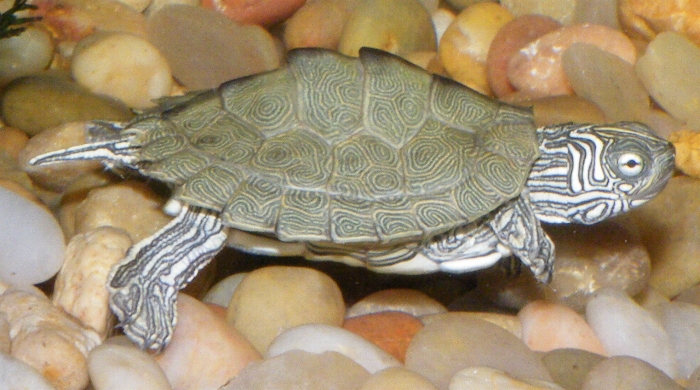
Cagle's Map Turtle

Cagle's Map Turtle

Graptemys caglei

Mokele, CC BY-SA 3.0, via Wikimedia Commons

Ouachita Map Turtle

Ouachita Map Turtle

Graptemys ouachitensis

Aaron Bishop, Public domain, via Wikimedia Commons

Side by side

Cagle's Map TurtleOuachita Map Turtle
Scientific nameGraptemys caglei Haynes & Mckown, 1974Graptemys ouachitensis Cagle, 1953
English nameCagle's Map TurtleOuachita Map Turtle
GroupReptilesReptiles
ClassReptilia ReptileReptilia Reptile
OrderTestudines TurtleTestudines Turtle
FamilyEmydidae TerrapinsEmydidae Terrapins
GenusGraptemys Map TurtlesGraptemys Map Turtles
Named in19741953
Red List categoryEndangeredLeast Concern
EnvironmentNot recordedterrestrial
Countries on record1 country3 countries
GBIF occurrence records626 records9,163 records

Rows where the two agree are shown in grey.

Where each is found

Both recorded in 1 country

Only Ouachita Map Turtle (2)

From Catalogue of Life checklists and GBIF occurrence records. A country missing from a list means no record is held, which is not proof of absence.

Checked facts

Cagle's Map TurtleOuachita Map Turtle
Appearance
  • The carapace and plastron have intricate patterns, and the posterior edge of the carapace is serrated. English Wikipedia
  • The carapace is somewhat flattened. animaldiversity.org
  • A prominent V-shaped marking on the head extending toward the eyes helps identify the species. animaldiversity.org
  • The shell ranges from dark yellow to brown and bears brown to black swirl-like markings on its scutes. animaldiversity.org
  • The plastron is yellowish, with black flecks and black edging around each scute. animaldiversity.org
  • The skin of the limbs, head, and tail is dark green to nearly black, with yellow to cream-colored stripes. animaldiversity.org
  • Male individuals have longer tails than females. animaldiversity.org
  • Hatchlings have rounder shells than adults and more pronounced lines around their plastral scutes. animaldiversity.org
  • The carapace is olive, dark brown, or black with light yellowish markings bordered by dark coloration. English Wikipedia
  • The posterior edge of the carapace is serrated and bears a row of low vertebral spines. English Wikipedia
  • The plastron ranges from cream to yellow and has dark lines and swirls. English Wikipedia
  • The body is grayish brown to blackish and has yellowish stripes. English Wikipedia
  • The head has rectangular yellow spots behind the eyes, oval spots below the eyes, and round spots on each side of the jaw. English Wikipedia
  • Some individuals have yellow head markings that merge into a thick C-shaped marking around the eye. English Wikipedia
  • The eyes have a black stripe running through their middle. English Wikipedia
  • The carapace is olive-green with one to six black blotches along the posterior end of each scute. animaldiversity.org
  • The black carapace blotches are surrounded by yellow or orange rings that fade with age. animaldiversity.org
  • The plastron is yellow or cream-colored with dark green swirls that turn brown in aging females. animaldiversity.org
  • Carapace keels are more prominent in juveniles and males than in females. animaldiversity.org
  • The head is dark green with yellow markings. animaldiversity.org
  • The eyes have a white iris and a yellow or black pupil. animaldiversity.org
  • Juveniles have the same coloration and patterns as adults, but their colors are more vibrant. animaldiversity.org
Size
Habitat
  • Cagle's map turtles inhabit relatively large creeks and rivers with sandy, gravelly, or muddy substrates. animaldiversity.org
  • Shallow water locations with moderate flow rates are common habitats for the species. animaldiversity.org
  • Individuals commonly bask on fallen trees, rocks, and cypress knees. animaldiversity.org
  • Submerged individuals are commonly found at depths of 1–3 metres. animaldiversity.org
  • The species primarily inhabits slow-moving freshwater rivers. animaldiversity.org
  • The species also inhabits oxbow lakes, reservoirs, and sloughs. animaldiversity.org
  • The turtles commonly occur in areas with abundant submerged vegetation. animaldiversity.org
  • They use unshaded river stretches with floating debris such as rocks, mud, and deadwood for basking. animaldiversity.org
  • Females generally occupy deeper and wider river sections with stronger currents. animaldiversity.org
  • Nesting sites include natural sand or gravel bars formed by channel movement. animaldiversity.org
Diet
  • The species feeds on shrimp, insects, molluscs, fish, and fish carrion. English Wikipedia
  • Its insect prey includes mayflies, caddisflies, beetles, grasshoppers, fly larvae, and midge larvae. English Wikipedia
  • The species also consumes algae and aquatic plants, including pondweed, duckweed, and manna grass. English Wikipedia
  • Its diet includes insects, worms, crayfish, snails, and naiads. dnr.wisconsin.gov
Behaviour
  • The Ouachita map turtle is rarely found on land except during nesting or basking. English Wikipedia
  • The species is diurnal and commonly basks in groups on logs or rocks. animaldiversity.org
  • Feeding activity generally begins in midmorning after basking. animaldiversity.org
  • Feeding activity slows in mid-September, while basking continues until mid-October. animaldiversity.org
  • The species does not migrate and instead moves to areas with moderate currents for winter brumation. animaldiversity.org
  • Brumation lasts from late October or early November until mid-April. animaldiversity.org
Reproduction
Distribution
  • Cagle's map turtle is endemic to Texas, where it occurs in the Guadalupe, San Antonio, and San Marcos Rivers. English Wikipedia
  • Approximately 60–82% of individuals are concentrated along a 27-km section of the middle Guadalupe River. animaldiversity.org
  • The species is endemic to the United States. English Wikipedia
  • The species occurs in Texas, Louisiana, Mississippi, Alabama, Oklahoma, Kansas, Arkansas, Missouri, Iowa, Minnesota, Wisconsin, Indiana, Ohio, West Virginia, Illinois, Tennessee, and Kentucky. English Wikipedia
  • The species is abundant along the Mississippi River. animaldiversity.org
  • The species is less common in eastern tributaries entering Tennessee and Louisiana. animaldiversity.org
  • Populations are sporadic in central Kentucky, eastern Illinois, Indiana, and Ohio. animaldiversity.org
  • The species has been documented once in northern West Virginia. animaldiversity.org
Conservation
  • Cagle's map turtle is listed as state-threatened in Texas because of its limited geographic range. tarleton.edu
  • Agricultural practices, fishing nets, and water pollution are major threats to the species. animaldiversity.org

In brief

Cagle's Map Turtle

Graptemys caglei is endemic to Texas, where it occurs in the Guadalupe, San Antonio, and San Marcos Rivers. It has a somewhat flattened, patterned shell with a serrated posterior edge and a prominent V-shaped marking on the head extending toward the eyes. Full profile

Ouachita Map Turtle

The species is endemic to the United States and occurs in Texas, Louisiana, Mississippi, Alabama, Oklahoma, Kansas, Arkansas, Missouri, Iowa, Minnesota, Wisconsin, Indiana, Ohio, West Virginia, Illinois, Tennessee, and Kentucky. It is distinguished by an olive-green to dark carapace with yellow or orange markings, a serrated posterior edge, and a head with distinctive yellow markings. Full profile

Compare something else

Page built on 28 November 2026 from the data on the two species pages, where every source is listed.

Cite this page

ScientificNames.org. (2026). Cagle's Map Turtle vs Ouachita Map Turtle. Retrieved November 28, 2026, from https://scientificnames.org/compare/cagles-map-turtle-vs-ouachita-map-turtle