Species · Reptiles
Ouachita Map Turtle Graptemys ouachitensis
The scientific name of the Ouachita Map Turtle is Graptemys ouachitensis. It is a species of reptile in the family Emydidae (terrapins), order Testudines. The name dates from 1953.
- Scientific name
- Graptemys ouachitensis Cagle, 1953
- Common name
- Ouachita Map Turtle
- Genus
- Graptemys
- Family
- Emydidae (Terrapins)
- Order
- Testudines
- Class
- Reptilia
- Red List category
- LC Least Concern
- Environment
- terrestrial
- Recorded in
- 3 countries
- Name status
- accepted in the Catalogue of Life

Overview
The species is endemic to the United States and occurs in Texas, Louisiana, Mississippi, Alabama, Oklahoma, Kansas, Arkansas, Missouri, Iowa, Minnesota, Wisconsin, Indiana, Ohio, West Virginia, Illinois, Tennessee, and Kentucky. It is distinguished by an olive-green to dark carapace with yellow or orange markings, a serrated posterior edge, and a head with distinctive yellow markings.
Written 26 November 2026 from the sources listed below. Each statement was checked against the passage it cites; statements that could not be supported were removed.
Appearance
The carapace is olive, dark brown, or black, with light yellowish markings bordered by dark coloration. It may have one to six black blotches along the posterior end of each scute, surrounded by yellow or orange rings that fade with age.[1][2][3]
The posterior edge of the carapace is serrated and bears a row of low vertebral spines. Carapace keels are more prominent in juveniles and males than in females.[4][5]
The plastron ranges from cream to yellow and has dark lines and swirls. These swirls are dark green and turn brown in aging females.[6][7]
The body is grayish brown to blackish with yellowish stripes. The head is dark green with yellow markings, including rectangular spots behind the eyes, oval spots below them, and round spots on each side of the jaw.[8][9][10]
Some individuals have yellow head markings that merge into a thick C-shaped marking around the eye. The eyes have a black stripe running through their middle, a white iris, and a yellow or black pupil.[11][12][13]
Juveniles have the same coloration and patterns as adults, but their colors are more vibrant.[14]
Habitat
The species primarily inhabits slow-moving freshwater rivers. It also occurs in oxbow lakes, reservoirs, and sloughs, commonly in areas with abundant submerged vegetation.[15][16][17]
The turtles use unshaded river stretches with floating debris such as rocks, mud, and deadwood for basking. Females generally occupy deeper and wider river sections with stronger currents.[18][19]
Natural sand or gravel bars formed by channel movement are among the species' nesting sites.[20]
Diet
The Ouachita Map Turtle feeds on shrimp, insects, molluscs, fish, and fish carrion. Its insect prey includes mayflies, caddisflies, beetles, grasshoppers, fly larvae, and midge larvae.[21][22]
Its diet also includes worms, crayfish, snails, and naiads. It consumes algae and aquatic plants, including pondweed, duckweed, and manna grass.[23][24]
Behaviour
The Ouachita Map Turtle is diurnal and commonly basks in groups on logs or rocks. It is rarely found on land except during nesting or basking.[25][26]
Feeding activity generally begins in midmorning after basking. Feeding slows in mid-September, while basking continues until mid-October.[27][28]
The species does not migrate and instead moves to areas with moderate currents for winter brumation. Brumation lasts from late October or early November until mid-April.[29][30]
Reproduction and life cycle
Males reach sexual maturity at two to three years of age, while females reach sexual maturity at six to seven years. Mating likely occurs during October and November.[31][32][33]
Females generally produce two to three clutches containing six to sixteen eggs each. Annual egg production averages 21 to 48 eggs per female.[34][35]
Females construct nests in sandbars, islands, and beaches within 100 m of water. Nests are typically 10 to 16 cm deep and are generally constructed shortly after dawn or dusk.[36][37][38]
Eggs measure 34 to 38 mm long and 22 to 26 mm wide, with a mass ranging from 8.1 to 13.5 g. Incubation lasts between 60 and 82 days.[39][40][41]
Cooler incubation temperatures produce males, whereas warmer temperatures produce females. The reported threshold incubation temperature for sex determination is 29.3 °C; a 2018 laboratory study produced all males at approximately 28 °C and all females at approximately 30 °C.[42][43][44]
Hatchlings are independent immediately after hatching. Females do not provide parental care after the eggs hatch.[45][46]
Conservation
Agricultural practices, fishing nets, and water pollution are major threats to the Ouachita Map Turtle.[47]
Classification of the Ouachita Map Turtle
| Kingdom | Animalia |
|---|---|
| Phylum | Chordata |
| Subphylum | Vertebrata |
| Infraphylum | Gnathostomata |
| Parvphylum | Osteichthyes |
| Megaclass | Tetrapoda |
| Class | Reptilia (Reptile) |
| Order | Testudines (Turtle) |
| Suborder | Cryptodira |
| Superfamily | Testudinoidea |
| Family | Emydidae (Terrapins) |
| Genus | Graptemys (Map Turtles) |
| Species | Graptemys ouachitensis Cagle, 1953 |
Where the Ouachita Map Turtle is found
Checklists and occurrence records place Graptemys ouachitensis in 3 countries across North America. GBIF holds 9,163 georeferenced records of it.
Countries
Regions and cities with the most records
- Oklahoma, United States 289
- Texas, United States 248
- Arkansas, United States 245
- Wisconsin, United States 242
- Tennessee, United States 230
- La Crosse, United States 171
- Sherman, United States 98
- Bethany, United States 94
- Yukon, United States 93
- Missouri, United States 90
- Oklahoma City, United States 89
- Mustang, United States 80
- Alabama, United States 78
- Kansas, United States 77
- Colleyville, United States 74
- Bedford, United States 72
- Indiana, United States 69
- California, United States 57
- Keller, United States 57
- Minnesota, United States 55
- Grapevine, United States 54
- Southlake, United States 53
- Louisiana, United States 49
- Kentucky, United States 48
- Arlington, United States 47
- Hurst, United States 45
- Haltom City, United States 44
- North Richland Hills, United States 43
- Watauga, United States 43
- Illinois, United States 40
- Euless, United States 39
- Coppell, United States 38
- Iowa, United States 37
- Flower Mound, United States 35
- Lewisville, United States 35
- Corinth, United States 34
11 more countries have a few records outside this range
These countries hold a few records of Graptemys ouachitensis but lie outside the range the checklists give for it. Such records are often zoo or garden specimens, museum material or vagrants, so the species is not counted as occurring there.
Range as the checklists state it
USA (Alabama, Texas, Louisiana, Oklahoma, Kansas, Nebraska, Arkansas, Missouri, Iowa, Minnesota, Wisconsin, Indiana, Ohio, West Virginia, Illinois, Kentucky, Tennessee, Mississippi)
A number beside a place is its count of GBIF occurrence records. A place without a number comes from a checklist alone. Records show where a species has been observed or collected, which can include escapes and vagrants.
Common names
English
- Ouachita Map Turtle
- Southern Map Turtle
Names in 13 other languages
- Arabic
- سلحفاة الخريطة أوشتا
- Catalan
- Tortuga Mapa de l'Ouachita
- Chinese
- 紋地圖龜
- Czech
- želva ouachitská
- Danish
- Ouachita-landkortskildpadde
- Dutch
- Ouachitazaagrugschildpad
- French
- Graptémyde d'Ouachita, Graptémyde de l'Ouachita (La), Tortue géographique Ouachita
- German
- Ouachita-Höckerschildkröte
- Hungarian
- ouachitai tarajosteknős
- Italian
- Testuggine carta geografica meridionale
- Japanese
- フトマユチズガメ
- Spanish
- Tortuga mapa de Ouachita
- Swedish
- kartsköldpadda
Synonyms
2 other scientific names have been used for this species and are now treated as synonyms of Graptemys ouachitensis.
- Graptemys ouachitensis ouachitensis Cagle, 1953
- Graptemys pseudogeographica ouachitensis Cagle, 1953
Related species
-
 Northern Map TurtleGraptemys geographica
-
 Barbour's Map TurtleGraptemys barbouri
-
 False Map TurtleGraptemys pseudogeographica
-
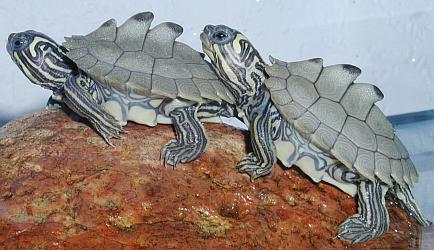 Black-knobbed Map TurtleGraptemys nigrinoda
-
 Ringed Map TurtleGraptemys oculifera
-
 Yellow-blotched Map TurtleGraptemys flavimaculata
-
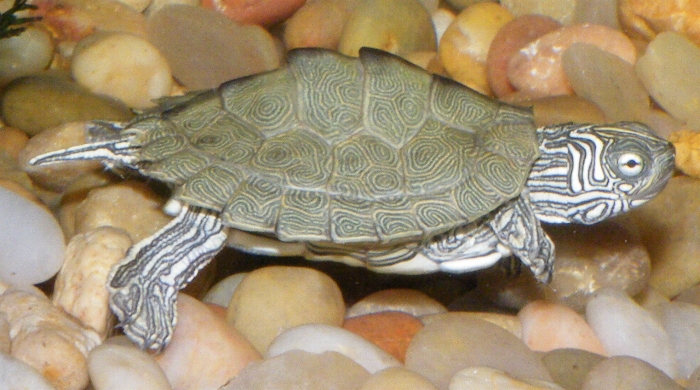 Cagle's Map TurtleGraptemys caglei
-
 Alabama Map TurtleGraptemys pulchra
Compare
Questions and answers
What is the scientific name of the Ouachita Map Turtle?
The scientific name of the Ouachita Map Turtle is Graptemys ouachitensis. Written with its author, the full name is Graptemys ouachitensis Cagle, 1953.
Which family does the Ouachita Map Turtle belong to?
Graptemys ouachitensis belongs to the family Emydidae, in the order Testudines and the class Reptilia.
Where is the Ouachita Map Turtle found?
Checklists and occurrence records place Graptemys ouachitensis in 3 countries: United States, Canada and Mexico.
What is the conservation status of the Ouachita Map Turtle?
The IUCN Red List category recorded for Graptemys ouachitensis is Least Concern (LC).
What other names does the Ouachita Map Turtle have?
Graptemys ouachitensis is also known in English as Southern Map Turtle.
How big do Ouachita map turtles get?
Adult females can reach a carapace length of 25 cm, while adult males can reach 13 cm. Female carapace lengths range from 120 to 260 mm, and male carapace lengths range from 90 to 178 mm. Hatchlings measure 27 to 35 mm in length.[48][49][50][51][52]
How rare is a map turtle?
The Ouachita Map Turtle is abundant along the Mississippi River but less common in eastern tributaries entering Tennessee and Louisiana. Populations are sporadic in central Kentucky, eastern Illinois, Indiana, and Ohio, and the species has been documented once in northern West Virginia.[53][54][55][56]
Sources
Passages the profile rests on
- The carapace is olive, dark brown, or black with light yellowish markings bordered by dark coloration. Source passage: “The carapace is olive, dark brown, or black in coloration with light yellowish markings with dark borders.” — English Wikipedia
- The carapace is olive-green with one to six black blotches along the posterior end of each scute. Source passage: “Ouachita map turtles have carapaces that are olive-green in color with one to six black blotches along the posterior end of each scute.” — animaldiversity.org
- The black carapace blotches are surrounded by yellow or orange rings that fade with age. Source passage: “These blotches are encircled by yellow or orange rings, but the ring colors fade with age.” — animaldiversity.org
- The posterior edge of the carapace is serrated and bears a row of low vertebral spines. Source passage: “This species' carapace features a row of low vertebral spines, and is serrated on the posterior rim.” — English Wikipedia
- Carapace keels are more prominent in juveniles and males than in females. Source passage: “Carapace keels are prominent in juveniles and males, but are more blunted in females.” — animaldiversity.org
- The plastron ranges from cream to yellow and has dark lines and swirls. Source passage: “The plastron color varies from cream to yellow and is patterned with dark lines and swirls.” — English Wikipedia
- The plastron is yellow or cream-colored with dark green swirls that turn brown in aging females. Source passage: “Their plastrons are yellow or cream-colored with dark green swirls. In females, this swirling pattern becomes brown as they age.” — animaldiversity.org
- The body is grayish brown to blackish and has yellowish stripes. Source passage: “The body color is grayish brown to blackish and is marked with yellowish stripes.” — English Wikipedia
- The head has rectangular yellow spots behind the eyes, oval spots below the eyes, and round spots on each side of the jaw. Source passage: “On the head, it has light yellow spots: a rectangular one behind each eye, an oval under each eye, and a round one on each side of the jaw.” — English Wikipedia
- The head is dark green with yellow markings. Source passage: “The heads of Ouachita map turtles are dark green with yellow markings.” — animaldiversity.org
- Some individuals have yellow head markings that merge into a thick C-shaped marking around the eye. Source passage: “In some specimens, the spot behind and the spot under the eye can combine to form a single thick "C" stain.” — English Wikipedia
- The eyes have a black stripe running through their middle. Source passage: “The eye has a black stripe in the middle.” — English Wikipedia
- The eyes have a white iris and a yellow or black pupil. Source passage: “The eyes of Ouachita map turtles have a white iris with yellow or black pupil.” — animaldiversity.org
- Juveniles have the same coloration and patterns as adults, but their colors are more vibrant. Source passage: “Juveniles have the same coloring and patterns as the adults, but with more vibrant colors.” — animaldiversity.org
- The species primarily inhabits slow-moving freshwater rivers. Source passage: “Ouachita map turtles primarily inhabit slow-moving freshwater rivers but can also be found in oxbow lakes, reservoirs, and sloughs.” — animaldiversity.org
- The species also inhabits oxbow lakes, reservoirs, and sloughs. Source passage: “Ouachita map turtles primarily inhabit slow-moving freshwater rivers but can also be found in oxbow lakes, reservoirs, and sloughs.” — animaldiversity.org
- The turtles commonly occur in areas with abundant submerged vegetation. Source passage: “Map turtles are common in areas with an abundance of submerged vegetation.” — animaldiversity.org
- They use unshaded river stretches with floating debris such as rocks, mud, and deadwood for basking. Source passage: “Populations of Ouachita map turtles can be found in stretches of unshaded areas of rivers with an abundance of floating debris (e.g., rocks, mud, deadwood) for basking.” — animaldiversity.org
- Females generally occupy deeper and wider river sections with stronger currents. Source passage: “Females typically occupy deeper, wider sections of rivers with a higher current due to their larger body size and superior swimming abilities.” — animaldiversity.org
- Nesting sites include natural sand or gravel bars formed by channel movement. Source passage: “Ouachita map turtles create nests for eggs in natural sand or gravel bars that are formed by channel movement.” — animaldiversity.org
- The species feeds on shrimp, insects, molluscs, fish, and fish carrion. Source passage: “Ouachita map turtles feed mainly on small aquatic animals such as shrimp, insects (such as mayflies, caddisflies, beetles, grasshoppers, fly larvae, and midge larvae), molluscs, fish, and fish carrion.” — English Wikipedia
- Its insect prey includes mayflies, caddisflies, beetles, grasshoppers, fly larvae, and midge larvae. Source passage: “insects (such as mayflies, caddisflies, beetles, grasshoppers, fly larvae, and midge larvae)” — English Wikipedia
- The species also consumes algae and aquatic plants, including pondweed, duckweed, and manna grass. Source passage: “They also consume algae and aquatic plants (such as pondweed, duckweed, and manna grass).” — English Wikipedia
- Its diet includes insects, worms, crayfish, snails, and naiads. Source passage: “Their diet consists of insects, worms, crayfish, snails, naiads, small” — dnr.wisconsin.gov
- The Ouachita map turtle is rarely found on land except during nesting or basking. Source passage: “The G. o. ouachitensis is rarely seen on land unless it is nesting season or it is basking.” — English Wikipedia
- The species is diurnal and commonly basks in groups on logs or rocks. Source passage: “Ouachita map turtles are diurnal and often bask on logs or rocks in groups to detect predators.” — animaldiversity.org
- Feeding activity generally begins in midmorning after basking. Source passage: “After basking, turtles begin feeding in midmorning and then alternate between feeding and basking.” — animaldiversity.org
- Feeding activity slows in mid-September, while basking continues until mid-October. Source passage: “Feeding activity slows in mid-September, but basking continues throughout mid-October.” — animaldiversity.org
- The species does not migrate and instead moves to areas with moderate currents for winter brumation. Source passage: “Ouachita map turtles do not migrate. Instead, they travel to areas of moderate currents and find logs or rocks to brumate throughout colder months.” — animaldiversity.org
- Brumation lasts from late October or early November until mid-April. Source passage: “Brumation lasts from late October or early November until mid-April.” — animaldiversity.org
- Males reach sexual maturity at two to three years of age. Source passage: “Males reach maturity at 2 to 3 years of age and females at 6 to 7 years old.” — animaldiversity.org
- Females reach sexual maturity at six to seven years of age. Source passage: “Males reach maturity at 2 to 3 years of age and females at 6 to 7 years old.” — animaldiversity.org
- Mating likely occurs during October and November. Source passage: “Mating likely occurs in October and November.” — animaldiversity.org
- Females generally produce two to three clutches containing six to sixteen eggs each. Source passage: “Female Ouachita map turtles are iteroparous and usually lay two to three clutches containing 6 to 16 eggs” — animaldiversity.org
- Annual egg production averages 21 to 48 eggs per female. Source passage: “and an average of 21 to 48 eggs annually.” — animaldiversity.org
- Females construct nests in sandbars, islands, and beaches within 100 m of water. Source passage: “Female Ouachita map turtles use sandbars, islands, and beaches within 100 m of water to build nests.” — animaldiversity.org
- Female nests are typically 10 to 16 cm deep. Source passage: “The nests are 10 to 16 cm deep and are flash-shaped.” — animaldiversity.org
- Females typically construct nests shortly after dawn or dusk. Source passage: “Female turtles typically make nests shortly after dawn or dusk.” — animaldiversity.org
- Egg incubation lasts between 60 and 82 days. Source passage: “Incubation takes 60 to 82 days and hatchlings are 27 to 35mm in length.” — animaldiversity.org
- Eggs measure 34 to 38 mm long and 22 to 26 mm wide. Source passage: “egg size ranges from 34 to 38 mm in length and 22 to 26 mm in width.” — animaldiversity.org
- Egg mass ranges from 8.1 to 13.5 g. Source passage: “Eggs range in mass from 8.1 to 13.5 g” — animaldiversity.org
- Cooler incubation temperatures produce males, whereas warmer temperatures produce females. Source passage: “Males are produced in cooler nests and females in warmer nests.” — animaldiversity.org
- Laboratory incubation at approximately 28 °C produced all males, while incubation at approximately 30 °C produced all females in a 2018 study. Source passage: “A study in 2018 found that, in a laboratory setting, incubated eggs around 28 °C produced all males and around 30 °C all females were produced.” — animaldiversity.org
- The reported threshold incubation temperature for sex determination is 29.3 °C. Source passage: “The threshold temperature was 29.3 °C.” — animaldiversity.org
- Hatchlings are independent immediately after hatching. Source passage: “Hatchlings are independent as soon as they hatch.” — animaldiversity.org
- Females do not provide parental care after the eggs hatch. Source passage: “Ouachita map turtles do not exhibit any parental investment after eggs hatch.” — animaldiversity.org
- Agricultural practices, fishing nets, and water pollution are major threats to the species. Source passage: “Ouachita map turtles are greatly threatened by agricultural practices, fishermen nets, and water pollution.” — animaldiversity.org
- Adult males can reach a carapace length of 13 cm. Source passage: “The males can grow to be as large as 5 in (13 cm) in carapace length.” — English Wikipedia
- Adult females can reach a carapace length of 25 cm. Source passage: “The females can grow to be up to 10 in (25 cm) in carapace length.” — English Wikipedia
- Female carapace lengths range from 120 to 260 mm. Source passage: “Females reach a carapace length of 120 to 260 mm, while males only reach carapace lengths of 90 to 178 mm.” — animaldiversity.org
- Male carapace lengths range from 90 to 178 mm. Source passage: “Females reach a carapace length of 120 to 260 mm, while males only reach carapace lengths of 90 to 178 mm.” — animaldiversity.org
- Hatchlings measure 27 to 35 mm in length. Source passage: “Incubation takes 60 to 82 days and hatchlings are 27 to 35mm in length.” — animaldiversity.org
- The species is abundant along the Mississippi River. Source passage: “They are abundant along the Mississippi River but are less common in eastern tributaries entering Tennessee and Louisiana.” — animaldiversity.org
- The species is less common in eastern tributaries entering Tennessee and Louisiana. Source passage: “They are abundant along the Mississippi River but are less common in eastern tributaries entering Tennessee and Louisiana.” — animaldiversity.org
- Populations are sporadic in central Kentucky, eastern Illinois, Indiana, and Ohio. Source passage: “Populations are more sporadic in central Kentucky, eastern Illinois, Indiana, and Ohio.” — animaldiversity.org
- The species has been documented once in northern West Virginia. Source passage: “Ouachita map turtles have been documented once in northern West Virginia.” — animaldiversity.org
Data
- Catalogue of Life, 2026-10-16 XR cc by
- Global Biodiversity Information Facility CC BY 4.0
- Wikidata CC0
- GeoNames CC BY 4.0
- Wikimedia Commons per image; credit shown with each image
- Within the Catalogue of Life, this name comes from The Reptile Database cc by
References
- Cagle, F. R. (1953) The status of the turtle Graptemys oculifera (Baur). Zoologica, 38, 137 - 144. https: // doi. org / 10.5962 / p. 203449 where the name was published
- Cagle, Fred R. (1953). Two new subspecies of Graptemys pseudogeographica. Occ. Pap. Mus. Zool. Univ. Michigan, No. 546: 1-17.
- Cagle, Fred R. (1954). Two new species of the genus Graptemys. Tulane Studies in Zoology 1 (11): 165-186.
- Green, N.B., & Pauley, T.K. (1987). Amphibians and reptiles in West Virginia. Univ. Of Pittsburgh Press, Pittsburgh, 241 Pp.
- Christiansen, J.L., & Bailey, R.M. (1988). The lizards and turtles of Iowa. Iowa Dept. Of Natur. Resources, Des Moines 19 Pp.
- Ernst,C.H. and Barbour,R.W. (1989). Turtles of the World. Smithsonian Institution Press, Washington D.C. - London.
- Conant, R., & Collins, J. T. (1991). A Field Guide to Reptiles and Amphibians of Eastern/Central North America, 3rd ed. Houghton Mifflin (Boston/New York), Xx + 450 P.
- Kirkpatrick, & David. (1993). Map turtles of the United States. Reptile & Amphibian Magazine (November/December): 7-17.
- Vogt R C. (1995). Graptemys ouachitensis Cagle, Ouachita map turtle. Catalogue of American Amphibians and Reptiles 603: 1-4.
- Dobie, James L.;Leary, Christopher J.;Davis, Aubrey E. (1996). Geographic Distribution. Graptemys ouachitensis ouachitensis. Herpetological Review 27 (2): 87.
- Sievert, Gregory; Collins, Joseph T. (1998). Geographic Distribution. Graptemys ouachitensis. Herpetological Review 29 (2): 109.
- Bartlett, R. D., & Bartlett, P. (1999). A Field Guide to Texas Reptiles and Amphibians. Gulf Publishing Co., Houston, Texas, 331 Pp.
- Dixon, James R. (2000). Amphibians and reptiles of Texas, second edition. Texas A&M University Press, 421 Pp.
- Stephens, P. R., & Wiens, J. J. (2003). Ecological diversification and phylogeny of emydid turtles. Biol. J. Linn. Soc. 79: 577-610.
- Lindeman, P. V. (2003). Diagnostic characteristics in lower Tennessee River populations of the map turtles Graptemys pseudogeographica and Graptemys ouachitensis. Chelonian Conserv. Biol. 4 (3): 564.
- Joyce, Walter G. and Christopher J. Bell. (2004). A review of the comparative morphology of extant testudinoid turtles (Reptilia: Testudines). Asiatic Herpetological Research 10: 53-109.
- Reynolds, Robert P.; Steve W. Gotte, and Carl H. Ernst. (2007). Catalog of Type Specimens of Recent Crocodilia and Testudines in the National Museum of Natural History, Smithsonian Institution. Smithsonian Contributions to Zoology 626: 1-49.
- Coleman, Jessica L. and Ronald L. Gutberlet Jr. (2008). Seasonal Variation in Basking in Two Syntopic Species of Map Turtles (Emydidae: Graptemys). Chelonian Conservation and Biology 7(2): 276.
- Lechowicz, Christopher. (2008). Tour d’horizon de l’histoire naturelle, la taxonomie, la préservation et les problémes actuels des tortues géographiques du genre Graptemys (Agassiz, 1857). Chéloniens 11:30-45.
- Bour, R. (2008). Global diversity of turtles (Chelonii; Reptilia) in freshwater. Hydrobiologia 595:593–598.
- Stephens, P. R., & Wiens, J. J. (2009). EVOLUTION OF SEXUAL SIZE DIMORPHISMS IN EMYDID TURTLES: ECOLOGICAL DIMORPHISM, RENSCH’S RULE, AND SYMPATRIC DIVERGENCE. Evolution 63-4: 910–925.
- Ernst, Carl H.; Lovich, Jeffrey E. (2009). Turtles of the United States and Canada, 2nd edition. Johns Hopkins University Press, 827 Pp.
- TTWG; Rhodin, A.G.J.; van Dijk, P.P.; Iverson, J.B. & Shaffer, H.B. [turtle taxonomy working group]. (2010). Turtles of the World, 2010 Update: Annotated Checklist of Taxonomy, Synonymy, Distribution, and Conservation Status. Chelonian Research Monographs (ISSN 1088-7105) No. 5, Doi:10.3854/Crm.5.000.Checklist.V3.2010.
- Sanders, Sheri A., Jessica L. Coleman, and John S. Placyk, Jr. (2010). Graptemys ouachitensis sabinensis (Sabine Map Turtle). Coloration. Herpetological Review 41(2): 214.
- TTWG; Dijk, Peter Paul van; John B. Iverson, H. Bradley Shaffer; Roger Bour & Anders G.J. Rhodin [turtle taxonomy working group]. (2011). Turtles of the World, 2011 Update: Annotated Checklist of Taxonomy, Synonymy, Distribution, and Conservation Status. Chelonian Research Monographs No. 5: 78 Pp.; Doi:10.3854/Crm.5.000.Checklist.V4.2011.
This species in other databases
- Catalogue of Life 6L57B
- Wikidata Q617739
- iNaturalist 371940
- WoRMS urn:lsid:marinespecies.org:taxname:1750710
- ITIS 173799
Page built on 26 November 2026. See how the catalog is made and all sources and licences.
Cite this page
ScientificNames.org. (2026). Graptemys ouachitensis (Ouachita Map Turtle). Retrieved November 26, 2026, from https://scientificnames.org/species/graptemys-ouachitensis
“Graptemys ouachitensis (Ouachita Map Turtle).” ScientificNames.org, 2026, scientificnames.org/species/graptemys-ouachitensis. Accessed 26 Nov. 2026.
ScientificNames.org. “Graptemys ouachitensis (Ouachita Map Turtle).” Accessed November 26, 2026. https://scientificnames.org/species/graptemys-ouachitensis.
@misc{scientificnames_graptemys_ouachitensis_ouachita_map_turtle,
  author = {{ScientificNames.org}},
  title = {Graptemys ouachitensis (Ouachita Map Turtle)},
  year = {2026},
  url = {https://scientificnames.org/species/graptemys-ouachitensis},
  note = {Accessed 2026-11-26}
}