Comparison

Coyote vs Ethiopian Wolf

Coyote (Canis latrans) and Ethiopian Wolf (Canis simensis) both belong to the genus Canis (dogs) and part ways below it.
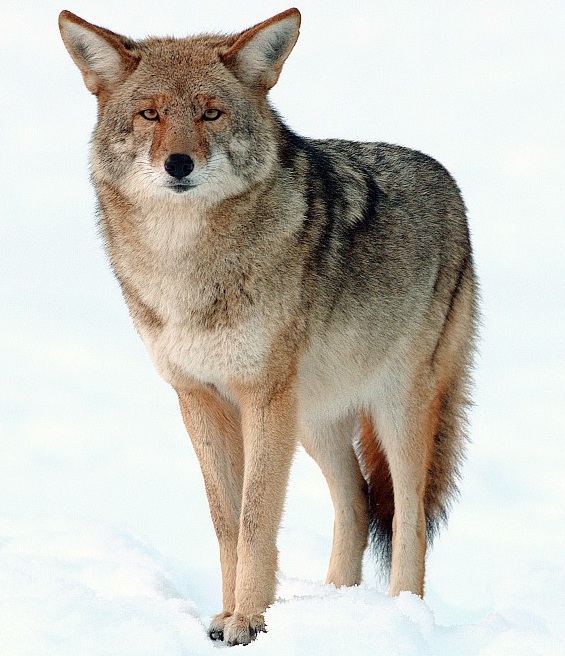
Coyote

Coyote

Canis latrans

Yathin S Krishnappa, CC BY-SA 3.0, via Wikimedia Commons

Ethiopian Wolf

Ethiopian Wolf

Canis simensis

Charles J. Sharp, CC BY-SA 4.0, via Wikimedia Commons

Side by side

CoyoteEthiopian Wolf
Scientific nameCanis latrans Say, 1823Canis simensis Rüppell, 1840
English nameCoyoteEthiopian Wolf
GroupMammalsMammals
ClassMammalia MammalMammalia Mammal
OrderCarnivora CarnivoresCarnivora Carnivores
FamilyCanidae DogsCanidae Dogs
GenusCanis DogsCanis Dogs
Named in18231840
Red List categoryLeast ConcernEndangered
EnvironmentterrestrialNot recorded
Countries on record10 countries1 country
GBIF occurrence records120,320 records191 records

Rows where the two agree are shown in grey.

Where each is found

Only Coyote (10)

Only Ethiopian Wolf (1)

From Catalogue of Life checklists and GBIF occurrence records. A country missing from a list means no record is held, which is not proof of absence.

Checked facts

CoyoteEthiopian Wolf
Appearance
  • The coyote typically has a coat combining light gray, reddish or fulvous, black, and white coloration. English Wikipedia
  • Coyotes have pointed ears, a narrow muzzle, and a bushy tail with a black tip. nps.gov
  • Coyotes generally have a grey-brown coat with black-tipped hairs along their backs. nps.gov
  • The coyote has longer ears and a relatively larger braincase than the gray wolf. English Wikipedia
  • Coyotes carry their tails downward when walking or running. English Wikipedia
No checked fact yet
Size
  • Male coyotes typically weigh between 8 and 20 kg. English Wikipedia
  • Female coyotes typically weigh between 7 and 18 kg. English Wikipedia
  • Adult coyotes have an average total body length, including the tail, of 1.0 to 1.35 m. English Wikipedia
  • The coyote's tail measures approximately 40 cm in length. English Wikipedia
  • The average shoulder height of coyotes ranges from 18 to 23 inches. nps.gov
  • Coyotes average approximately 20 to 35 pounds in weight according to the Jewel Cave National Monument account. nps.gov
  • Northern coyote subspecies average approximately 18 kg, compared with 11.5 kg for southern Mexican subspecies. English Wikipedia
No checked fact yet
HabitatNo checked fact yet
Diet
  • Coyotes preferentially prey on Dall's sheep, white-tailed deer, eastern cottontail rabbits, and California voles. pmc.ncbi.nlm.nih.gov
  • Coyotes avoid preying on small mammals, including carnivorans and arboreal species. pmc.ncbi.nlm.nih.gov
  • Coyotes consume deer, rabbits, hares, rodents, birds, reptiles, amphibians, fish, and invertebrates. English Wikipedia
  • Coyotes occasionally consume fruits and vegetables. English Wikipedia
  • Coyotes in the southern United States may consume more frogs than coyotes in other regions. nps.gov
  • Coyotes in the Yukon may consume more berries. nps.gov
  • Vegetation consumption by coyotes is greatest during summer and autumn. research.fs.usda.gov
No checked fact yet
Behaviour
  • Coyotes can live either in family units or in loosely organized packs of unrelated individuals. English Wikipedia
  • Coyotes can hunt either individually or in groups. pmc.ncbi.nlm.nih.gov
  • Coyotes may form groups of five to six adults under favorable conditions. nps.gov
  • Coyote packs containing more than ten animals have been observed. nps.gov
  • Coyotes may establish and defend territories or survive as nonterritorial transient individuals. pmc.ncbi.nlm.nih.gov
  • Coyotes characteristically produce howls that rapidly change in tone and pitch. English Wikipedia
No checked fact yet
ReproductionNo checked fact yet
Distribution
  • Coyotes are native to North America. English Wikipedia
  • Coyotes occur throughout North and Central America. animaldiversity.org
  • Coyotes have expanded their geographic range by approximately 40 percent over the past 120 years. research.fs.usda.gov
  • Coyotes currently occur in every US state except Hawaii and extend as far north as the Arctic. nps.gov
  • Coyotes were first sighted in eastern Panama in 2013. English Wikipedia
No checked fact yet
Conservation
  • The coyote is classified as Least Concern by the International Union for Conservation of Nature. English Wikipedia
  • Human persecution is a major cause of coyote mortality. nps.gov
  • Trapping for their pelts is one of the major causes of coyote mortality throughout their range. nps.gov
  • Coyotes have expanded their range despite substantial persecution related to actual or perceived livestock predation. pmc.ncbi.nlm.nih.gov
No checked fact yet
Name originNo checked fact yet

In brief

Coyote

Coyotes are native to North America and inhabit environments ranging from dry tropical deciduous forests and prairies to woodlands, mountains, and urban areas. The Coyote has pointed ears, a narrow muzzle, a bushy black-tipped tail, and a coat combining gray, reddish, black, and white coloration. Full profile

Compare something else

Page built on 24 November 2026 from the data on the two species pages, where every source is listed.

Cite this page

ScientificNames.org. (2026). Coyote vs Ethiopian Wolf. Retrieved November 24, 2026, from https://scientificnames.org/compare/coyote-vs-ethiopian-wolf