| Appearance | - The Ethiopian wolf has a slender build, long legs, and a reddish coat with distinctive white markings. animaldiversity.org
- Its skull has a long facial region that accounts for 58% of its total length. English Wikipedia
- Its ears are broad, pointed, and directed forward. English Wikipedia
- Its canine teeth measure between 14 and 22 mm in length. English Wikipedia
- Its coat ranges from ochre to rusty red, with whitish to pale ginger underfur. English Wikipedia
- Its throat, chest, and underparts are white, with a distinct white band along the sides of its neck. English Wikipedia
- Its lips, gums, and palate have black pigmentation. English Wikipedia
- Its tail is white underneath and has a black tip. English Wikipedia
- Females generally have paler coats than males. animaldiversity.org
- The species has five toes on each front foot and four on each hind foot. animaldiversity.org
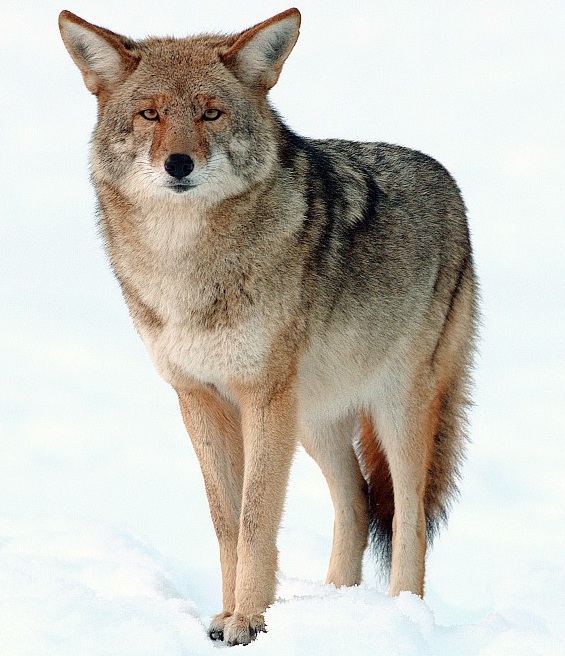
| - The coyote typically has a coat combining light gray, reddish or fulvous, black, and white coloration. English Wikipedia
- Coyotes have pointed ears, a narrow muzzle, and a bushy tail with a black tip. nps.gov
- Coyotes generally have a grey-brown coat with black-tipped hairs along their backs. nps.gov
- The coyote has longer ears and a relatively larger braincase than the gray wolf. English Wikipedia
- Coyotes carry their tails downward when walking or running. English Wikipedia
|
|---|
| Size | | - Male coyotes typically weigh between 8 and 20 kg. English Wikipedia
- Female coyotes typically weigh between 7 and 18 kg. English Wikipedia
- Adult coyotes have an average total body length, including the tail, of 1.0 to 1.35 m. English Wikipedia
- The coyote's tail measures approximately 40 cm in length. English Wikipedia
- The average shoulder height of coyotes ranges from 18 to 23 inches. nps.gov
- Coyotes average approximately 20 to 35 pounds in weight according to the Jewel Cave National Monument account. nps.gov
- Northern coyote subspecies average approximately 18 kg, compared with 11.5 kg for southern Mexican subspecies. English Wikipedia
|
|---|
| Habitat | - The species occupies high-altitude habitats between 3,000 and 4,400 m above sea level. animaldiversity.org
- Its habitat consists of isolated pockets of Afroalpine grassland. English Wikipedia
| |
|---|
| Diet | - The Ethiopian wolf primarily feeds on rodents, including giant mole-rats and common grass rats. animaldiversity.org
- Murid rodents account for 95.8% of prey items recorded in an analysis of 689 feces. animaldiversity.org
- Giant mole-rats are the principal dietary component wherever they occur within the wolf's hunting range. animaldiversity.org
- The common mole-rat becomes the most frequently consumed prey when giant mole-rats are absent. animaldiversity.org
- The species also consumes goslings, eggs, young reedbuck, young mountain nyala, and occasionally carrion. animaldiversity.org
- Ethiopian wolves frequently store captured prey in shallow holes. animaldiversity.org
| - Coyotes preferentially prey on Dall's sheep, white-tailed deer, eastern cottontail rabbits, and California voles. pmc.ncbi.nlm.nih.gov
- Coyotes avoid preying on small mammals, including carnivorans and arboreal species. pmc.ncbi.nlm.nih.gov
- Coyotes consume deer, rabbits, hares, rodents, birds, reptiles, amphibians, fish, and invertebrates. English Wikipedia
- Coyotes occasionally consume fruits and vegetables. English Wikipedia
- Coyotes in the southern United States may consume more frogs than coyotes in other regions. nps.gov
- Coyotes in the Yukon may consume more berries. nps.gov
- Vegetation consumption by coyotes is greatest during summer and autumn. research.fs.usda.gov
|
|---|
| Behaviour | - The Ethiopian wolf is social and forms packs typically containing around six individuals. English Wikipedia
- Although social, the species generally hunts and feeds individually. English Wikipedia
- The species is primarily active during daylight hours. English Wikipedia
- Wolf packs maintain communal territories averaging approximately 6 km². English Wikipedia
- Ethiopian wolves rest together in the open at night. English Wikipedia
- Packs congregate for greetings and territorial patrols at dawn, noon, and evening. English Wikipedia
- The species uses scent marking and vocal interactions to defend territorial boundaries. English Wikipedia
- Ethiopian wolves use vocalizations for long-distance communication, with howls audible up to 5 km away. animaldiversity.org
- The species sometimes forms temporary associations with grazing gelada troops while hunting rodents. English Wikipedia
| - Coyotes can live either in family units or in loosely organized packs of unrelated individuals. English Wikipedia
- Coyotes can hunt either individually or in groups. pmc.ncbi.nlm.nih.gov
- Coyotes may form groups of five to six adults under favorable conditions. nps.gov
- Coyote packs containing more than ten animals have been observed. nps.gov
- Coyotes may establish and defend territories or survive as nonterritorial transient individuals. pmc.ncbi.nlm.nih.gov
- Coyotes characteristically produce howls that rapidly change in tone and pitch. English Wikipedia
|
|---|
| Reproduction | | |
|---|
| Distribution | - The Ethiopian wolf is endemic to the Ethiopian Highlands. pmc.ncbi.nlm.nih.gov
- Its present distribution consists of six isolated populations in the Ethiopian highlands. pmc.ncbi.nlm.nih.gov
- Its recorded mountain habitats include the Arssi, Bale, Simien, and Gojjam regions, as well as northeast Shoa and Mount Guna. animaldiversity.org
- The current range is restricted to mountain elevations exceeding 3,000 m above sea level. pmc.ncbi.nlm.nih.gov
| - Coyotes are native to North America. English Wikipedia
- Coyotes occur throughout North and Central America. animaldiversity.org
- Coyotes have expanded their geographic range by approximately 40 percent over the past 120 years. research.fs.usda.gov
- Coyotes currently occur in every US state except Hawaii and extend as far north as the Arctic. nps.gov
- Coyotes were first sighted in eastern Panama in 2013. English Wikipedia
|
|---|
| Conservation | - The Ethiopian wolf is classified as endangered by the IUCN. English Wikipedia
- A 2011 estimate placed the adult population between 360 and 440 individuals. English Wikipedia
- Habitat degradation caused by overgrazing is a documented threat to the species. English Wikipedia
- Disease transmission and interbreeding from free-ranging dogs threaten Ethiopian wolf populations. English Wikipedia
- Oxford University's Ethiopian Wolf Conservation Programme uses vaccination and community outreach to protect the species. English Wikipedia
- Climate modelling projects a significant reduction in suitable Ethiopian wolf territories under future climate scenarios. pmc.ncbi.nlm.nih.gov
| - The coyote is classified as Least Concern by the International Union for Conservation of Nature. English Wikipedia
- Human persecution is a major cause of coyote mortality. nps.gov
- Trapping for their pelts is one of the major causes of coyote mortality throughout their range. nps.gov
- Coyotes have expanded their range despite substantial persecution related to actual or perceived livestock predation. pmc.ncbi.nlm.nih.gov
|
|---|
| Similar species | - The Ethiopian wolf is similar in size and build to the North American coyote. English Wikipedia
- The Ethiopian wolf is larger than the black-backed jackal, side-striped jackal, and African wolf. English Wikipedia
- The Ethiopian wolf is genetically more closely related to gray wolves and coyotes than to other African canids. English Wikipedia
| No checked fact yet |
|---|
| Name origin | No checked fact yet | |
|---|