| Appearance | - The species has a slender body and a relatively small overall build. English Wikipedia
- The species has an enlarged rostral scale at the front of its snout. English Wikipedia
- Its head is very short relative to its body, making the head distinguishable from the neck. English Wikipedia
- Its coloration ranges from red-orange to yellow. English Wikipedia
- The body has thick black rings that completely encircle it, although the rings do not completely encircle the tail. English Wikipedia
- The species has approximately 20–47 black rings along its body. English Wikipedia
- The species has a narrow hood immediately below its head. English Wikipedia
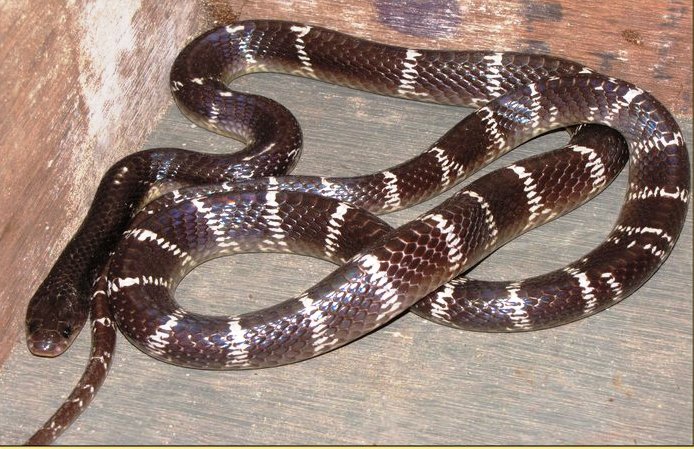
| - The common krait generally has a black or bluish-black body with narrow white crossbands. English Wikipedia
- The common krait has a cylindrical body that tapers towards a short, rounded tail. English Wikipedia
- The common krait has a flat head and relatively small eyes with rounded pupils. English Wikipedia
- The common krait has highly polished scales arranged in 15–17 rows, with an enlarged hexagonal vertebral row. English Wikipedia
- The common krait typically has approximately 40 thin white crossbars, which may be indistinct or absent near the front of the body. English Wikipedia
- Young common kraits have conspicuous white crossbars across the anterior part of their bodies. English Wikipedia
- The upper lips and belly of the common krait are white. English Wikipedia
- Albino individuals of the common krait occur but are extremely rare. English Wikipedia
|
|---|
| Size | - Adults typically measure approximately 49–61 cm in total length, including the tail. English Wikipedia
- Some individuals reach approximately 76 cm in total length. English Wikipedia
| - The average body length of the common krait is approximately 0.9 m. English Wikipedia
- The common krait can reach a maximum recorded length of 1.75 m. English Wikipedia
- Male common kraits are longer than females and have proportionately longer tails. English Wikipedia
|
|---|
| Habitat | - The species primarily inhabits very arid environments. English Wikipedia
- Its habitats include deserts and rocky or sandy ecosystems. English Wikipedia
- Individuals commonly shelter beneath rocks, in burrows, and in tunnels. English Wikipedia
- The Karoo habitat in South Africa is characterized by low predictable rainfall and sparse vegetation consisting mostly of shrubs and scrub. English Wikipedia
| - The common krait inhabits scrub jungles, grasslands, agricultural fields, semi-desert environments and rocky terrain. English Wikipedia
- The common krait occurs in suburban gardens and human-modified landscapes such as plantations and cultivated lands. English Wikipedia
- The common krait takes refuge in termite mounds, rat burrows and locations beneath debris. English Wikipedia
- The common krait is particularly associated with habitats near streams, canals and ponds. English Wikipedia
- During the monsoon season, the common krait may enter houses in search of shelter or prey. English Wikipedia
|
|---|
| Diet | - Lizards are the species' principal reported prey. English Wikipedia
- The species also hunts legless skinks, small rodents, and occasionally other snakes. English Wikipedia
- The species hunts vertebrates that are active during the day while they are sleeping at night. English Wikipedia
- In captivity, the species consumes some fish, mice, small rats, and chicken legs. English Wikipedia
- Chicken legs are a preferred food for juvenile individuals in captivity. English Wikipedia
| - The common krait feeds primarily on other snakes, including venomous kraits and vipers. English Wikipedia
- The common krait also consumes small rodents, lizards, birds and frogs. English Wikipedia
|
|---|
| Behaviour | - The species is nocturnal, with most of its activity and hunting occurring at night. English Wikipedia
- Individuals use smell and taste when hunting prey. English Wikipedia
- Individuals generally leave their burrows or holes to search for nearby small vertebrates. English Wikipedia
- The species tends to emerge from shelters on cooler nights rather than warmer summer nights. English Wikipedia
- When approaching prey or responding to a threat, the species raises its body before striking and injecting venom. English Wikipedia
| - The common krait is nocturnal and is most active during the night. English Wikipedia
- During daylight hours, the common krait remains inactive and hides in concealed locations. English Wikipedia
- The common krait generally avoids confrontation and is non-aggressive. English Wikipedia
- When threatened, the common krait may coil tightly with its head tucked underneath. English Wikipedia
- The common krait rarely bites unless provoked. English Wikipedia
- Common krait bites have been frequently recorded among people sleeping on the ground. English Wikipedia
- Common krait bites investigated in Anuradhapura occurred at night while victims were asleep on the floor. pmc.ncbi.nlm.nih.gov
|
|---|
| Reproduction | - Captive breeding activity begins during winter as temperatures cool. English Wikipedia
- Individuals increase their food intake during the breeding period to meet additional reproductive energy requirements. English Wikipedia
- When mating occurs during the described breeding period, eggs are generally laid in May or June. English Wikipedia
- Eggs generally begin hatching approximately 65 days after laying. English Wikipedia
- A typical clutch contains between 3 and 11 eggs. English Wikipedia
- Females may produce multiple clutches during a single breeding period in captivity. English Wikipedia
- Hatchlings measure approximately 17–18 cm in total length. English Wikipedia
- The species is reported to be exceptionally easy to breed in captivity. English Wikipedia
| |
|---|
| Distribution | - The species is native to southern Africa. English Wikipedia
- Its recorded range includes the Karoo and former Cape Province, extending northward into Namibia. English Wikipedia
| - The common krait occurs in India, Pakistan, Bangladesh, Sri Lanka and Nepal. English Wikipedia
- The reported western extent of the common krait's range includes Afghanistan and potentially parts of Iran. English Wikipedia
|
|---|
| Conservation | - As of 2015, the species was not listed as threatened or requiring conservation efforts. English Wikipedia
- Road and highway traffic is identified as a threat because vehicles can run over individuals. English Wikipedia
| - The common krait is reported to have a stable population despite localized habitat fragmentation and persecution. English Wikipedia
|
|---|
| Other | | - The common krait is highly venomous. English Wikipedia
- The common krait's venom is predominantly neurotoxic. English Wikipedia
- Phospholipases A2 account for approximately 64.5% of the common krait's venom proteome. English Wikipedia
- The common krait is identified as the deadliest snake commonly found in Sri Lanka's dry zone. pmc.ncbi.nlm.nih.gov
- In a prospective Anuradhapura study, 210 farmers bitten by common kraits were investigated over three years. pmc.ncbi.nlm.nih.gov
- In the Anuradhapura study, 16 patients, representing 7.6% of the investigated cases, died. pmc.ncbi.nlm.nih.gov
|
|---|