Species · Reptiles
Common Krait Bungarus caeruleus
The scientific name of the Common Krait is Bungarus caeruleus. It is a species of reptile in the family Elapidae (cobras), order Squamata. The name dates from 1801.
- Scientific name
- Bungarus caeruleus (Schneider, 1801)
- Common name
- Common Krait
- Genus
- Bungarus
- Family
- Elapidae (Cobras)
- Order
- Squamata
- Class
- Reptilia
- Red List category
- LC Least Concern
- Recorded in
- 8 countries
- Name status
- accepted in the Catalogue of Life
Overview
The Common Krait (Bungarus caeruleus) is a highly venomous snake in the family Elapidae, order Squamata and class Reptilia. It occurs in India, Pakistan, Bangladesh, Sri Lanka and Nepal, with a reported western extent including Afghanistan and potentially parts of Iran. It is predominantly nocturnal and feeds primarily on other snakes, including venomous kraits and vipers.
Written 24 November 2026 from the sources listed below. Each statement was checked against the passage it cites; statements that could not be supported were removed.
Appearance
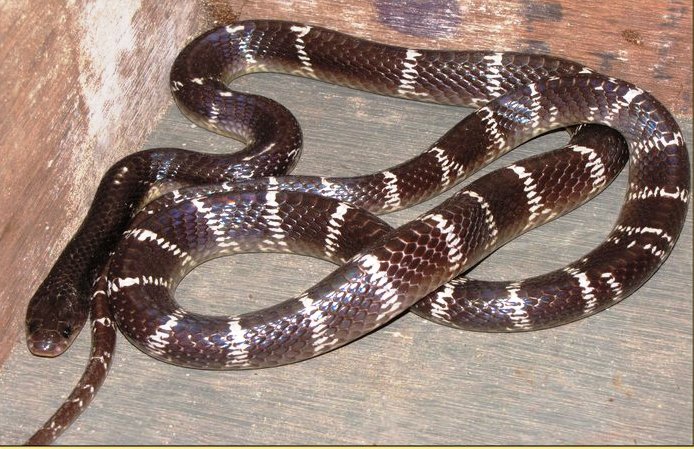
The Common Krait generally has a black or bluish-black cylindrical body with narrow white crossbands and a short, rounded tail. Its body tapers towards the tail, and its head is flat, with relatively small eyes and rounded pupils.[1][2][3]
Its highly polished scales are arranged in 15–17 rows, including an enlarged hexagonal vertebral row. It typically has approximately 40 thin white crossbars, which may be indistinct or absent near the front of the body.[4][5]
Young Common Kraits have conspicuous white crossbars across the anterior part of their bodies. The upper lips and belly are white, while albino individuals occur but are extremely rare.[6][7][8]
The average body length is approximately 0.9 m, and the maximum recorded length is 1.75 m. Males are longer than females and have proportionately longer tails.[9][10][11]
Habitat
The Common Krait inhabits scrub jungles, grasslands, agricultural fields, semi-desert environments and rocky terrain. It also occurs in suburban gardens and human-modified landscapes such as plantations and cultivated lands.[12][13]
It takes refuge in termite mounds, rat burrows and locations beneath debris. It is particularly associated with habitats near streams, canals and ponds.[14][15]
During the monsoon season, the Common Krait may enter houses in search of shelter or prey.[16]
Diet
The Common Krait feeds primarily on other snakes, including venomous kraits and vipers. Its diet also includes small rodents, lizards, birds and frogs.[17][18]
Behaviour
The Common Krait is nocturnal and is most active during the night. During daylight hours, it remains inactive and hides in concealed locations.[19][20]
It generally avoids confrontation and is non-aggressive. When threatened, it may coil tightly with its head tucked underneath and rarely bites unless provoked.[21][22][23]
Common Krait bites have been frequently recorded among people sleeping on the ground. Bites investigated in Anuradhapura occurred at night while victims were asleep on the floor.[24][25]
Reproduction and life cycle
The Common Krait is an egg-laying snake. Females lay clutches of 5–15 eggs during late winter or summer and deposit them in secluded locations such as leaf litter or burrows.[26][27][28]
Females guard their eggs until hatching. The eggs hatch after approximately 60 days, and hatchlings are independent and venomous from birth.[29][30][31]
Male Common Kraits engage in combat displays.[32]
Conservation
The Common Krait is reported to have a stable population despite localized habitat fragmentation and persecution.[33]
Classification of the Common Krait
| Kingdom | Animalia |
|---|---|
| Phylum | Chordata |
| Subphylum | Vertebrata |
| Infraphylum | Gnathostomata |
| Parvphylum | Osteichthyes |
| Megaclass | Tetrapoda |
| Class | Reptilia (Reptile) |
| Order | Squamata (Snakes) |
| Suborder | Serpentes (Snakes) |
| Infraorder | Alethinophidia |
| Family | Elapidae (Cobras) |
| Genus | Bungarus (Deathpickers) |
| Species | Bungarus caeruleus (Schneider, 1801) |
Where the Common Krait is found
Checklists and occurrence records place Bungarus caeruleus in 8 countries across Asia. GBIF holds 1,003 georeferenced records of it.
Countries
Regions and cities with the most records
- Maharashtra, India 130
- Karnataka, India 105
- Tamil Nadu, India 78
- Kerala, India 58
- Odisha, India 45
- Andhra Pradesh, India 39
- Kharakvasla, India 38
- Gujarat, India 37
- Pimpri, India 37
- Pimpri-Chinchwad, India 37
- Pune, India 36
- Khadki, India 35
- West Bengal, India 35
- Chhattisgarh, India 34
- Bengaluru, India 24
- Dehu Road, India 20
- Goa, India 19
- Telangana, India 19
- Uttar Pradesh, India 19
- Bhawānipatna, India 18
- Madhya Pradesh, India 18
- Uttarakhand, India 16
- Punjab, Pakistan 15
- Rajasthan, India 14
- Badlapur, India 13
- Beypore, India 13
- Cheruvannur, India 13
- Himachal Pradesh, India 13
- Kozhikode, India 13
- Kunnamangalam, India 13
- Panvel, India 12
- Panjim, India 11
- Haryana, India 10
- Ashoknagar Kalyangarh, India 9
- Dehradun, India 9
- Idaiyarpālaiyam, India 9
Range as the checklists state it
Afghanistan, Pakistan, India (Tamil Nadu, Madhya Pradesh, Gujarat, Haryana, Maharashtra, Kerala, Karnataka (Castle Rock, and probably all over) [A. Captain, pers. Comm.], Punjab [Dino Aulakh, pers. comm.], Jammu and Kashmir, Odisha, Telangana, Nagaland), Sri Lanka, Bangladesh, Nepal.
A number beside a place is its count of GBIF occurrence records. A place without a number comes from a checklist alone. Records show where a species has been observed or collected, which can include escapes and vagrants.
Common names
English
- Common Krait
- Common Indian Krait
- Common/Indian Krait
- Indian Krait
Names in 18 other languages
- Bengali
- Kal Keutey
- Chinese
- 青環蛇
- Czech
- bungar modravý
- Finnish
- Intiankraitti
- French
- Bongare indien
- German
- Indischer Krait
- Gujarati
- કાળોતરો
- Hungarian
- közönséges krait
- Italian
- Bungaro comune, Krait comune
- Japanese
- インドアマガサ
- Marathi
- मण्यार
- Polish
- niemrawiec indyjski
- Russian
- Голубой бунгарус, Индийский крайт
- Sinhala
- තෙල් කරවලා, මග මරුවා
- Slovenian
- navadni krait
- Spanish
- Krait Común
- Tamil
- கட்டுவிரியன்
- ori
- ଚିତି
Synonyms
9 other scientific names have been used for this species and are now treated as synonyms of Bungarus caeruleus.
- Boa latotecta Boie, 1827
- Boa latotecta Hermann, 1804
- Boa lineata Shaw, 1802
- Bungarus arcuatus Duméril & Bibron, 1854
- Bungarus candidus Wall, 1907
- Bungarus candidus var. caeruleus Boulenger, 1896
- Bungarus romulusi Sunagar et al., 2021
- Pseudoboa caerulea Schneider, 1801
- Bungarus sindanus Boulenger, 1897 ambiguous synonym
Related species
-
 Banded KraitBungarus fasciatus
-
 Many-banded KraitBungarus multicinctus
-
 Blue KraitBungarus candidus
-
 Red-headed KraitBungarus flaviceps
-
 Sind KraitBungarus sindanus
-
 Greater Black KraitBungarus niger
-
 Ceylon KraitBungarus ceylonicus
-
 Suzhen’s KraitBungarus suzhenae
Compare
- Common Krait vs Tiger Snake
- Common Krait vs Indian Cobra
- Inland Taipan vs Common Krait
- King Cobra vs Common Krait
- Black Mamba vs Common Krait
- Common Krait vs Eastern Brown Snake
- Common Krait vs Banded Krait
- Common Krait vs Many-banded Krait
- Common Krait vs Blue Krait
- Common Krait vs Red-headed Krait
- Common Krait vs Sind Krait
Questions and answers
What is the scientific name of the Common Krait?
The scientific name of the Common Krait is Bungarus caeruleus. Written with its author, the full name is Bungarus caeruleus (Schneider, 1801).
Which family does the Common Krait belong to?
Bungarus caeruleus belongs to the family Elapidae, in the order Squamata and the class Reptilia.
Where is the Common Krait found?
Checklists and occurrence records place Bungarus caeruleus in 8 countries, including India, Pakistan, Sri Lanka, Myanmar, Nepal and Afghanistan.
What is the conservation status of the Common Krait?
The IUCN Red List category recorded for Bungarus caeruleus is Least Concern (LC).
What other names does the Common Krait have?
Bungarus caeruleus is also known in English as Common Indian Krait, Common/Indian Krait and Indian Krait.
How poisonous is common krait?
The Common Krait is highly venomous, and its venom is predominantly neurotoxic. Phospholipases A2 account for approximately 64.5% of its venom proteome.[34][35][36]
What snake has a 100% mortality rate?
The Common Krait is identified as the deadliest snake commonly found in Sri Lanka's dry zone. However, the reported Anuradhapura study recorded 16 deaths, representing 7.6% of the 210 investigated cases.[37][38][39]
Why is krait called a silent killer?
The Common Krait is nocturnal and generally remains inactive in concealed locations during daylight. Bites have frequently been recorded among people sleeping on the ground, including cases investigated in Anuradhapura in which victims were asleep on the floor at night.[19][20][24][25]
What do common kraits eat?
Common Kraits feed primarily on other snakes, including venomous kraits and vipers. They also consume small rodents, lizards, birds and frogs.[17][18]
Where do common kraits live?
Common Kraits occur in India, Pakistan, Bangladesh, Sri Lanka and Nepal. Their reported western range includes Afghanistan and potentially parts of Iran. They inhabit scrub jungles, grasslands, agricultural fields, semi-desert environments, rocky terrain and human-modified landscapes.[40][41][12][13]
Sources
Passages the profile rests on
- The common krait generally has a black or bluish-black body with narrow white crossbands. Source passage: “Their coloration is generally black or bluish-black, with about 40 thin, white crossbars” — English Wikipedia
- The common krait has a cylindrical body that tapers towards a short, rounded tail. Source passage: “The body is cylindrical, tapering towards the tail. The tail is short and rounded.” — English Wikipedia
- The common krait has a flat head and relatively small eyes with rounded pupils. Source passage: “The head is flat and the neck is hardly visible. The body is cylindrical, tapering towards the tail. The tail is short and rounded. The eyes are rather small, with rounded pupils” — English Wikipedia
- The common krait has highly polished scales arranged in 15–17 rows, with an enlarged hexagonal vertebral row. Source passage: “The scales are highly polished, in 15–17 rows; the vertebral row is distinctly enlarged and hexagonal.” — English Wikipedia
- The common krait typically has approximately 40 thin white crossbars, which may be indistinct or absent near the front of the body. Source passage: “with about 40 thin, white crossbars, which may be indistinct or absent anteriorly.” — English Wikipedia
- Young common kraits have conspicuous white crossbars across the anterior part of their bodies. Source passage: “The pattern, however, is complete and well-defined in the young, which are marked with conspicuous crossbars even anteriorly” — English Wikipedia
- The upper lips and belly of the common krait are white. Source passage: “the upper lips and belly are white.” — English Wikipedia
- Albino individuals of the common krait occur but are extremely rare. Source passage: “Albino specimens can be found, although such cases are extremely rare.” — English Wikipedia
- The average body length of the common krait is approximately 0.9 m. Source passage: “The average length of the common krait is 0.9 m (2 ft 11 in)” — English Wikipedia
- The common krait can reach a maximum recorded length of 1.75 m. Source passage: “but it can grow to 1.75 m (5 ft 9 in).” — English Wikipedia
- Male common kraits are longer than females and have proportionately longer tails. Source passage: “Males are longer than females, with proportionately longer tails.” — English Wikipedia
- The common krait inhabits scrub jungles, grasslands, agricultural fields, semi-desert environments and rocky terrain. Source passage: “including scrub jungles, grasslands, agricultural fields, semi-desert areas, rocky terrains” — English Wikipedia
- The common krait occurs in suburban gardens and human-modified landscapes such as plantations and cultivated lands. Source passage: “and suburban gardens. It is frequently found in human-modified landscapes such as plantations and cultivated lands.” — English Wikipedia
- The common krait takes refuge in termite mounds, rat burrows and locations beneath debris. Source passage: “The common krait often takes refuge in termite mounds, rat burrows, or under debris.” — English Wikipedia
- The common krait is particularly associated with habitats near streams, canals and ponds. Source passage: “It is particularly associated with areas near water sources, such as streams, canals, and ponds.” — English Wikipedia
- During the monsoon season, the common krait may enter houses in search of shelter or prey. Source passage: “During the monsoon season, it often enters houses in search of shelter or prey.” — English Wikipedia
- The common krait feeds primarily on other snakes, including venomous kraits and vipers. Source passage: “The common krait feeds primarily on other snakes, including venomous snakes like other kraits and vipers.” — English Wikipedia
- The common krait also consumes small rodents, lizards, birds and frogs. Source passage: “It also feeds on small rodents, lizards, birds and frogs.” — English Wikipedia
- The common krait is nocturnal and is most active during the night. Source passage: “The common krait is a nocturnal snake, most active during the night” — English Wikipedia
- During daylight hours, the common krait remains inactive and hides in concealed locations. Source passage: “During the day, it remains inactive and hides in concealed locations such as rodent burrows, termite mounds, or under debris.” — English Wikipedia
- The common krait generally avoids confrontation and is non-aggressive. Source passage: “Despite its potent venom, the common krait is generally non-aggressive and prefers to avoid confrontation.” — English Wikipedia
- When threatened, the common krait may coil tightly with its head tucked underneath. Source passage: “When threatened, it often coils itself tightly with its head tucked underneath as a defensive posture.” — English Wikipedia
- The common krait rarely bites unless provoked. Source passage: “but rarely bites unless provoked.” — English Wikipedia
- Common krait bites have been frequently recorded among people sleeping on the ground. Source passage: “Records of people sleeping on the ground getting bitten are common.” — English Wikipedia
- Common krait bites investigated in Anuradhapura occurred at night while victims were asleep on the floor. Source passage: “The bite occurred at night while the victims were asleep on the floor.” — pmc.ncbi.nlm.nih.gov
- The common krait is an egg-laying snake. Source passage: “The common krait is oviparous.” — English Wikipedia
- Female common kraits lay clutches of 5–15 eggs during late winter or summer. Source passage: “Females lay clutches of 5–15 eggs during late winter or summer months” — English Wikipedia
- Female common kraits deposit their eggs in secluded locations such as leaf litter or burrows. Source passage: “in secluded areas such as leaf litter or burrows.” — English Wikipedia
- Female common kraits guard their eggs until hatching. Source passage: “female kraits exhibit parental care by guarding their eggs” — English Wikipedia
- Common krait eggs hatch after approximately 60 days. Source passage: “until they hatch after about 60 days.” — English Wikipedia
- Common krait hatchlings are independent and venomous from birth. Source passage: “The hatchlings emerge fully independent and equipped with venom from birth.” — English Wikipedia
- Male common kraits engage in combat displays. Source passage: “The males are known to engage in combat displays.” — English Wikipedia
- The common krait is reported to have a stable population despite localized habitat fragmentation and persecution. Source passage: “This adaptability has contributed to its stable population despite localized threats, such as habitat fragmentation and persecution.” — English Wikipedia
- The common krait is highly venomous. Source passage: “The common krait (Bungarus caeruleus) is a highly venomous snake species” — English Wikipedia
- The common krait's venom is predominantly neurotoxic. Source passage: “as its neurotoxic venom is one of the most potent venoms on humans among Indian snakes.” — English Wikipedia
- Phospholipases A2 account for approximately 64.5% of the common krait's venom proteome. Source passage: “The venom is dominated by phospholipases A2 (PLA2), constituting approximately 64.5% of its proteome” — English Wikipedia
- The common krait is identified as the deadliest snake commonly found in Sri Lanka's dry zone. Source passage: “Common krait (Bungarus caeruleus) is the deadliest snake found commonly in the dry zone of Sri Lanka.” — pmc.ncbi.nlm.nih.gov
- In a prospective Anuradhapura study, 210 farmers bitten by common kraits were investigated over three years. Source passage: “In Anuradhapura, 210 farmers bitten by the common krait over a three year period were investigated prospectively” — pmc.ncbi.nlm.nih.gov
- In the Anuradhapura study, 16 patients, representing 7.6% of the investigated cases, died. Source passage: “Sixteen (7.6%) patients died” — pmc.ncbi.nlm.nih.gov
- The common krait occurs in India, Pakistan, Bangladesh, Sri Lanka and Nepal. Source passage: “including India, Pakistan, Bangladesh, Sri Lanka, Nepal” — English Wikipedia
- The reported western extent of the common krait's range includes Afghanistan and potentially parts of Iran. Source passage: “Its range extends westward into Afghanistan and potentially parts of Iran.” — English Wikipedia
Data
- Catalogue of Life, 2026-10-16 XR cc by
- Global Biodiversity Information Facility CC BY 4.0
- Wikidata CC0
- GeoNames CC BY 4.0
- Wikimedia Commons per image; credit shown with each image
- Within the Catalogue of Life, this name comes from The Reptile Database cc by
References
- Schneider, & JOHANN GOTTLOB. (1801). Historiae Amphibiorum naturalis et literariae. Fasciculus secundus continens Crocodilos, Scincos, Chamaesauras, Boas. Pseudoboas, Elapes, Angues. Amphisbaenas et Caecilias. Frommanni, Jena. 374 Pp.
- Duméril, A. M. C., Bibron, G. & DUMÉRIL, A. H. A.,. (1854). Erpétologie générale ou histoire naturelle complète des reptiles. Tome septième. Deuxième partie, comprenant l’histoire des serpents venimeux. Paris, Librairie Encyclopédique de Roret: I-Xii + 781-1536.
- Anderson, J. (1871). On some Indian reptiles. Proc. Zool. Soc. London 1871: 149-211.
- Boulenger, George A. (1890). The Fauna of British India, Including Ceylon and Burma. Reptilia and Batrachia. Taylor & Francis, London, Xviii, 541 Pp.
- Boulenger, G. A. (1896). Catalogue of the snakes in the British Museum, Vol. 3. London (Taylor & Francis), Xiv + 727 Pp.
- Pillay, & Shunkara Narayana, R. (1904). Notes on the structure of the teeth of some poisonous snakes found in Travancore. Ann. Mag. Nat. Hist. (7) 13 (75): 238-239.
- Bannerman, W. B. (1905). Note on the breeding of the Krait (Bungarus caeruleus). J. Bombay Nat. Hist. Soc. 16: 743.
- Wall, F. (1908). A popular treatise of the common Indian snakes. Part VIII. J. Bombay Nat. Hist. Soc. 18: 711-735.
- Cholmondeley, E. C. (1908). Kraits in Indore. J. Bombay Nat. Hist. Soc. 18: 921-924.
- Wall, F. (1908). The poisonous terrestrial snakes of our British Indian dominions and how to recognise them, 2nd ed. Bombay, Bombay Natural History Society, 68 Pp.
- Smith, O. A. (1913). A case of cannibalism by Bungarus coeruleus. J. Bombay Nat. Hist. Soc. 23: 373.
- Wall, F. (1913). On the Common (Bungarus caeruleus) and Sind Kraits (Bungarus sindanus). J. Bombay Nat. Hist. Soc. 22: 401.
- Pitman, C. R. S. (1913). Kraits in the Dera Ismail Khan District. J. Bombay Nat. Hist. Soc. 22: 636.
- Wall, F. (1913). The Common and Sind Kraits (Bungarus caeruleus and sindanus) - A correction. J. Bombay Nat. Hist. Soc. 22: 808.
- Wall, F. (1919). A 17 Scale Krait (Bungarus caeruleus) from Bangalore. J. Bombay Nat. Hist. Soc. 26: 1046.
- Smith, M. A. (1943). The Fauna of British India, Ceylon and Burma, Including the Whole of the Indo-Chinese Sub-Region. Reptilia and Amphibia. 3 (Serpentes). Taylor and Francis, London. 583 Pp.
- Constable, JOHN D. (1949). Reptiles from the Indian Peninsula in the Museum of Comparative Zoology. Bull. Mus. Comp. Zool. Harvard 103: 59-160.
- Sharma, R. C. (1976). Records of the reptiles of Goa. Records Zool. Survey India 71 (1975): 149-167.
- Kramer, E. (1977). Zur Schlangenfauna Nepals. Revue Suisse de Zoologie 84 (3): 721-761.
- Khan, M. S. (1985). Taxonomic notes on Bungarus caeruleus (Schneider) and Bungarus sindanus Boulenger. The Snake 17: 71-78.
- Zug, G. R., & Mitchell, J. C. (1995). Amphibians and Reptiles of the Royal Chitwan National Park, Nepal. Asiatic Herpetological Research 6: 172-180.
- Bauer, Aaron M. (1998). South Asian Herpetological specimens of historical note in the Zoological Museum, Berlin. Hamadryad 23 (2): 133-149 [1999].
- de Silva, A. (1998). Snakes of Sri Lanka: a checklist and an annotated bibliography. Dept. Wildlife Conservation/ GEF /UNDP/ FAO, Colombo.
- Shah, K. B. (1998). Checklist of the herpetofauna of Nepal with english and vernacular names. NAHSON Bull., Nat. Hist. Soc. Nepal, Kathmandu 8 (1-4): 26-30.
- Whitaker, & Romulus and Ashok Captain. (2004). Snakes of India. Draco Books, 500 Pp., Reprinted 2007.
This species in other databases
Page built on 24 November 2026. See how the catalog is made and all sources and licences.
Cite this page
ScientificNames.org. (2026). Bungarus caeruleus (Common Krait). Retrieved November 24, 2026, from https://scientificnames.org/species/bungarus-caeruleus
“Bungarus caeruleus (Common Krait).” ScientificNames.org, 2026, scientificnames.org/species/bungarus-caeruleus. Accessed 24 Nov. 2026.
ScientificNames.org. “Bungarus caeruleus (Common Krait).” Accessed November 24, 2026. https://scientificnames.org/species/bungarus-caeruleus.
@misc{scientificnames_bungarus_caeruleus_common_krait,
  author = {{ScientificNames.org}},
  title = {Bungarus caeruleus (Common Krait)},
  year = {2026},
  url = {https://scientificnames.org/species/bungarus-caeruleus},
  note = {Accessed 2026-11-24}
}