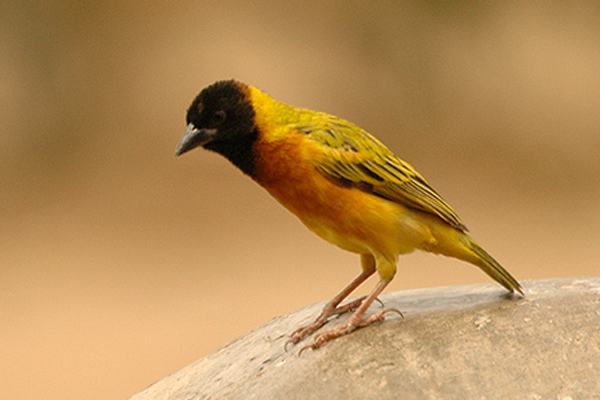
| Appearance | - The Cape Weaver has streaked olive-brown upperparts and a long, pointed, conical bill. English Wikipedia
- Breeding males have yellow heads and underparts, orange faces and white irises. English Wikipedia
- Adult females have olive-yellow heads and breasts that become pale yellow towards the lower belly. English Wikipedia
- Young Cape Weavers resemble adult females. English Wikipedia
- Female Cape Weavers normally have brown eyes, although some develop pale eyes during summer. English Wikipedia
- Females and non-breeding males have dull olive-green upperparts and buffy-yellow underparts. sanbi.org
- The wings are blackish with yellow to green colouring along their edges. sanbi.org
- Breeding males have black bills, whereas females and non-breeding males have pinkish-brown bills. sanbi.org
- The legs of Cape Weavers are pinkish-brown. sanbi.org
| - Breeding males have a black head and a yellow collar at the nape. English Wikipedia
- The yellow nuchal collar is absent in Juba and golden-backed weavers. English Wikipedia
- The species has plain greenish mantle plumage that distinguishes it from golden-backed and village weavers. English Wikipedia
- Its underparts are pale yellow with a variable amount of chestnut coloration. English Wikipedia
- Females and non-breeding males lack the black head. English Wikipedia
- Females and non-breeding males have dark eyes and a darker bill compared with female masked weavers. English Wikipedia
- Females and non-breeding males have buffy breast plumage. English Wikipedia
|
|---|
| Size | | No checked fact yet |
|---|
| Habitat | - Cape Weavers inhabit open grassland, lowland fynbos, coastal thicket and farmland where permanent water and trees are available. English Wikipedia
- In hotter and more arid regions, Cape Weavers are restricted to upland habitats. English Wikipedia
- Cape Weavers do not occur in forests. English Wikipedia
- Cape Weavers inhabit areas near water that contain trees and shrubs. sanbi.org
| |
|---|
| Diet | - Cape Weavers are omnivores whose diet is divided approximately equally between animal and plant matter. English Wikipedia
- Cape Weavers consume insects, spiders, seeds, nectar and fruit. English Wikipedia
- Female Cape Weavers appear to consume a more varied diet than males. English Wikipedia
- Cape Weavers are major pollinators of aloes in South Africa. English Wikipedia
- Cape Weavers feed on flowers, fruits, nectar and grass seeds. sanbi.org
- Cape Weavers obtain insects from beneath tree bark and rocks. sanbi.org
| No checked fact yet |
|---|
| Behaviour | - Outside the breeding season, Cape Weavers form flocks. English Wikipedia
- Cape Weavers congregate in large communal roosts throughout the year. English Wikipedia
- Cape Weavers bathe even during rain or mist. English Wikipedia
- Cape Weavers have been observed practising anting. English Wikipedia
- Cape Weavers move in mixed flocks with sparrows, canaries, bishops and other weavers. sanbi.org
- Male Cape Weavers can travel up to 20 km to collect nest-building materials. sanbi.org
- Male Cape Weavers attract females by hanging from nest entrances, swaying, flapping their wings and making calls. sanbi.org
- Male Cape Weavers mark their territorial boundaries by singing and lunging. sanbi.org
| - The species often lives in an Acacia tree approximately three metres from land. English Wikipedia
- Living in Acacia trees away from land is described as a means of preventing predation. English Wikipedia
|
|---|
| Reproduction | - Cape Weavers are polygynous, with individual males mating with as many as seven females in one breeding season. English Wikipedia
- Male Cape Weavers usually form breeding colonies containing between two and twenty males. English Wikipedia
- Male Cape Weavers construct multiple nests within small territories and defend them against other males. English Wikipedia
- Male Cape Weavers take approximately one week to construct their nests. English Wikipedia
- Cape Weaver nests are kidney-shaped and waterproof, and are constructed from woven strips of grass or reeds. English Wikipedia
- Female Cape Weavers line accepted nests with fine grass and feathers. English Wikipedia
- Female Cape Weavers lay clutches containing two to five eggs. English Wikipedia
- Female Cape Weavers incubate their eggs for approximately two weeks. English Wikipedia
- Cape Weaver chicks leave the nest at approximately 17 days of age. English Wikipedia
- Cape Weaver eggs are greenish-blue and have a relatively even colour distribution. sanbi.org
- Cape Weavers commonly construct nests in willow trees near water. sanbi.org
- Cape Weavers breed in noisy colonies or occasionally as individual pairs. sanbi.org
- Cape Weaver breeding colonies usually contain twenty or more nests. sanbi.org
- Female Cape Weavers generally feed their chicks, although some males also participate occasionally. sanbi.org
- Cape Weaver eggs are laid from July to November in the Eastern Cape. sanbi.org
- Cape Weaver eggs are laid from August to February in KwaZulu-Natal and inland provinces. sanbi.org
| No checked fact yet |
|---|
| Distribution | - The Cape Weaver is endemic to South Africa, Lesotho and Eswatini. English Wikipedia
- The Cape Weaver occurs from the Orange River in the Northern Cape south to the Cape of Good Hope and east to northern KwaZulu-Natal. English Wikipedia
- The Cape Weaver's distribution extends inland almost to Bloemfontein in the Free State. English Wikipedia
| - The species occurs in West, Central, and East Africa. English Wikipedia
- The species has been introduced to the Iberian Peninsula. English Wikipedia
- The nominate subspecies P. m. melanocephalus occurs in Mauritania, Senegal, Gambia, Mali, and Niger. English Wikipedia
- The subspecies P. m. capitalis occurs from Guinea-Bissau to Nigeria and extends into northern Cameroon, southwestern Chad, and northern Central African Republic. English Wikipedia
- The subspecies P. m. duboisi occurs in eastern Congo, southern Central African Republic, southwestern Sudan, and northern Zambia. English Wikipedia
- The subspecies P. m. fischeri occurs in eastern Democratic Republic of the Congo, Uganda, western Kenya, northwestern Tanzania, and northern Zambia. English Wikipedia
|
|---|
| Conservation | - The Cape Weaver is classified as Least Concern. sanbi.org
- The Cape Weaver is common and is not considered threatened. English Wikipedia
- Cape Weavers can become agricultural pests in orchards and farmland in the Western Cape. English Wikipedia
| No checked fact yet |
|---|
| Similar species | No checked fact yet | - The taxon P. victoriae is considered a hybrid between the black-headed weaver and P. castanops. English Wikipedia
|
|---|
| Other | - Cape Weavers are sometimes subjected to brood parasitism by the Diederik Cuckoo. English Wikipedia
- Cape Weaver nests can be heavily infested with mites. English Wikipedia
- Cape Weaver fledglings can be parasitised by ticks. English Wikipedia
- Cape Weaver nests can subsequently be reused by Cape Sparrows and African Dusky Flycatchers. English Wikipedia
- Cape Weaver nests provide shelter for other birds and animals that depend on them for breeding or roosting. sanbi.org
| No checked fact yet |
|---|