Species · Birds
Black-headed Weaver Ploceus melanocephalus
The scientific name of the Black-headed Weaver is Ploceus melanocephalus. It is a species of bird in the family Ploceidae (bishops), order Passeriformes. The name dates from 1758.
- Scientific name
- Ploceus melanocephalus (Linnaeus, 1758)
- Common name
- Black-headed Weaver
- Genus
- Ploceus
- Family
- Ploceidae (Bishops)
- Order
- Passeriformes
- Class
- Aves
- Red List category
- LC Least Concern
- Recorded in
- 34 countries
- Name status
- accepted in the Catalogue of Life
Overview
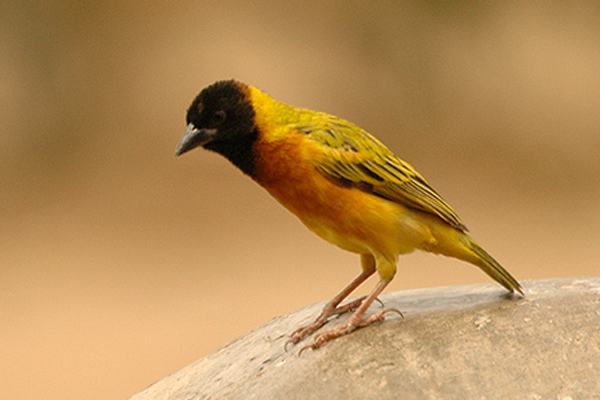
Ploceus melanocephalus occurs in West, Central, and East Africa, breeding in damp areas of tropical Africa. Breeding males have a black head, a yellow collar at the nape, and plain greenish mantle plumage.
Written 26 November 2026 from the sources listed below. Each statement was checked against the passage it cites; statements that could not be supported were removed.
Appearance
Breeding males have a black head and a yellow collar at the nape. The yellow nuchal collar is absent in Juba and golden-backed weavers.[1][2]
The species has plain greenish mantle plumage that distinguishes it from golden-backed and village weavers. Its underparts are pale yellow with a variable amount of chestnut coloration.[3][4]
Females and non-breeding males lack the black head and have dark eyes and a darker bill compared with female masked weavers. They also have buffy breast plumage.[5][6][7]
Habitat
The Black-headed Weaver breeds in damp areas of tropical Africa. It inhabits savanna and similar environments, typically near water.[8][9]
The species occurs in West, Central, and East Africa and has been introduced to the Iberian Peninsula.[10][11]
The nominate subspecies P. m. melanocephalus occurs in Mauritania, Senegal, Gambia, Mali, and Niger.[12]
The subspecies P. m. capitalis occurs from Guinea-Bissau to Nigeria and extends into northern Cameroon, southwestern Chad, and northern Central African Republic.[13]
The subspecies P. m. duboisi occurs in eastern Congo, southern Central African Republic, southwestern Sudan, and northern Zambia.[14]
The subspecies P. m. fischeri occurs in eastern Democratic Republic of the Congo, Uganda, western Kenya, northwestern Tanzania, and northern Zambia.[15]
Behaviour
The species often lives in an Acacia tree approximately three metres from land. Living in Acacia trees away from land is described as a means of preventing predation.[16][17]
Similar species
The taxon P. victoriae is considered a hybrid between the Black-headed Weaver and P. castanops.[18]
Classification of the Black-headed Weaver
| Kingdom | Animalia |
|---|---|
| Phylum | Chordata |
| Subphylum | Vertebrata |
| Infraphylum | Gnathostomata |
| Parvphylum | Osteichthyes |
| Megaclass | Tetrapoda |
| Class | Aves (Bird) |
| Order | Passeriformes (Passerine) |
| Family | Ploceidae (Bishops) |
| Genus | Ploceus (Typical Weavers) |
| Species | Ploceus melanocephalus (Linnaeus, 1758) |
Where the Black-headed Weaver is found
Checklists and occurrence records place Ploceus melanocephalus in 34 countries. GBIF holds 41,313 georeferenced records of it.
Countries
- Belgium 11
- Benin 334
- Burkina Faso 526
- Burundi 61
- Cameroon 39
- Central African Republic 19
- Chad 87
- Democratic Republic of the Congo 603
- Ethiopia 83
- France 4
- Gambia 1,158
- Germany 8
- Ghana 402
- Guinea 12
- Guinea-Bissau 171
- Kenya 1,133
- Liberia 4
- Mali 66
- Mauritania 75
- Niger 23
- Nigeria 635
- Portugal 7,527
- Republic of the Congo 137
- Rwanda 2,614
- Senegal 3,023
- South Africa 6
- South Sudan 13
- Spain 12,742
- Sudan 17
- Tanzania 268
- Togo 73
- Uganda 9,404
- Zambia 32
- Zimbabwe 3
Regions and cities with the most records
- Faro, Portugal 5,349
- Quarteira, Portugal 5,063
- Loulé, Portugal 5,059
- Faro, Portugal 3,687
- Los Palacios y Villafranca, Spain 3,536
- Olhão, Portugal 3,310
- Quelfes, Portugal 3,244
- Laranjeiro, Portugal 3,242
- Las Cabezas de San Juan, Spain 2,862
- Coria del Río, Spain 2,769
- Albufeira, Portugal 2,071
- Saint-Louis, Senegal 1,639
- Katabi, Uganda 1,520
- Entebbe, Uganda 1,492
- Kasanje, Uganda 1,489
- Ndera, Rwanda 1,319
- Kigali, Rwanda 1,316
- Kajansi, Uganda 1,167
- Marvila, Portugal 1,069
- Kamuhanda / Ruyenzi, Rwanda 1,039
- Parque das Nações, Portugal 1,017
- Utrera, Spain 1,010
- Sacavém, Portugal 1,003
- Moscavide e Portela, Portugal 1,001
- Olivais, Portugal 999
- Dos Hermanas, Spain 962
- Mairena del Aljarafe, Spain 944
- Santarém, Portugal 903
- Montijo, Portugal 902
- Saint-Louis, Senegal 807
- Lavradio, Portugal 757
- Barreiro, Portugal 745
- Rubanda, Uganda 728
- Dakar, Senegal 727
- N’diareme limamoulaye, Senegal 710
- Pikine, Senegal 708
6 more countries have a few records outside this range
These countries hold a few records of Ploceus melanocephalus but lie outside the range the checklists give for it. Such records are often zoo or garden specimens, museum material or vagrants, so the species is not counted as occurring there.
A number beside a place is its count of GBIF occurrence records. A place without a number comes from a checklist alone. Records show where a species has been observed or collected, which can include escapes and vagrants.
Common names
English
- Black-headed Weaver
- BHWE
- Yellow-backed Weaver
Names in 30 other languages
- Asturian
- texedor tiestaprietu
- Bulgarian
- Черноглав тъкач
- Catalan
- teixidor capnegre
- Chinese
- 黑头黄背织雀, 黑頭黃背織布鳥
- Croatian
- crnoglava pletilja
- Czech
- snovač černohlavý
- Danish
- Sorthovedet Væver
- Dutch
- Zwartkopwever
- Esperanto
- nigrakapa teksbirdo
- Estonian
- mustpea-kangurlind
- Finnish
- mustapääkutoja
- French
- Malimbe à tête noire, Tisserin à tête noire
- German
- Schwarzkopfweber
- Hungarian
- feketefejű szövőmadár
- Irish
- Fíodóir ceanndubh
- Italian
- Tessitore testanera
- Japanese
- ズグロハタオリ
- Lithuanian
- juodagalvis audėjas
- Norwegian
- svarthodevever
- Polish
- wikłacz czarnogłowy
- Portuguese
- tecelão-de-cabeça-preta
- Russian
- Черноголовый ткач
- Scottish Gaelic
- Fidder kione-doo
- Serbian
- Crnoglava tekstor tkalja
- Slovak
- pletiarka čiernohlavá
- Spanish
- Tejedor cabecinegro
- Swedish
- svarthuvad vävare
- Turkish
- Kara Başlı Dokumacı
- Ukrainian
- ткачик чорноголовий
- Welsh
- gwehydd penddu
Synonyms
2 other scientific names have been used for this species and are now treated as synonyms of Ploceus melanocephalus.
- Loxia melanocephala Linnaeus, C, 1758
- Malimbus melanocephalus Linnaeus, C, 1758
Subspecies and varieties
- Ploceus melanocephalus capitalis subspecies
- Ploceus melanocephalus dimidiatus subspecies
- Ploceus melanocephalus duboisi subspecies
- Ploceus melanocephalus fischeri subspecies
- Ploceus melanocephalus melanocephalus subspecies
- Ploceus melanocephalus usumburae subspecies
Related species
-
 Southern Masked WeaverPloceus velatus
-
 Village WeaverPloceus cucullatus
-
 Cape WeaverPloceus capensis
-
 Eastern Golden WeaverPloceus subaureus
-
 Asian Golden WeaverPloceus hypoxanthus
-
 Baglafecht WeaverPloceus baglafecht
-
 Spectacled WeaverPloceus ocularis
-
 Streaked WeaverPloceus manyar
Compare
Questions and answers
What is the scientific name of the Black-headed Weaver?
The scientific name of the Black-headed Weaver is Ploceus melanocephalus. Written with its author, the full name is Ploceus melanocephalus (Linnaeus, 1758).
Which family does the Black-headed Weaver belong to?
Ploceus melanocephalus belongs to the family Ploceidae, in the order Passeriformes and the class Aves.
Where is the Black-headed Weaver found?
Checklists and occurrence records place Ploceus melanocephalus in 34 countries, including Spain, Uganda, Portugal, Senegal, Rwanda and Gambia.
What is the conservation status of the Black-headed Weaver?
The IUCN Red List category recorded for Ploceus melanocephalus is Least Concern (LC).
What other names does the Black-headed Weaver have?
Ploceus melanocephalus is also known in English as BHWE and Yellow-backed Weaver.
Sources
Passages the profile rests on
- Breeding males have a black head and a yellow collar at the nape. Source passage: “Breeding males have a black head and yellow nuchal collar” — English Wikipedia
- The yellow nuchal collar is absent in Juba and golden-backed weavers. Source passage: “which is absent in the Juba and golden-backed weavers.” — English Wikipedia
- The species has plain greenish mantle plumage that distinguishes it from golden-backed and village weavers. Source passage: “It also differs from the latter species and village weaver by its plain, greenish mantle plumage.” — English Wikipedia
- Its underparts are pale yellow with a variable amount of chestnut coloration. Source passage: “The pale yellow underpart plumage is suffused with a variable amount of chestnut.” — English Wikipedia
- Females and non-breeding males lack the black head. Source passage: “The female and non-breeding male lack the black head” — English Wikipedia
- Females and non-breeding males have dark eyes and a darker bill compared with female masked weavers. Source passage: “except that they have dark eyes and a darker bill.” — English Wikipedia
- Females and non-breeding males have buffy breast plumage. Source passage: “Their buffy breast plumage also distinguishes them from non-breeding golden-backed weavers.” — English Wikipedia
- The species breeds in damp areas of tropical Africa. Source passage: “It is a resident breeder in damp areas in tropical Africa.” — English Wikipedia
- The species inhabits savanna and similar environments, typically near water. Source passage: “It is found in savanna and similar habitats, typically near water.” — English Wikipedia
- The species occurs in West, Central, and East Africa. Source passage: “It is found in West, Central, and East Africa” — English Wikipedia
- The species has been introduced to the Iberian Peninsula. Source passage: “but it has also been introduced to the Iberian Peninsula.” — English Wikipedia
- The nominate subspecies P. m. melanocephalus occurs in Mauritania, Senegal, Gambia, Mali, and Niger. Source passage: “P. m. melanocephalus (Linnaeus, 1758) – Mauritania, Senegal, Gambia, Mali and Niger” — English Wikipedia
- The subspecies P. m. capitalis occurs from Guinea-Bissau to Nigeria and extends into northern Cameroon, southwestern Chad, and northern Central African Republic. Source passage: “P. m. capitalis (Latham, 1790) – Guinea Bissau to Nigeria, north Cameroon, southwest Chad and north Central African Republic” — English Wikipedia
- The subspecies P. m. duboisi occurs in eastern Congo, southern Central African Republic, southwestern Sudan, and northern Zambia. Source passage: “P. m. duboisi Hartlaub, 1886 – east Congo, south Central African Republic and southwest Sudan to north Zambia” — English Wikipedia
- The subspecies P. m. fischeri occurs in eastern Democratic Republic of the Congo, Uganda, western Kenya, northwestern Tanzania, and northern Zambia. Source passage: “P. m. fischeri Reichenow, 1887 – east DR Congo, Uganda, west Kenya, northwest Tanzania and north Zambia” — English Wikipedia
- The species often lives in an Acacia tree approximately three metres from land. Source passage: “It often lives on an Acacia tree 3 meter away from land to prevent predation.” — English Wikipedia
- Living in Acacia trees away from land is described as a means of preventing predation. Source passage: “to prevent predation.” — English Wikipedia
- The taxon P. victoriae is considered a hybrid between the black-headed weaver and P. castanops. Source passage: “P. victoriae Ash, 1986 is now thought to be a hybrid between P. melanocephalus and P. castanops.” — English Wikipedia
Data
- Catalogue of Life, 2026-10-16 XR cc by
- Global Biodiversity Information Facility CC BY 4.0
- Wikidata CC0
- GeoNames CC BY 4.0
- Wikimedia Commons per image; credit shown with each image
- Within the Catalogue of Life, this name comes from The Integrated Taxonomic Information System cc0
References
- Gill, Frank, & and Minturn Wright. (2006). Birds of the World: Recommended English Names.
This species in other databases
Page built on 28 November 2026. See how the catalog is made and all sources and licences.
Cite this page
ScientificNames.org. (2026). Ploceus melanocephalus (Black-headed Weaver). Retrieved November 28, 2026, from https://scientificnames.org/species/ploceus-melanocephalus
“Ploceus melanocephalus (Black-headed Weaver).” ScientificNames.org, 2026, scientificnames.org/species/ploceus-melanocephalus. Accessed 28 Nov. 2026.
ScientificNames.org. “Ploceus melanocephalus (Black-headed Weaver).” Accessed November 28, 2026. https://scientificnames.org/species/ploceus-melanocephalus.
@misc{scientificnames_ploceus_melanocephalus_black_headed_weaver,
  author = {{ScientificNames.org}},
  title = {Ploceus melanocephalus (Black-headed Weaver)},
  year = {2026},
  url = {https://scientificnames.org/species/ploceus-melanocephalus},
  note = {Accessed 2026-11-28}
}