Comparison
Karira vs Caper
Karira (Capparis decidua) and Caper (Capparis spinosa) both belong to the genus Capparis (caper) and part ways below it. Both are recorded in 16 countries.

Karira
Capparis decidua
Original uploader was LRBurdak at en.wikipedia.org., Public domain, via Wikimedia Commons


Side by side
| Karira | Caper | |
|---|---|---|
| Scientific name | Capparis decidua (Forssk.) Edgew. | Capparis spinosa L. |
| English name | Karira | Caper |
| Group | Flowering plants | Flowering plants |
| Class | Magnoliopsida | Magnoliopsida |
| Order | Capparales | Capparales |
| Family | Capparaceae Caper Family | Capparaceae Caper Family |
| Genus | Capparis Caper | Capparis Caper |
| Red List category | Least Concern | Least Concern |
| Countries on record | 25 countries | 86 countries |
| GBIF occurrence records | 1,415 records | 22,992 records |
Rows where the two agree are shown in grey.
Where each is found
Both recorded in 16 countries
Only Karira (9)
Only Caper (70)
- Afghanistan
- Albania
- American Samoa
- Armenia
- Australia
- Azerbaijan
- China
- Cook Islands
- Croatia
- Cyprus
- Djibouti
- Fiji
- France
- French Polynesia
- Georgia
- Germany
- Gibraltar
- Greece
- Guam
- Indonesia
- Iraq
- Italy
- Kazakhstan
- Kenya
- Kuwait
- Kyrgyzstan
- Lebanon
- Madagascar
- Malta
- Micronesia
- Mongolia
- Montenegro
- Nauru
- Nepal
- New Caledonia
- Niue
- North Macedonia
- Northern Mariana Islands
- Palau
- Palestinian Territory
- Papua New Guinea
- Philippines
- Pitcairn
- Portugal
- Qatar
- Russia
- Samoa
- Sao Tome and Principe
- Seychelles
- Slovenia
- Solomon Islands
- Somalia
- Spain
- Sri Lanka
- Switzerland
- Syria
- Tajikistan
- Tanzania
- Tonga
- Tunisia
- Turkey
- Turkmenistan
- Ukraine
- United Arab Emirates
- United States
- United States Minor Outlying Islands
- Uzbekistan
- Vanuatu
- Vatican
- Wallis and Futuna
From Catalogue of Life checklists and GBIF occurrence records. A country missing from a list means no record is held, which is not proof of absence.
Checked facts
| Karira | Caper | |
|---|---|---|
| Appearance |
|
|
| Size |
| No checked fact yet |
| Habitat |
|
|
| Diet |
|
|
| Behaviour |
|
|
| Reproduction |
|
|
| Distribution |
|
|
| Uses |
|
|
| Other |
| No checked fact yet |
In brief
Karira
Karira (Capparis decidua) is a small, much-branched tree or shrub in the family Capparaceae, order Capparales and class Magnoliopsida. The species occurs in arid regions of North Africa, West Asia and South Asia, including the Thar Desert. It is marked by slender, gray-green, leafless branches, conspicuous red flowers and pink, fleshy berries. Full profile
Caper
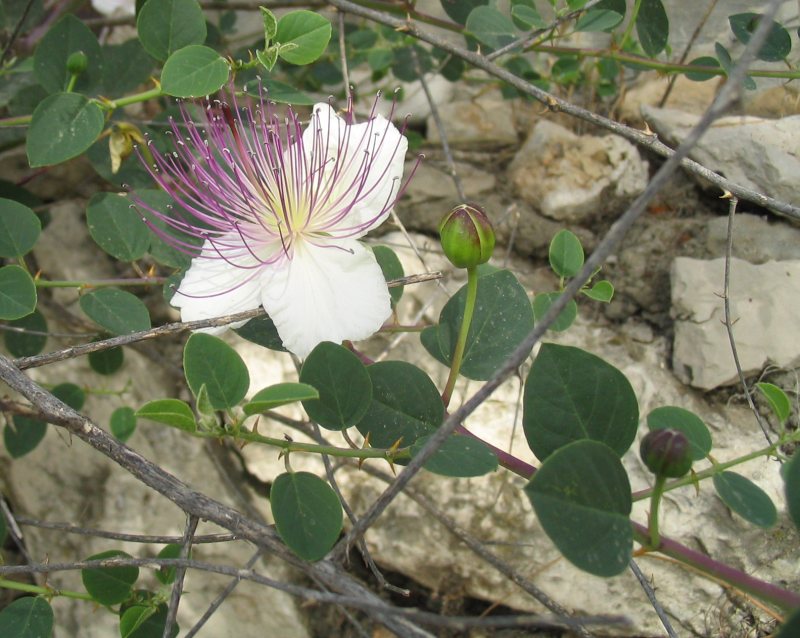
Capparis spinosa occurs across the Mediterranean Basin, Arabian Peninsula, and parts of Western and Central Asia. It produces edible flower buds and oblong, multi-seeded fruits. Full profile
Compare something else
Page built on 28 November 2026 from the data on the two species pages, where every source is listed.
Cite this page
ScientificNames.org. (2026). Karira vs Caper. Retrieved November 28, 2026, from https://scientificnames.org/compare/karira-vs-caper
“Karira vs Caper.” ScientificNames.org, 2026, scientificnames.org/compare/karira-vs-caper. Accessed 28 Nov. 2026.
ScientificNames.org. “Karira vs Caper.” Accessed November 28, 2026. https://scientificnames.org/compare/karira-vs-caper.
@misc{scientificnames_karira_vs_caper,
  author = {{ScientificNames.org}},
  title = {Karira vs Caper},
  year = {2026},
  url = {https://scientificnames.org/compare/karira-vs-caper},
  note = {Accessed 2026-11-28}
}