Species · Flowering plants
Karira Capparis decidua
The scientific name of the Karira is Capparis decidua. It is a species of flowering plant in the family Capparaceae (caper family), order Capparales.
- Scientific name
- Capparis decidua (Forssk.) Edgew.
- Common name
- Karira
- Genus
- Capparis
- Family
- Capparaceae (Caper Family)
- Order
- Capparales
- Class
- Magnoliopsida
- Red List category
- LC Least Concern
- Recorded in
- 25 countries
- Name status
- accepted in the Catalogue of Life

Overview
Karira (Capparis decidua) is a small, much-branched tree or shrub in the family Capparaceae, order Capparales and class Magnoliopsida. The species occurs in arid regions of North Africa, West Asia and South Asia, including the Thar Desert. It is marked by slender, gray-green, leafless branches, conspicuous red flowers and pink, fleshy berries.
Written 26 November 2026 from the sources listed below. Each statement was checked against the passage it cites; statements that could not be supported were removed.
Appearance
Karira is a small, much-branched tree or shrub with slender, gray-green, leafless branches. It rarely grows taller than 5 metres.[1][2][3]
Its small, short-lived leaves occur only on young shoots and emerge between November and January. The plant produces conspicuous red flowers during March–April and August–September.[4][5][6]
Its berries are pink and fleshy. Ripe fruits are produced around May and October.[7][8]
Habitat
Karira occurs in arid regions of North Africa, West Asia and South Asia, including the Thar Desert.[9][10][11][12]
Khair city in Uttar Pradesh, India, is noted for its Kair trees.[13]
Diet
The fruit and young buds of karira are edible raw. Birds readily consume its pink, fleshy berries.[7][14][15]
The fruits can attract helpful insectivores.[16]
Behaviour
Karira is extremely drought-resistant and tolerates some frost.[17][18]
Reproduction and life cycle
Karira reproduces vegetatively by producing root suckers. It produces ripe fruits around May and October.[8][19]
Uses
The fruits are used to prepare vegetable dishes, curry and fine pickles.[20][21][22]
The plant is used in folk medicine and herbalism.[23]
Karira can be used in landscape gardening. It can also be planted for afforestation and reforestation in semidesert and desert environments.[24][25]
The plant provides assistance against soil erosion.[26]
Classification of the Karira
| Kingdom | Plantae |
|---|---|
| Subkingdom | Pteridobiotina |
| Phylum | Tracheophyta |
| Class | Magnoliopsida |
| Order | Capparales |
| Family | Capparaceae (Caper Family) |
| Tribe | Cappareae |
| Genus | Capparis (Caper) |
| Species | Capparis decidua (Forssk.) Edgew. |
Where the Karira is found
Checklists and occurrence records place Capparis decidua in 25 countries across Africa and Asia. GBIF holds 1,415 georeferenced records of it.
Countries
- Algeria
- Bahrain
- Burkina Faso 2
- Cameroon 5
- Chad 230
- Egypt 46
- Eritrea 3
- Ethiopia 37
- India 463
- Iran 8
- Israel 78
- Jordan 3
- Libya 1
- Mauritania 177
- Morocco 2
- Niger 25
- Nigeria 1
- Oman 3
- Pakistan 103
- Saudi Arabia 49
- Senegal 23
- South Sudan
- Sudan 111
- Western Sahara 13
- Yemen 32
Regions and cities with the most records
- Rajasthan, India 201
- Gujarat, India 123
- Dakhlet Nouadhibou, Mauritania 86
- Southern District, Israel 68
- Red Sea, Sudan 52
- Hadjer-Lamis, Chad 49
- Inchiri, Mauritania 42
- Maharashtra, India 39
- Ouadaï, Chad 38
- Punjab, Pakistan 38
- Batha, Chad 28
- Keshorai Pātan, India 28
- Suakin, Sudan 27
- Wadi Fira, Chad 23
- Kāpren, India 21
- Amreli, India 18
- Lāthi, India 18
- Bīdāsar, India 16
- Chhāpar, India 16
- Lādnūn, India 16
- Sūjāngarh, India 16
- Aya Nagar, India 15
- Bhati, India 15
- Delhi Cantonment, India 15
- Dera Māndi, India 15
- Kusum Pur, India 15
- New Delhi, India 15
- Rijokri, India 15
- Samālka, India 15
- Sila, Chad 15
- Sultan Pur, India 15
- Vadodara, India 15
- Chhatarpur, India 14
- Deoli, India 14
- Kāpas Herd, India 14
- Malakpur Kohi Rangpur, India 14
1 more country has a few records outside this range
These countries hold a few records of Capparis decidua but lie outside the range the checklists give for it. Such records are often zoo or garden specimens, museum material or vagrants, so the species is not counted as occurring there.
Range as the checklists state it
Morocco; Western Sahara; Algeria; Libya; Egypt (Desert Oases, Eastern Desert, Great Southwestern Desert, Nile Valley, SE-Egypt); Mauritania; Senegal; SE-Burkina Faso; Niger; Nigeria; Chad (incl. Tibesti); Sudan; South Sudan; Ethiopia; Eritrea; Soqotra; Iran (S-Iran); Israel (Rift Valley); Sinai peninsula (C-Sinai, S-Sinai); Saudi Arabia (C-Saudi Arabia, NE-Saudi Arabia, N-Saudi Arabia, Hejaz, Midyan, Rub al Khali, Asir, Nejd Desert); Bahrain; Oman (Mascat & Oman); Yemen (N-Inner Yemen, SW-Yemen, Tihama, W-Yemen); Pakistan (Karachi, Sind, Baluchistan, Pakistani Punjab, N. W. Frontier Prov., Mirpur); India (widespread)
A number beside a place is its count of GBIF occurrence records. A place without a number comes from a checklist alone. Records show where a species has been observed or collected, which can include escapes and vagrants.
Common names
English
- Karira
- Sodada
Names in 1 other language
- Arabic
- تندب, حنبوق, سوداد
Synonyms
6 other scientific names have been used for this species and are now treated as synonyms of Capparis decidua.
- Capparis aphylla Roth
- Capparis decidua Pax
- Capparis sodada R.Br.
- Maerua linearis (DC.) Pax
- Niebuhria linearis DC.
- Sodada decidua Forssk.
Related species
-
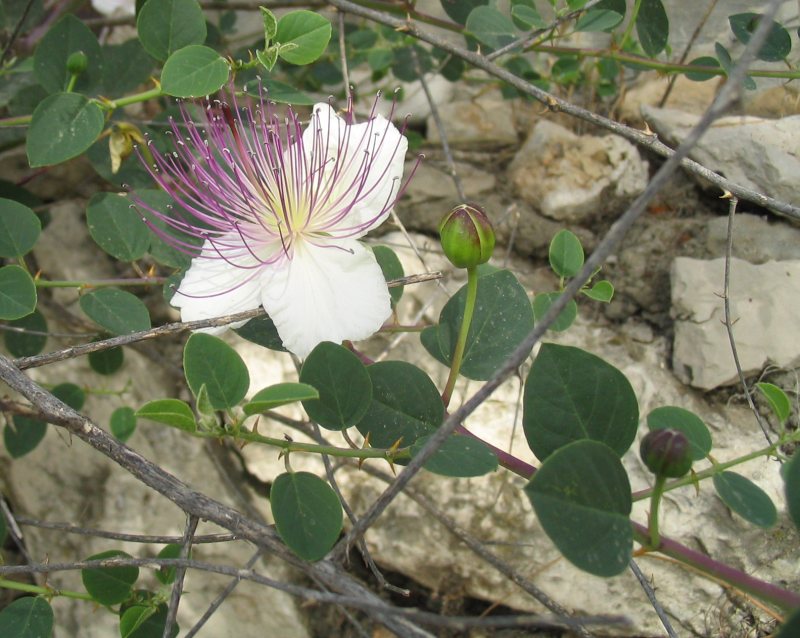 CaperCapparis spinosa
-
 Wild OrangeCapparis mitchellii
-
 African CaperCapparis tomentosa
-
 Ceylon CaperCapparis zeylanica
-
 Brush Caper BerryCapparis arborea
-
 Wild OrangeCapparis canescens
-
 NipanCapparis lasiantha
-
 Narrow-Leaved CaperbushCapparis brassii
Compare
Questions and answers
What is the scientific name of the Karira?
The scientific name of the Karira is Capparis decidua. Written with its author, the full name is Capparis decidua (Forssk.) Edgew..
Which family does the Karira belong to?
Capparis decidua belongs to the family Capparaceae, in the order Capparales and the class Magnoliopsida.
Where is the Karira found?
Checklists and occurrence records place Capparis decidua in 25 countries, including India, Chad, Mauritania, Sudan, Pakistan and Israel.
What is the conservation status of the Karira?
The IUCN Red List category recorded for Capparis decidua is Least Concern (LC).
What other names does the Karira have?
Capparis decidua is also known in English as Sodada.
Sources
Passages the profile rests on
- Capparis decidua is a small, much-branched tree or shrub. Source passage: “It is a small much-branched tree or shrub.” — English Wikipedia
- The plant has slender, gray-green, leafless branches. Source passage: “It bears a mass of slender, gray-green leafless branches” — English Wikipedia
- The plant rarely grows taller than 5 metres. Source passage: “It rarely exceeds a height of 5 metres (16 feet).” — English Wikipedia
- Its small, short-lived leaves occur only on young shoots. Source passage: “the small caducous leaves being found only on young shoots.” — English Wikipedia
- Its new leaves emerge between November and January. Source passage: “The new flush of leaves appears in November–January.” — English Wikipedia
- The plant produces conspicuous red flowers during March–April and August–September. Source passage: “Red conspicuous flowers appear in March to April and August–September” — English Wikipedia
- Its berries are pink and fleshy. Source passage: “The pink fleshy berries are readily eaten by birds.” — English Wikipedia
- The plant produces ripe fruits around May and October. Source passage: “and ripe by May and October.” — English Wikipedia
- The species occurs in arid regions. Source passage: “It can be found in arid regions in North Africa, the West Asia, and South Asia, including the Thar Desert.” — English Wikipedia
- The species occurs in North Africa. Source passage: “It can be found in arid regions in North Africa, the West Asia, and South Asia, including the Thar Desert.” — English Wikipedia
- The species occurs in West Asia. Source passage: “It can be found in arid regions in North Africa, the West Asia, and South Asia, including the Thar Desert.” — English Wikipedia
- The species occurs in South Asia, including the Thar Desert. Source passage: “It can be found in arid regions in North Africa, the West Asia, and South Asia, including the Thar Desert.” — English Wikipedia
- Khair city in Uttar Pradesh, India, is noted for its Kair trees. Source passage: “Khair city in Uttar Pradesh, India is famous for Kair trees.” — English Wikipedia
- Birds readily consume the plant's pink fleshy berries. Source passage: “The pink fleshy berries are readily eaten by birds.” — English Wikipedia
- The fruit and young buds of the species are edible raw. Source passage: “The fruit and young buds can be eaten raw.” — English Wikipedia
- The fruits can attract helpful insectivores. Source passage: “Its spicy fruits are used for preparing vegetables, curry and fine pickles and can attract helpful insectivores” — English Wikipedia
- The plant is extremely drought-resistant. Source passage: “It is extremely drought-resistant” — English Wikipedia
- The plant tolerates some frost. Source passage: “and tolerates some frost.” — English Wikipedia
- The plant reproduces vegetatively by producing root suckers. Source passage: “It coppices well and produces root suckers freely.” — English Wikipedia
- The fruits are used to prepare vegetable dishes. Source passage: “Its spicy fruits are used for preparing vegetables, curry and fine pickles” — English Wikipedia
- The fruits are used to prepare curry. Source passage: “Its spicy fruits are used for preparing vegetables, curry and fine pickles” — English Wikipedia
- The fruits are used to prepare fine pickles. Source passage: “Its spicy fruits are used for preparing vegetables, curry and fine pickles” — English Wikipedia
- The plant is used in folk medicine and herbalism. Source passage: “the plant also is used in folk medicine and herbalism.” — English Wikipedia
- The species can be used in landscape gardening. Source passage: “It can be used in landscape gardening, afforestation and reforestation in semidesert and desert areas” — English Wikipedia
- The species can be planted for afforestation and reforestation in semidesert and desert environments. Source passage: “It can be used in landscape gardening, afforestation and reforestation in semidesert and desert areas” — English Wikipedia
- The plant provides assistance against soil erosion. Source passage: “it provides assistance against soil erosion.” — English Wikipedia
Data
- Catalogue of Life, 2026-10-16 XR cc by
- Global Biodiversity Information Facility CC BY 4.0
- Wikidata CC0
- GeoNames CC BY 4.0
- Wikimedia Commons per image; credit shown with each image
- Within the Catalogue of Life, this name comes from Synonymic Checklists of the Vascular Plants of the World cc by
References
- Edgew. (1862). J. Proc. Linn. Soc., Bot. 6: 184 (1862). where the name was published
This species in other databases
Page built on 26 November 2026. See how the catalog is made and all sources and licences.
Cite this page
ScientificNames.org. (2026). Capparis decidua (Karira). Retrieved November 26, 2026, from https://scientificnames.org/species/capparis-decidua
“Capparis decidua (Karira).” ScientificNames.org, 2026, scientificnames.org/species/capparis-decidua. Accessed 26 Nov. 2026.
ScientificNames.org. “Capparis decidua (Karira).” Accessed November 26, 2026. https://scientificnames.org/species/capparis-decidua.
@misc{scientificnames_capparis_decidua_karira,
  author = {{ScientificNames.org}},
  title = {Capparis decidua (Karira)},
  year = {2026},
  url = {https://scientificnames.org/species/capparis-decidua},
  note = {Accessed 2026-11-26}
}