Comparison

Cascade Caverns Salamander vs Texas Blind Salamander

Cascade Caverns Salamander (Eurycea latitans) and Texas Blind Salamander (Eurycea rathbuni) both belong to the genus Eurycea (brook salamander) and part ways below it. Both are recorded in 1 country.

Cascade Caverns Salamander

Eurycea latitans
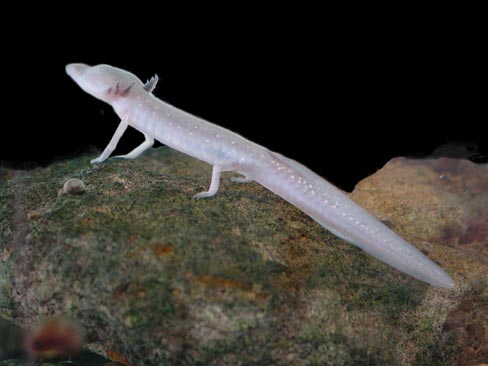
Texas Blind Salamander

Texas Blind Salamander

Eurycea rathbuni

Photograph courtesy of Joe N. Fries, U.S. Fish and Wildlife Service, Public domain, via Wikimedia Commons

Side by side

Cascade Caverns SalamanderTexas Blind Salamander
Scientific nameEurycea latitans Smith & Potter, 1946Eurycea rathbuni (Stejneger, 1896)
English nameCascade Caverns SalamanderTexas Blind Salamander
GroupAmphibiansAmphibians
ClassAmphibia AmphibiansAmphibia Amphibians
OrderCaudata SalamandersCaudata Salamanders
FamilyPlethodontidae Lungless SalamandersPlethodontidae Lungless Salamanders
GenusEurycea Brook SalamanderEurycea Brook Salamander
Named in19461896
Red List categoryVulnerableCritically Endangered
Countries on record1 country1 country
GBIF occurrence records384 records388 records

Rows where the two agree are shown in grey.

Where each is found

Both recorded in 1 country

From Catalogue of Life checklists and GBIF occurrence records. A country missing from a list means no record is held, which is not proof of absence.

Checked facts

Cascade Caverns SalamanderTexas Blind Salamander
Appearance
  • The salamander has translucent skin with a faint brown net-shaped pattern and often displays white speckling. English Wikipedia
  • The species has a stout body and short legs. English Wikipedia
  • Its eyes are reduced and positioned beneath a layer of skin. English Wikipedia
  • Adults retain juvenile characteristics, including external gills. English Wikipedia
  • The amount of variation in the species' coloration remains unknown because it is rarely observed. English Wikipedia
SizeNo checked fact yet
Habitat
  • The species inhabits aquatic environments in Cascade Caverns in Kendall County, Texas. English Wikipedia
  • The species lives in spring waters deep within limestone rock strata. English Wikipedia
  • The species inhabits karstic springs and subterranean voids within the Trinity and Edwards aquifers in Central Texas. fws.gov
  • The species depends on both surface and subsurface aquatic habitats throughout the year. fws.gov
  • A significant portion of the population is assumed to occupy subterranean voids, particularly during drought. fws.gov
  • The species depends on adequate water quality and water quantity for survival and persistence. fws.gov
  • The species' habitat includes karstic landscapes containing canyons, caves and sinkholes formed through erosion by spring, stream and river flows. fws.gov
  • Suitable habitat requires flowing groundwater with chemical components within the normal range of natural conditions. fws.gov
  • The natural physical structures of spring openings, spring runs, creeks and subterranean spaces should remain free of human-caused disturbances. fws.gov
  • The species inhabits underground streams and deep pools in caves. English Wikipedia
  • Its underground pools are generally cool, measuring approximately 21–22 °C. English Wikipedia
  • It inhabits underground water-filled caves in the Edwards Aquifer. tpwd.texas.gov
  • The species is usually restricted to caves, although it has also been found in wells. animaldiversity.org
DietNo checked fact yet
  • Its diet includes blind shrimp, snails, and amphipods. English Wikipedia
  • Tiny snails, shrimp, and other aquatic invertebrates form its diet. tpwd.texas.gov
  • Its diet varies according to the food material flowing into its cave habitat. English Wikipedia
Behaviour
  • The species is almost entirely subterranean. English Wikipedia
  • The species is entirely aquatic, like other central Texas Eurycea species. fws.gov
  • The species hunts by moving its head from side to side while searching the bottom for food. tpwd.texas.gov
  • It detects prey by sensing water-pressure waves in underground water. tpwd.texas.gov
  • The species is neotenic and retains external gills throughout its life. animaldiversity.org
ReproductionNo checked fact yet
Distribution
  • The species occupies springs, outflow channels and underlying subterranean voids in northern Bexar, western Comal and southern Kendall counties. fws.gov
No checked fact yet
Conservation
  • The species is described as threatened and potentially at risk of becoming endangered. English Wikipedia
  • Urban sprawl and associated development threaten the persistence of the species. fws.gov
  • Land-use conversion and impervious surfaces are identified as threats to the species. fws.gov
  • Drought and water demands in Central Texas threaten the species. fws.gov
  • Degradation of water quality by contaminants and pollutants threatens the species. fws.gov
  • A genetic sampling effort targeting the species began in 2020 through collaboration between the U.S. Fish and Wildlife Service Texas Fish and Wildlife Conservation Office and Texas Parks and Wildlife Department. fws.gov
  • The species was listed as endangered on March 11, 1967. English Wikipedia
  • The species is listed as endangered under the U.S. Endangered Species Act. animaldiversity.org
  • Groundwater pumping for commercial or domestic purposes threatens the species by increasing its vulnerability to predators and potentially causing extinction. English Wikipedia
  • Stormwater runoff and chemical spills are sources of pollution affecting the Edwards Aquifer. English Wikipedia
  • Urban growth, water overuse, and pollution threaten the species' survival. tpwd.texas.gov
  • The species depends on a continuous supply of clean, cool water from the Edwards Aquifer. tpwd.texas.gov
UsesNo checked fact yet
Similar speciesNo checked fact yet
  • The Texas blind salamander resembles the European olm. English Wikipedia
  • Unlike the olm, it has four digits on its front limbs and five on its back limbs. English Wikipedia

In brief

Cascade Caverns Salamander

Eurycea latitans has translucent skin, reduced eyes beneath a layer of skin, a stout body, short legs and external gills that persist into adulthood. Full profile

Texas Blind Salamander

Eurycea rathbuni inhabits underground water-filled caves in the Edwards Aquifer. It has vestigial eyes covered by skin, red external gills, and a white body with little skin pigment. Full profile

Compare something else

Page built on 27 November 2026 from the data on the two species pages, where every source is listed.

Cite this page

ScientificNames.org. (2026). Cascade Caverns Salamander vs Texas Blind Salamander. Retrieved November 27, 2026, from https://scientificnames.org/compare/cascade-caverns-salamander-vs-texas-blind-salamander