Species · Amphibians
Texas Blind Salamander Eurycea rathbuni
The scientific name of the Texas Blind Salamander is Eurycea rathbuni. It is a species of amphibian in the family Plethodontidae (lungless salamanders), order Caudata. The name dates from 1896.
- Scientific name
- Eurycea rathbuni (Stejneger, 1896)
- Common name
- Texas Blind Salamander
- Genus
- Eurycea
- Family
- Plethodontidae (Lungless Salamanders)
- Order
- Caudata
- Class
- Amphibia
- Red List category
- CR Critically Endangered
- Recorded in
- 1 country
- Name status
- accepted in the Catalogue of Life
Overview
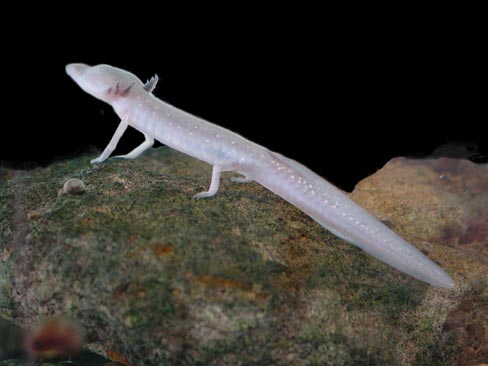
Eurycea rathbuni inhabits underground water-filled caves in the Edwards Aquifer. It has vestigial eyes covered by skin, red external gills, and a white body with little skin pigment.
Written 26 November 2026 from the sources listed below. Each statement was checked against the passage it cites; statements that could not be supported were removed.
Appearance
The Texas Blind Salamander has a broad, flat head and snout. Its eyes are vestigial and covered by skin, with two small black dots beneath the skin instead of externally visible eyes.[1][2][3]
Its vestigial eyes contain an optic nerve but may lack lenses and well-defined retinas. Its body is white with little skin pigment, and its external gills are red.[4][5][6]
It has four digits on each forelimb and five on each hind limb. Its limbs are very thin and elongated, and its tail is laterally compressed, finned, and tapered at the end.[7][8][9]
It has twelve costal grooves. Its lateral line contains numerous neuromasts that detect mechanical stimuli and are thought to assist navigation and prey detection.[10][11][12]
The species can regenerate lost tails and limbs. Mature individuals measure approximately 13 centimeters in length.[13][14]
Habitat
The Texas Blind Salamander inhabits underground streams and deep pools in caves. Its underground pools are generally cool, measuring approximately 21–22 °C.[15][16]
It inhabits underground water-filled caves in the Edwards Aquifer. It is usually restricted to caves, although it has also been found in wells.[17][18]
Diet
Its diet includes blind shrimp, snails, and amphipods. Tiny snails, shrimp, and other aquatic invertebrates form its diet.[19][20]
Its diet varies according to the food material flowing into its cave habitat.[21]
Behaviour
The Texas Blind Salamander hunts by moving its head from side to side while searching the bottom for food. It detects prey by sensing water-pressure waves in underground water.[22][23]
The species is neotenic and retains external gills throughout its life.[24]
Reproduction and life cycle
The Texas Blind Salamander has separate male and female sexes. Reproduction occurs throughout the year, and females mature and reproduce without responding to seasonal cues.[25][26][27]
Females initiate courtship by rubbing their chins along males' backs. They may nip males when initial courtship attempts do not stimulate a response.[28][29]
Males deposit spermatophores on rocks or other substrate, which females collect with their cloacas. Females produce an average of five small egg clutches annually.[30][31]
Conservation
The Texas Blind Salamander was listed as endangered on March 11, 1967. It is listed as endangered under the U.S. Endangered Species Act.[32][33]
Groundwater pumping for commercial or domestic purposes threatens the species by increasing its vulnerability to predators and potentially causing extinction.[34]
Stormwater runoff and chemical spills are sources of pollution affecting the Edwards Aquifer. Urban growth, water overuse, and pollution threaten the species' survival.[35][36]
The species depends on a continuous supply of clean, cool water from the Edwards Aquifer.[37]
Similar species
The Texas Blind Salamander resembles the European olm. Unlike the olm, it has four digits on its front limbs and five on its back limbs.[38][39]
Uses
The Texas Blind Salamander is not considered a resource for humans.[40]
Classification of the Texas Blind Salamander
| Kingdom | Animalia |
|---|---|
| Phylum | Chordata |
| Subphylum | Vertebrata |
| Infraphylum | Gnathostomata |
| Parvphylum | Osteichthyes |
| Megaclass | Tetrapoda |
| Class | Amphibia (Amphibians) |
| Order | Caudata (Salamanders) |
| Family | Plethodontidae (Lungless Salamanders) |
| Subfamily | Hemidactyliinae |
| Genus | Eurycea (Brook Salamander) |
| Species | Eurycea rathbuni (Stejneger, 1896) |
Where the Texas Blind Salamander is found
Checklists and occurrence records place Eurycea rathbuni in 1 country across North America. GBIF holds 388 georeferenced records of it.
Countries
Regions and cities with the most records
Range as the checklists state it
North America
A number beside a place is its count of GBIF occurrence records. A place without a number comes from a checklist alone. Records show where a species has been observed or collected, which can include escapes and vagrants.
Common names
English
- Texas Blind Salamander
Names in 6 other languages
- Czech
- mločík studňový
- French
- Eurycée aveugle du Texas
- Portuguese
- Salamandra-cega-do-Texas
- Russian
- Ратбунов колодезный тритон, Техасская слепая саламандра
- Spanish
- Salamandra Ciega de Texas
- Turkish
- Teksas kör semenderi
Synonyms
One other scientific name has been used for this species and is now treated as a synonym of Eurycea rathbuni.
- Typhlomolge rathbuni Stejneger, 1896
Related species
- Blanco Blind SalamanderEurycea robusta
-
 Northern Two-lined SalamanderEurycea bislineata
-
 Barton Springs SalamanderEurycea sosorum
-
 Long-tailed SalamanderEurycea longicauda
-
 Cave SalamanderEurycea lucifuga
-
 Southern Two-lined SalamanderEurycea cirrigera
-
 Blue Ridge Two-lined SalamanderEurycea wilderae
-
 Western Grotto SalamanderEurycea spelaea
Compare
Questions and answers
What is the scientific name of the Texas Blind Salamander?
The scientific name of the Texas Blind Salamander is Eurycea rathbuni. Written with its author, the full name is Eurycea rathbuni (Stejneger, 1896).
Which family does the Texas Blind Salamander belong to?
Eurycea rathbuni belongs to the family Plethodontidae, in the order Caudata and the class Amphibia.
Where is the Texas Blind Salamander found?
Checklists and occurrence records place Eurycea rathbuni in 1 country: United States.
What is the conservation status of the Texas Blind Salamander?
The IUCN Red List category recorded for Eurycea rathbuni is Critically Endangered (CR).
Why is the Texas blind salamander blind?
Its eyes are vestigial and covered by skin. They contain an optic nerve but may lack lenses and well-defined retinas.[2][4]
What do Texas blind salamanders eat?
Their diet includes blind shrimp, snails, amphipods, and other aquatic invertebrates. Their diet varies according to the food material flowing into their cave habitat.[19][20][21]
Sources
Passages the profile rests on
- The species has a broad, flat head and snout. Source passage: “The species has a broad, flat snout and head” — English Wikipedia
- Its eyes are vestigial and covered by skin. Source passage: “vestigial eyes beneath that are covered by skin.” — English Wikipedia
- It has two small black dots beneath its skin instead of externally visible eyes. Source passage: “it has no eyes, only two small black dots under the skin.” — tpwd.texas.gov
- Its vestigial eyes contain an optic nerve but may lack lenses and well-defined retinas. Source passage: “This species' vestigial eyes contain an optic nerve, but are less developed than those of other species in the Eurycea, often lacking important features like lenses and well-defined retinas” — English Wikipedia
- Its body is white and has little skin pigment. Source passage: “It has little skin pigment, is white in color” — tpwd.texas.gov
- Its external gills are red. Source passage: “and has red external gills used to get oxygen from the water.” — tpwd.texas.gov
- It has four digits on each forelimb and five on each hind limb. Source passage: “The forelimbs carry four digits and the hind limbs possess five digits.” — English Wikipedia
- Its limbs are very thin and elongated. Source passage: “The four limbs are very thin and elongate.” — animaldiversity.org
- Its tail is laterally compressed, finned, and tapered at the end. Source passage: “The tail is laterally compressed and finned, tapering at its end.” — animaldiversity.org
- Its lateral line contains numerous neuromasts that detect mechanical stimuli. Source passage: “this species has numerous neuromasts in their lateral line that detect mechanical stimuli in the environment.” — English Wikipedia
- Its neuromasts are thought to assist navigation and prey detection. Source passage: “These neuromasts are thought to play an important role in navigation and prey detection for this species with reduced visual capacity.” — English Wikipedia
- It has twelve costal grooves. Source passage: “It has twelve costal grooves as well.” — animaldiversity.org
- The species can regenerate lost tails and limbs. Source passage: “The species is found to be able to regenerate its tail and limbs if they are lost.” — English Wikipedia
- Mature individuals measure approximately 13 centimeters in length. Source passage: “The salamander's mature length is around 13 cm (5 in).” — English Wikipedia
- The species inhabits underground streams and deep pools in caves. Source passage: “Adults and immature larvae are well-adapted for living in underground streams or deep pools in caves” — English Wikipedia
- Its underground pools are generally cool, measuring approximately 21–22 °C. Source passage: “The deep pools are cool environments nearly constantly staying at 21–22 °C (70–72 °F)” — English Wikipedia
- It inhabits underground water-filled caves in the Edwards Aquifer. Source passage: “The Texas blind salamander lives in water-filled caves of the Edwards Aquifer near San Marcos, Texas.” — tpwd.texas.gov
- The species is usually restricted to caves, although it has also been found in wells. Source passage: “It has been found in wells but is usually restricted to caves” — animaldiversity.org
- Its diet includes blind shrimp, snails, and amphipods. Source passage: “includes blind shrimp (Palaemonetes antrorum), snails, and amphipods.” — English Wikipedia
- Tiny snails, shrimp, and other aquatic invertebrates form its diet. Source passage: “Tiny snails, shrimp, and other aquatic invertebrates make up its diet.” — tpwd.texas.gov
- Its diet varies according to the food material flowing into its cave habitat. Source passage: “Its diet varies by what flows into its cave” — English Wikipedia
- The species hunts by moving its head from side to side while searching the bottom for food. Source passage: “It moves its head from side to side as it searches for food on the bottom.” — tpwd.texas.gov
- It detects prey by sensing water-pressure waves in underground water. Source passage: “It hunts animal food by sensing water pressure waves created by prey in the still underground waters where it lives.” — tpwd.texas.gov
- The species is neotenic and retains external gills throughout its life. Source passage: “Eurycea rathbuni is neotenic and thus bright red gills are present throughout the lifecycle.” — animaldiversity.org
- Reproduction occurs throughout the year. Source passage: “Reproduction occurs year round.” — tpwd.texas.gov
- Females mature and reproduce throughout the year without responding to seasonal cues. Source passage: “The species is known to be acyclic with females maturing and reproducing throughout the year, unresponsive to seasonal cues.” — animaldiversity.org
- The species has separate male and female sexes. Source passage: “gonochoric/gonochoristic/dioecious (sexes separate)” — animaldiversity.org
- Females initiate courtship by rubbing their chins along males' backs. Source passage: “Her behavior is characterized by rubbing her chin along the male's back.” — animaldiversity.org
- Females may nip males when their initial courtship attempts do not stimulate a response. Source passage: “She may even resort to nipping at his sides if he further ignores her advances.” — animaldiversity.org
- Males deposit spermatophores on rocks or other substrate, which females collect with their cloacas. Source passage: “The male will deposit a spermatophore on a rock or substrate and the female will then pick it up with her cloaca” — animaldiversity.org
- Females produce an average of five small egg clutches annually. Source passage: “with females found to produce 5 small egg clutches on average per year.” — English Wikipedia
- The species was listed as endangered on March 11, 1967. Source passage: “The salamanders were listed as an endangered species on March 11th, 1967” — English Wikipedia
- The species is listed as endangered under the U.S. Endangered Species Act. Source passage: “Eurycea rathbuni is listed as endangered under the U.S. Endangered Species Act” — animaldiversity.org
- Groundwater pumping for commercial or domestic purposes threatens the species by increasing its vulnerability to predators and potentially causing extinction. Source passage: “Continuous pumping of groundwater for commercial or domestic purposes leaves the salamanders vulnerable to predators and can eventually lead to their extinction.” — English Wikipedia
- Stormwater runoff and chemical spills are sources of pollution affecting the Edwards Aquifer. Source passage: “The Edwards Aquifer is becoming polluted from stormwater runoff and chemical spills.” — English Wikipedia
- Urban growth, water overuse, and pollution threaten the species' survival. Source passage: “Pollution and overuse of water caused by the growth of cities threaten its survival.” — tpwd.texas.gov
- The species depends on a continuous supply of clean, cool water from the Edwards Aquifer. Source passage: “The Texas blind salamander depends on a constant supply of clean, cool water from the Edwards Aquifer.” — tpwd.texas.gov
- The Texas blind salamander resembles the European olm. Source passage: “This species resembles the olm, another stygofaunal salamander from Europe.” — English Wikipedia
- Unlike the olm, it has four digits on its front limbs and five on its back limbs. Source passage: “it has more digits on each limb: four on the front limbs and five on the back, while the olm has three and two respectively.” — English Wikipedia
- The species is not considered a resource for humans. Source passage: “This salamander is not a resource for humans.” — animaldiversity.org
Data
- Catalogue of Life, 2026-10-16 XR cc by
- Global Biodiversity Information Facility CC BY 4.0
- Wikidata CC0
- GeoNames CC BY 4.0
- Wikimedia Commons per image; credit shown with each image
- iNaturalist per image; credit shown with each image
- Within the Catalogue of Life, this name comes from The Integrated Taxonomic Information System cc0
References
- Crother, Brian I., Jeff Boundy, Jonathan A. Campbell, Kevin de Quieroz, Darrel Frost, et al. (2003). Scientific and Standard English Names of Amphibians and Reptiles of North America North of Mexico: Update. Herpetological Review, Vol. 34, No. 3.
- Crother, Brian I., Jeff Boundy, Frank T. Burbrink, et al. / Moriarty, John J., ed. (2008). Scientific and Standard English Names of Amphibians and Reptiles of North America North of Mexico, With Comments Regarding Confidence in Our Understanding, Sixth Ed. Herpetological Circular No. 37.
This species in other databases
Page built on 26 November 2026. See how the catalog is made and all sources and licences.
Cite this page
ScientificNames.org. (2026). Eurycea rathbuni (Texas Blind Salamander). Retrieved November 26, 2026, from https://scientificnames.org/species/eurycea-rathbuni
“Eurycea rathbuni (Texas Blind Salamander).” ScientificNames.org, 2026, scientificnames.org/species/eurycea-rathbuni. Accessed 26 Nov. 2026.
ScientificNames.org. “Eurycea rathbuni (Texas Blind Salamander).” Accessed November 26, 2026. https://scientificnames.org/species/eurycea-rathbuni.
@misc{scientificnames_eurycea_rathbuni_texas_blind_salamander,
  author = {{ScientificNames.org}},
  title = {Eurycea rathbuni (Texas Blind Salamander)},
  year = {2026},
  url = {https://scientificnames.org/species/eurycea-rathbuni},
  note = {Accessed 2026-11-26}
}