Comparison
Cat Greenbrier vs Common Smilax
Cat Greenbrier (Smilax glauca) and Common Smilax (Smilax aspera) both belong to the genus Smilax (greenbriar) and part ways below it.

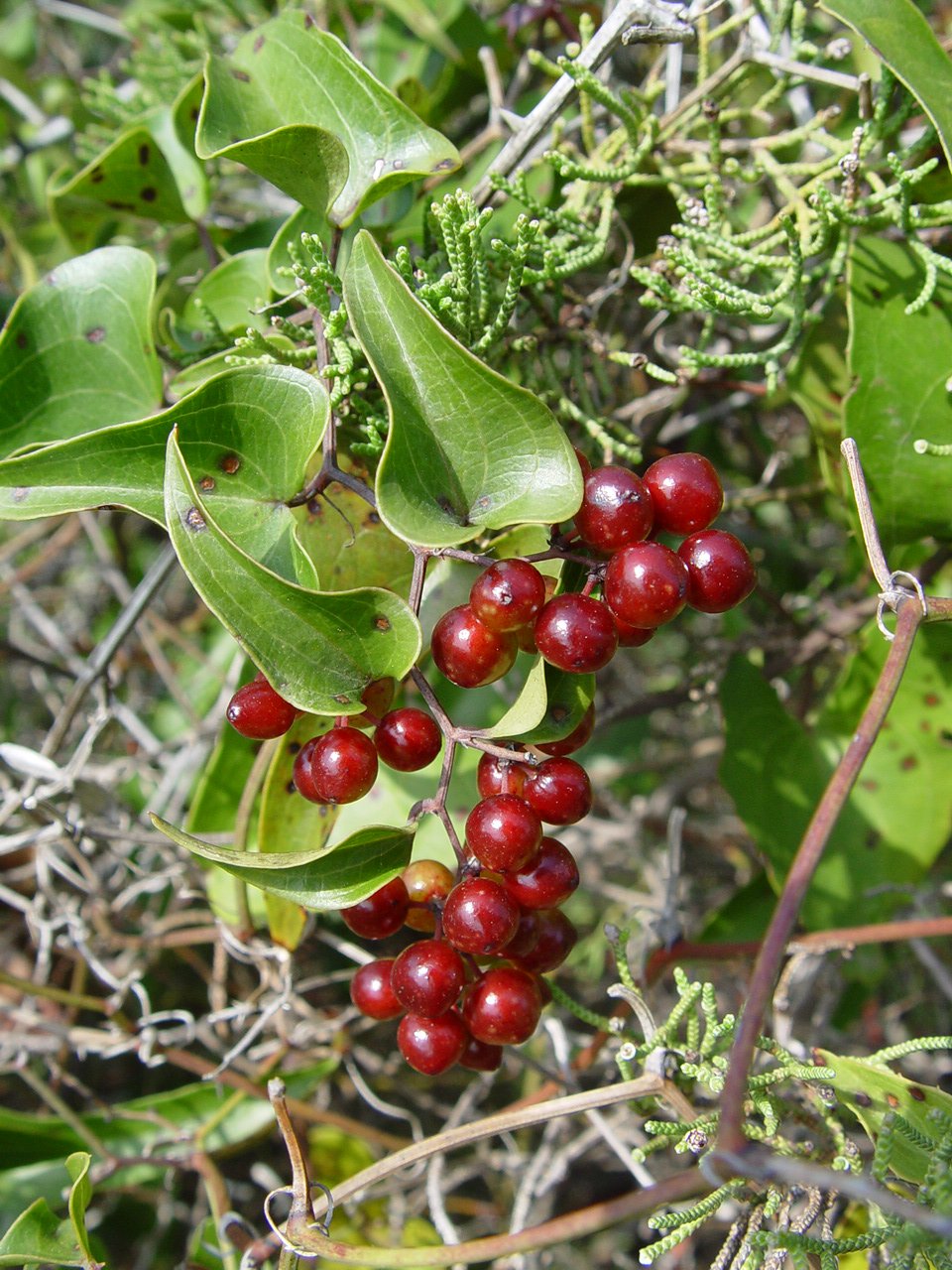


Side by side
| Cat Greenbrier | Common Smilax | |
|---|---|---|
| Scientific name | Smilax glauca Walter | Smilax aspera L. |
| English name | Cat Greenbrier | Common Smilax |
| Group | Flowering plants | Flowering plants |
| Class | Liliopsida | Liliopsida |
| Order | Liliales | Liliales |
| Family | Smilacaceae Greenbriars | Smilacaceae Greenbriars |
| Genus | Smilax Greenbriar | Smilax Greenbriar |
| Countries on record | 2 countries | 50 countries |
| GBIF occurrence records | 13,518 records | 106,978 records |
Rows where the two agree are shown in grey.
Where each is found
Only Cat Greenbrier (2)
Only Common Smilax (50)
- Albania
- Algeria
- Armenia
- Bangladesh
- Belgium
- Bhutan
- Bosnia and Herzegovina
- Bulgaria
- China
- Croatia
- Cyprus
- Democratic Republic of the Congo
- Eritrea
- Ethiopia
- France
- Georgia
- Germany
- Gibraltar
- Greece
- Hungary
- India
- Iran
- Israel
- Italy
- Jordan
- Kenya
- Lebanon
- Libya
- Malawi
- Malta
- Monaco
- Montenegro
- Morocco
- Myanmar
- Nepal
- Pakistan
- Palestinian Territory
- Portugal
- Russia
- Slovenia
- Spain
- Sri Lanka
- Syria
- Tanzania
- The Netherlands
- Tunisia
- Turkey
- Uganda
- United Kingdom
- Zambia
From Catalogue of Life checklists and GBIF occurrence records. A country missing from a list means no record is held, which is not proof of absence.
Checked facts
| Cat Greenbrier | Common Smilax | |
|---|---|---|
| Appearance |
|
|
| Size | No checked fact yet |
|
| Habitat |
|
|
| Diet |
|
|
| Behaviour |
| No checked fact yet |
| Reproduction |
|
|
| Distribution |
|
|
| Conservation |
| No checked fact yet |
| Uses |
| No checked fact yet |
In brief
Cat Greenbrier
Smilax glauca is native to central and eastern parts of the United States and Mexico. It has prickly stems, gray-glaucous to whitish leaf undersides, and fleshy berries. Full profile
Common Smilax
Common Smilax is a perennial evergreen climbing plant with flexible stems bearing sharp thorns. It grows in woodland and scrub habitats. Full profile
Compare something else
Page built on 29 November 2026 from the data on the two species pages, where every source is listed.
Cite this page
ScientificNames.org. (2026). Cat Greenbrier vs Common Smilax. Retrieved November 29, 2026, from https://scientificnames.org/compare/cat-greenbrier-vs-common-smilax
“Cat Greenbrier vs Common Smilax.” ScientificNames.org, 2026, scientificnames.org/compare/cat-greenbrier-vs-common-smilax. Accessed 29 Nov. 2026.
ScientificNames.org. “Cat Greenbrier vs Common Smilax.” Accessed November 29, 2026. https://scientificnames.org/compare/cat-greenbrier-vs-common-smilax.
@misc{scientificnames_cat_greenbrier_vs_common_smilax,
  author = {{ScientificNames.org}},
  title = {Cat Greenbrier vs Common Smilax},
  year = {2026},
  url = {https://scientificnames.org/compare/cat-greenbrier-vs-common-smilax},
  note = {Accessed 2026-11-29}
}