Species · Flowering plants
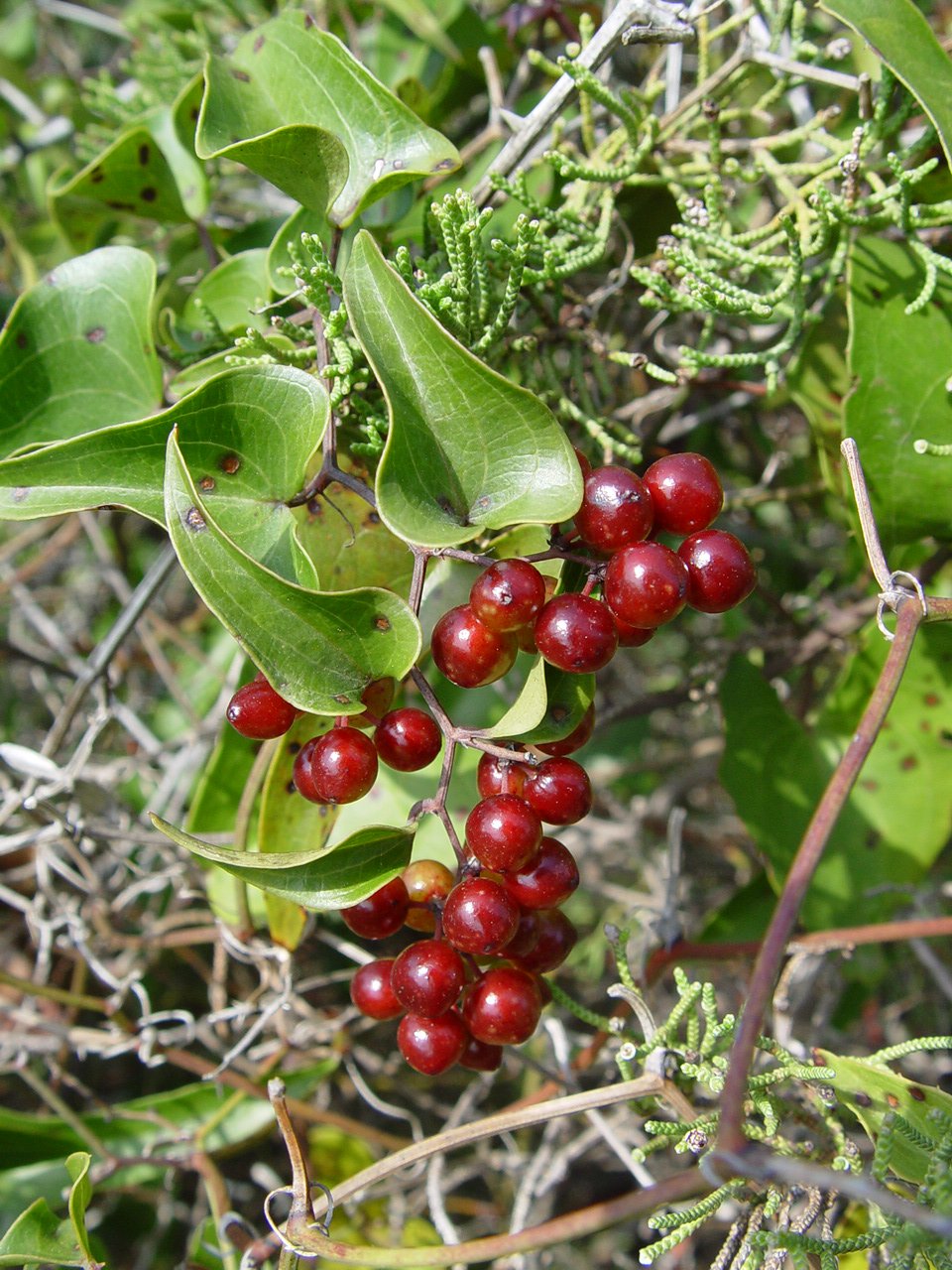
Cat Greenbrier Smilax glauca
The scientific name of the Cat Greenbrier is Smilax glauca. It is a species of flowering plant in the family Smilacaceae (greenbriars), order Liliales.
- Scientific name
- Smilax glauca Walter
- Common name
- Cat Greenbrier
- Genus
- Smilax
- Family
- Smilacaceae (Greenbriars)
- Order
- Liliales
- Class
- Liliopsida
- Recorded in
- 2 countries
- Name status
- accepted in the Catalogue of Life

Overview
Smilax glauca is native to central and eastern parts of the United States and Mexico. It has prickly stems, gray-glaucous to whitish leaf undersides, and fleshy berries.
Written 26 November 2026 from the sources listed below. Each statement was checked against the passage it cites; statements that could not be supported were removed.
Appearance
Its leaves are simple, with one leaf at each node, and their undersides are gray-glaucous to whitish. The plant produces fleshy berries.[1][2][3]
Habitat
Cat greenbrier commonly grows in wooded areas and along fences. It also occurs in disturbed habitats, including forest edges and grasslands, and in wetlands.[4][5][6]
The plant can grow in sandy, loamy, and clay soils, in full sun and semi-shaded areas.[7][8]
Behaviour
Cat greenbrier climbs using tendrils and can grow over trees, shrubs, and stumps.[9][10]
It is evergreen in the southern United States. The plant is resistant to fire because it resprouts from rhizomes, although fire can kill its above-ground growth.[11][12][13]
Reproduction and life cycle
Cat greenbrier is dioecious. Its ovule-bearing flowers have a single superior ovary.[14][15]
The species generally produces berries in winter.[16]
Diet
Catbrier roots were among the major foods recorded for released Florida sandhill cranes.[17]
Conservation
Cat greenbrier increases in importance following fires in upland southern pine forests.[18]
Uses
The stem prickles have traditionally been rubbed on skin as a counterirritant for pain and muscle cramps. The stems and leaves have been used to prepare tea for stomach complaints.[19][20]
The roots can be boiled to make a jelly-like food. They can also be dried and processed into powder.[21][22]
Classification of the Cat Greenbrier
| Kingdom | Plantae |
|---|---|
| Subkingdom | Pteridobiotina |
| Phylum | Tracheophyta |
| Class | Liliopsida |
| Order | Liliales |
| Family | Smilacaceae (Greenbriars) |
| Genus | Smilax (Greenbriar) |
| Species | Smilax glauca Walter |
Where the Cat Greenbrier is found
Checklists and occurrence records place Smilax glauca in 2 countries across North America. GBIF holds 13,518 georeferenced records of it.
Countries
Regions and cities with the most records
- North Carolina, United States 966
- Virginia, United States 936
- Maryland, United States 762
- New Jersey, United States 739
- Georgia, United States 568
- Florida, United States 559
- Mississippi, United States 531
- Alabama, United States 503
- Pennsylvania, United States 435
- Tennessee, United States 429
- McLean, United States 411
- Arlington, United States 394
- Adams Morgan, United States 393
- Texas, United States 393
- Mount Pleasant, United States 390
- Baileys Crossroads, United States 389
- Bethesda, United States 387
- New York, United States 387
- Foggy Bottom, United States 384
- Brightwood, United States 382
- Central 14th Street / Spring Road, United States 381
- Golden Triangle, United States 379
- Columbia Heights, United States 377
- South Carolina, United States 374
- Petworth, United States 372
- Silver Spring, United States 372
- Kennedy Street, United States 371
- West Falls Church, United States 371
- Idylwood, United States 370
- Chillum, United States 367
- Pleasant Plains, United States 367
- Downtown DC, United States 366
- Langley Park, United States 366
- Park View, United States 366
- Shaw, United States 364
- Washington, United States 364
1 more country has a few records outside this range
These countries hold a few records of Smilax glauca but lie outside the range the checklists give for it. Such records are often zoo or garden specimens, museum material or vagrants, so the species is not counted as occurring there.
A number beside a place is its count of GBIF occurrence records. A place without a number comes from a checklist alone. Records show where a species has been observed or collected, which can include escapes and vagrants.
Common names
English
- Cat Greenbrier
- Catbrier
- Sawbrier
- Wild Sarsaparilla
Synonyms
9 other scientific names have been used for this species and are now treated as synonyms of Smilax glauca.
- Smilax caroliniana F.Dietr.
- Smilax discolor Schltdl.
- Smilax glauca var. discolor (Schltdl.) C.V.Morton
- Smilax glauca var. genuina S.F.Blake
- Smilax glauca var. glauca
- Smilax glauca var. leucophylla S.F.Blake
- Smilax glauca var. leurophylla S.F.Blake
- Smilax sarsaparilla L.
- Smilax spinulosa Sm.
Related species
-
 Common GreenbrierSmilax rotundifolia
-
 Common SmilaxSmilax aspera
-
 CatbrierSmilax bona-nox
-
 Carrion-flowerSmilax herbacea
-
 ChinarootSmilax china
-
 Chinese SmilaxSmilax glabra
-
 Bristly GreenbrierSmilax tamnoides
-
 Sweet SarsaparillaSmilax glyciphylla
Compare
Questions and answers
What is the scientific name of the Cat Greenbrier?
The scientific name of the Cat Greenbrier is Smilax glauca. Written with its author, the full name is Smilax glauca Walter.
Which family does the Cat Greenbrier belong to?
Smilax glauca belongs to the family Smilacaceae, in the order Liliales and the class Liliopsida.
Where is the Cat Greenbrier found?
Checklists and occurrence records place Smilax glauca in 2 countries: United States and Mexico.
What other names does the Cat Greenbrier have?
Smilax glauca is also known in English as Catbrier, Sawbrier and Wild Sarsaparilla.
What is another name for smilax?
Cat greenbrier is an English name recorded for Smilax glauca Walter.[23]
Are catbrier berries edible?
The plant produces fleshy berries, but their edibility is not established here.[3]
What eats Smilax?
Catbrier roots were among the major foods recorded for released Florida sandhill cranes.[17]
Sources
Passages the profile rests on
- The undersides of its leaves are gray-glaucous to whitish. Source passage: “Leaves are notably gray-glaucous to whitish beneath.” — English Wikipedia
- Its leaves are simple, with one leaf at each node. Source passage: “The leaves of the species are simple; there is a single leaf per node that dies in the winter.” — English Wikipedia
- The plant produces fleshy berries. Source passage: “This plant has fleshy berries.” — English Wikipedia
- The species commonly grows in wooded areas and along fences. Source passage: “It commonly inhabits wooded areas and fences” — English Wikipedia
- Smilax glauca occurs in disturbed habitats, including forest edges and grasslands. Source passage: “Smilax glauca occurs in disturbed habitats such as forest edges and grasslands.” — English Wikipedia
- The species also occurs in wetlands. Source passage: “Smilax glauca also occurs in wetlands” — English Wikipedia
- The plant can grow in sandy, loamy, and clay soils. Source passage: “This species can survive in sandy, loamy, and clay soils.” — English Wikipedia
- Smilax glauca can grow in full sun and semi-shaded areas. Source passage: “succeeds in most soils in sun and in semi-shaded areas.” — English Wikipedia
- The vine climbs using tendrils. Source passage: “climbs by means of tendrils.” — English Wikipedia
- The species can grow over trees, shrubs, and stumps. Source passage: “It can grow over trees, shrubs, or stumps.” — English Wikipedia
- Smilax glauca is evergreen in the southern United States. Source passage: “The plants tend to be evergreen in the more southern United States.” — English Wikipedia
- The plant is resistant to fire because it resprouts from rhizomes. Source passage: “Smilax glauca is resistant to fire because it sprouts from rhizomes.” — English Wikipedia
- Fire can kill the above-ground growth, after which the plant resprouts. Source passage: “The immediate effect of fire on Smilax glauca is being top-killed with subsequent resprouting.” — English Wikipedia
- Smilax glauca is dioecious. Source passage: “It is a dioecious plant” — English Wikipedia
- The ovule-bearing flowers have a single superior ovary. Source passage: “the ovule bearing flowers have one superior ovary.” — English Wikipedia
- The species generally produces berries in winter. Source passage: “Smilax glauca produces berries, generally in the winter.” — English Wikipedia
- Catbrier roots were among the major foods recorded for released Florida sandhill cranes. Source passage: “Major foods included subsurface bulbs, roots, and tubers of yellow star grass (Hypoxis micrantha), catbrier (Smilax glauca), and false garlic (Allium” — digitalcommons.unl.edu
- The species increases in importance following fires in upland southern pine forests. Source passage: “Smilax glauca increases in importance after fire in upland southern pine forests.” — English Wikipedia
- The stem prickles have traditionally been rubbed on skin as a counterirritant for pain and muscle cramps. Source passage: “The stem prickles have been rubbed on the skin to act as a counterirritant to relieve pain and muscle cramps.” — English Wikipedia
- The stems and leaves have been used to prepare tea for stomach complaints. Source passage: “The stems and leaves have also been used to make a tea that relieves stomach issues.” — English Wikipedia
- The roots can be boiled to make a jelly-like food. Source passage: “Smilax glauca root can be boiled and made into a jelly-like food” — English Wikipedia
- The roots can be dried and processed into powder. Source passage: “the root can also be dried and made into a powder.” — English Wikipedia
- Smilax glauca is a woody climbing vine with prickly stems. Source passage: “Smilax glauca has prickly stems and climbs by means of tendrils.” — English Wikipedia
Data
- Catalogue of Life, 2026-10-16 XR cc by
- Global Biodiversity Information Facility CC BY 4.0
- Wikidata CC0
- GeoNames CC BY 4.0
- Wikimedia Commons per image; credit shown with each image
- Within the Catalogue of Life, this name comes from The World Checklist of Vascular Plants (WCVP) cc by
References
- Fl. Carol.: 245 (1788) where the name was published
This species in other databases
Page built on 27 November 2026. See how the catalog is made and all sources and licences.
Cite this page
ScientificNames.org. (2026). Smilax glauca (Cat Greenbrier). Retrieved November 27, 2026, from https://scientificnames.org/species/smilax-glauca
“Smilax glauca (Cat Greenbrier).” ScientificNames.org, 2026, scientificnames.org/species/smilax-glauca. Accessed 27 Nov. 2026.
ScientificNames.org. “Smilax glauca (Cat Greenbrier).” Accessed November 27, 2026. https://scientificnames.org/species/smilax-glauca.
@misc{scientificnames_smilax_glauca_cat_greenbrier,
  author = {{ScientificNames.org}},
  title = {Smilax glauca (Cat Greenbrier)},
  year = {2026},
  url = {https://scientificnames.org/species/smilax-glauca},
  note = {Accessed 2026-11-27}
}